



By DOUGLAS W. MOTLEY
Senior Writer
Ben Price, who is a longtime mountain resident, told the Alpine Mountaineer in a candid Nov. 2 interview that he was taking out the trash one evening when something unusual in the forest caught his eye. “It glowed green, it moved slowly straight toward me and then I saw more, thousands more, hundreds of thousands of them surrounding my house. It was an invasion.”
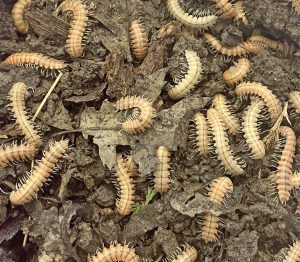
A cluster of millipedes.
Price said he has seen the California glowworm, which is rare, solitary and native to our mountains, but had never seen glowing millipedes before, let alone thousands of them. After searching the Internet, Price said, he found that there are 11 species of glowing millipedes in California. Called Motyxia millipedes, they are 1.5 inches long, beige/salmon colored, bioluminescent, glow a pale green, are nocturnal and toxic if eaten. He also learned that they are native to the Sierra Nevada Mountains, the Santa Monica Mountains and the San Luis Obispo foothills, and that they have never been officially documented in the San Bernardino Mountains.
According to Price, he spent weeks searching the forest behind his house with a blacklight, which makes the millipedes easier to see, and was able to determine a hard perimeter of about 35 acres.
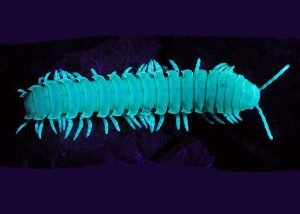
A single glowing millipede.
“The odd fact that they were contained to a relatively small, 35 acres led me to believe the millipedes were invasive rather than a native species. But I had to be sure, so I contacted an expert, Dr. Paul Marek, a diplopodologist who published a scientific paper about these millipedes in 2015. Paul responded, saying he had only heard rumors of Motyxia from San Bernardino County, so it was great news to hear this.”
After sending Dr. Marek a box of millipedes for DNA testing to determine the exact species, Price learned that the millipedes were an invasive species called Motyxia Sequoiae that hale from the Sequoia National Forest. Since Sequoia is roughly 250 miles away, Price figured they couldn’t have migrated here, but were somehow brought here a long time ago, long enough for their population to expand to 35 acres.
“How did they get here? I have a theory,” Price said, adding, “Back in the old days, around the 1950s or 60s, it was very common for people up here to plant Sequoias in their yards. You see them everywhere. They look like cedars, but the fascicles are longer, the bark is redder and they’re more conical and symmetrical than cedars.” Subsequently, Price checked the 35-acre parcel near his house and found 15 Sequoia trees growing within the perimeter. “The cool part is the area where the Sequoias are located is also where the millipedes are most dense. Coincidence? I think not.”
To be positively sure the millipedes and Sequoias were brought here together, said Price, the DNA of the planted Sequoias would have to be compared to the DNA of Sequoias growing naturally in their native territory in the Sierras. “If the DNA matches, then the millipede mystery is solved; if not, their origin will remain a mystery.”
At this time, Price said, the specific location of the glowing millipedes will remain a secret to preserve the privacy of the millipedes and the mountain residents who live among them.
“But the saga isn’t over. I assure you these millipedes are here to stay. One day, they will be as common as squirrels and Steller’s jays. But it’s not something to worry about; they mind their own business, they eat dead plants and they don’t bite, so I would like to take this opportunity to officially welcome them to these mountains. They’re a wonderful addition to the ecosystem and, frankly, I’m rooting for them. They illuminate the forest by night and enrich the soil by day.”




0 Comments