



San Bernardino County’s efforts to expand housing options for individuals experiencing homelessness and those at risk of becoming homeless have received national praise.
The Community Development and Housing Department (CDH), in partnership with the Office of Homeless Services (OHS), have been honored by the National Association of Counties (NACo) with a 2024 Achievement Award for developing a grant program to create additional housing opportunities.
Every year, NACo’s Achievement Awards honor outstanding county government programs that enhance services for residents. This year, NACo recognized the county’s innovative approach to combatting homelessness by establishing a $40 million grant program offered to external entities, primarily cities and community and faith-based organizations, to develop new units to increase the county’s sheltering and housing capacity. The funding was made possible by the support of the San Bernardino County Board of Supervisors.

San Bernardino County Assistant Executive Officer Diane Rundles presents the 2024 NACo Achievement Award to CDH Deputy Director Evan Miles.
“I would like to thank the Board of Supervisors for approving this critical funding that has increased the county’s housing capacity and significantly improved the lives of those experiencing homelessness,” said CDH Director Carrie Harmon. “The board’s dedication to addressing this issue has contributed to a better quality of life for San Bernardino County residents.”
Although cities and community and faith-based organizations have identified sites and established plans to create additional housing units, they often do not have the funds to complete the projects or support the projects on an ongoing basis. This has resulted in a very slow, and sometimes stagnant, development of sorely needed low barrier shelters, which creates an immediate gap in available resources for those interfacing with people experiencing homelessness.
“I deeply appreciate the Board of Supervisors for supporting this critical initiative,” said OHS Chief Marcus Dillard. “We would not be able to effectively combat homelessness and provide the safe and stable housing that our community needs without their support.”
The Housing Development Fund is designed to provide gap funding that can be leveraged with local, state and federal funding. Since the inception of the grant program, funding has been awarded to four projects with two projects currently scheduled to deliver new shelter beds by December of this year.
The city of Fontana received $5 million to assist with the acquisition and conversion of an existing 60-unit motel into an interim housing facility with up to 120 beds. The property is being operated as an interim shelter over a 15-year term.
In addition, Water of Life Community Church in Fontana received $5 million to assist with funding predevelopment requirements, site improvements and housing improvements for an emergency and transitional housing project. Funds will be used to obtain 20 units through travel trailers to accelerate the delivery of sheltering units. These units will be replaced by 30 units of emergency and transitional shelter upon the completion of a permanent housing structure. The project also includes the development of a two-story supportive services building that will provide case management, counseling, job training, financial literacy and food distribution. Other projects throughout the county are in the earlier stages of negotiations and approvals.
“Through this investment, the county and its partners are making a tremendous impact in our communities,” said Harmon. “We look forward to continuing to transform lives.”
For more information about ongoing efforts to increase affordable housing in San Bernardino County, visit https://cdh.sbcounty.gov/.
County prepares Line fire burn scar for possible flooding
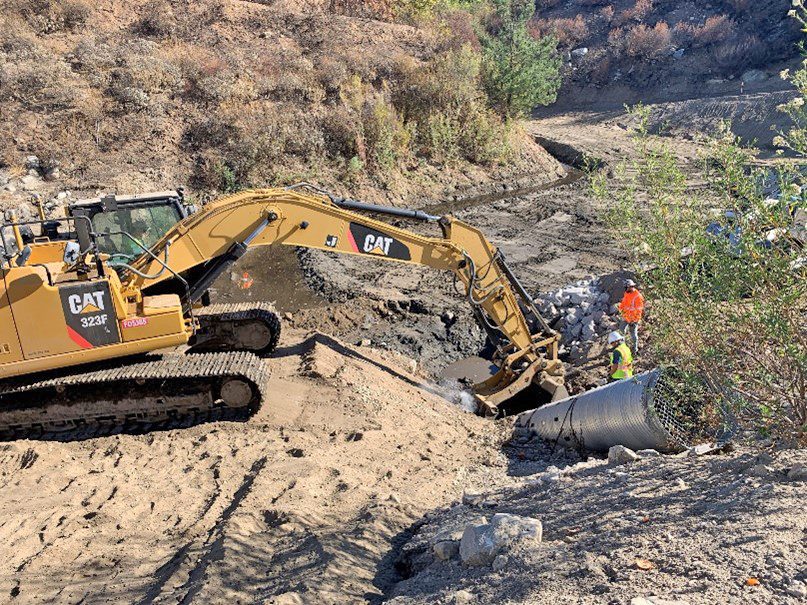
San Bernardino County Public Works recently outlined its intensified efforts to protect communities following the nearly contained Line fire. At the fire’s base, crews have installed a trash rack to filter debris, allowing water to flow safely during storms. In Cook Canyon, teams are also setting up an outlet pipe to handle anticipated runoff and erosion from fire-damaged slopes.
“It’s critical for us to capture debris flow, remove it and prepare for the next storm,” explained Assistant Director of Public Works David Doublet, emphasizing the importance of ongoing maintenance to protect the community.
Across the county, teams are actively clearing and repairing flood control facilities, storm drains and basins. In addition to these physical measures, the county has expanded its surveillance capabilities, installing more cameras in key areas within the burn scar. Currently, 86 cameras and rain gauges feed data to a central dashboard, allowing officials to monitor conditions in real time, providing a level of preparedness they lacked in 2010 when a sudden mudslide caused significant damage to homes in East Highland.
As the county prepares for the first major winter storms, Public Works is urging residents to take proactive steps to protect their properties and families. Residents can access resources on the county website for detailed information on flood and debris flow preparedness, helping ensure community-wide safety during the upcoming season.
In addition, the Flood Control District (FCD) is actively collaborating with Cal Fire, the Burned Area Emergency Response (BAER) team and the California Watershed Emergency Response Teams (WERTs) to prepare for potential floods in vulnerable areas.
For more information, visit the county’s flood preparedness page at prepare.sbcounty.gov.



0 Comments