



IMPORTANT UPDATE:
Exploration Trail temporarily closed
Because there was no clear signage on site (presumably from the Forest Service) that this high-profile trail – featured in last week’s edition of the Alpine Mountaineer – has been temporarily closed in the wake of the Line Fire, your “Let’s Go Hiking” columnist became aware of the closure only after visiting and writing about the route. That said, the article’s detailed information on the trail itself is accurate. Please keep it in mind when officials give the “open once again” signal. ~T.W.
By TIM WILCOX
Special to the Alpine Mountaineer
Where: Heaps Peak Arboretum
Length: 2.4 miles (triple transit)
Elevation gain: 122 feet (from mid-trail)
Challenge: easy
There’s a 30-acre alpine treasure situated on Highway 18 between Lake Arrowhead and Running Springs. It’s Heaps Peak Arboretum, which is celebrating its 40th year. This Forest Service preserve, managed by the nonprofit Rim of the World Interpretive Association (ROWIA), attracts thousands of visitors annually from across the mountains and down the hill.
The Sequoia Trail is the arboretum’s primary attraction. That’s especially the case during winter months, when the site’s wildflowers are dormant. The trail is usually negotiable even when covered with snow, as long as it’s not too deep.
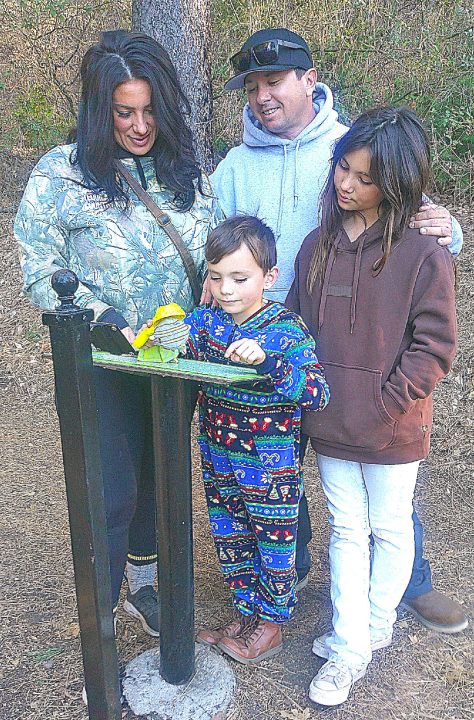
Members of the Skipper family from East Highland pause just beyond the giant sequoias to learn about Pacific dogwood trees. Parents Zack and Rhea are joined by daughter Ricki and son Dane. (Photo by T. Wilcox)
Anyway, this is a short, irregular loop – less than a mile long – that descends gently for half its length, then rises slowly the rest of the way. ROWIA has prepared a detailed brochure that invites visitors/hikers to conduct their own self-guided tour. Its numbered paragraphs correspond to the numeric posts along the way. The text is interesting and easy to understand.
So, unless you’ve done it during a previous visit, pick up the light-green brochure from one of the arboretum’s entryway dispensers or at its colorful information kiosk. Bear in mind, too, that you’ll need a Forest Service Adventure Pass to park in the large lot ($5 for a daily and $30 for an annual pass). The site’s information booth is typically open 11 a.m. to 3 p.m. weekends and always has a good supply of these passes. At other times you can purchase them from area vendors such as Jensen’s, 7-Eleven, Valero, Five Points and BaseCamp. There’s also a QR code hanging on the information booth during off-hours that allows visitors to purchase a pass with their smartphones. Consider it an excellent investment in the forest!
On the trail
Note that the brochure is written for a clockwise transit. Launch your hike, then, at the information kiosk (not to be confused with the information booth) and head left down the sidewalk. Past the arboretum’s three rustic restrooms, the trail shifts from paved surface to beaten earth.
A few steps farther, at Post 2, you’ll see a large cone displayed. It’s from a Coulter pine, which produces the world’s heaviest cones – “weighing up to eight pounds,” as the guide reports. Then, at Post 4, you’ll view an amazing black-oak cluster to your right. Why amazing? Because within a relatively small circumference, it boasts nine distinct trunks.
Consulting the guide, you’ll also encounter and learn about other native trees such as the incense cedar, white fir, sugar pine, quaking aspen, Jeffrey pine, knobcone pine and Pacific dogwood. Significantly, there’s a grove of non-native trees that are the trail’s arboreal celebrities. More about them in a moment. . .
Continuing down the well-maintained pathway, which averages about four feet wide, you’ll view nearby mountain ridges and, on clear days, the high desert. Passing a large boulder on the right, you’ll come to a bridge over Joe’s Creek. This is the exact halfway point of the trail. Now the route begins its ascendant portion. Look to your left, and you’ll see Strawberry Peak in the near distance and summits of the San Gabriel Mountains farther west.
OK, wind through a series of switchbacks until you arrive at a sign identifying a 75-foot spur leading to Horseshoe Springs. Turn left there, and you’ll be looking down on a heavily vegetated seep where bears, mountain lions, bobcats and other wildlife come to drink after dark. For obvious reasons, humans are encouraged to be elsewhere during nighttime hours.
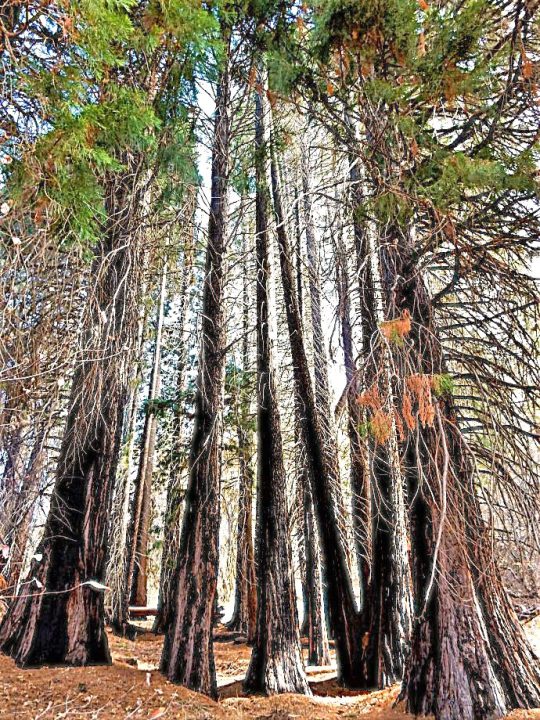
Back on the main route, you’re just minutes away from the trail’s No. 1 attraction at Post 22: the Ann Henck Stewart Memorial Grove – the largest stand of giant sequoias (Sequoia gigantea) in the San Bernardino Mountains. These magnificent trees pale in comparison to the world-famous sequoias up north, some of which are more than 3,000 years old. Sequoias don’t grow naturally in Southern California’s drier and warmer climate. Instead, these specimens were planted here in the 1930s.
Nearing trail’s end, you’ll pass through a stretch of Pacific dogwoods, completely barren now. In spring, however – especially around Mother’s Day – they put on a spectacular show with their white “blossoms” that look like flowers but are actually bracts (modified leaves). A few minutes later, and you’re back where you began.
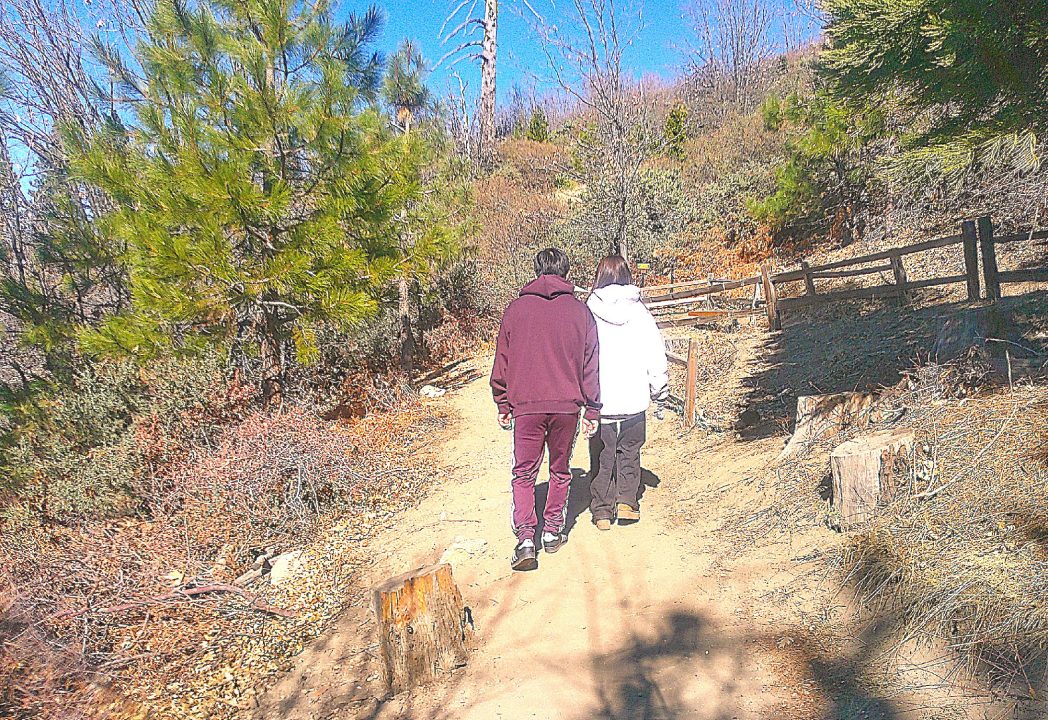
The Sequoia Trail is wide and easy to navigate. Here, just beyond its halfway point, hikers approach an interpretive station focusing on the ecology of wildfires, then enter a series of switchbacks en route to the sequoia grove. (Photo by T. Wilcox)
Should you want to make this short, but fascinating, trail a real hike, why not traverse it three times? If you feel inspired to do so, consider changing directions on the loop, hiking counterclockwise for the second transit and clockwise again for the third. This will extend your adventure to about one hour.
Before departing, stroll around the grounds, pausing to take in the information kiosk’s informative displays and other interpretive elements on the arboretum’s upper level. This is a mountain treasure of the first order!
NOTES: Open daily from dawn to dusk, Heaps Peak Arboretum is located on Highway 18 east of Skyforest and beyond SkyPark about one-half mile. Its Sequoia Trail is especially family friendly and can even accommodate strollers with larger wheels. A daily or annual Adventure Pass is required for parking in the Forest Service lot.



0 Comments