



By Mary-Justine Lanyon
The deputies at the Twin Peaks Sheriff’s Station were second in the county for calls for service per deputy.
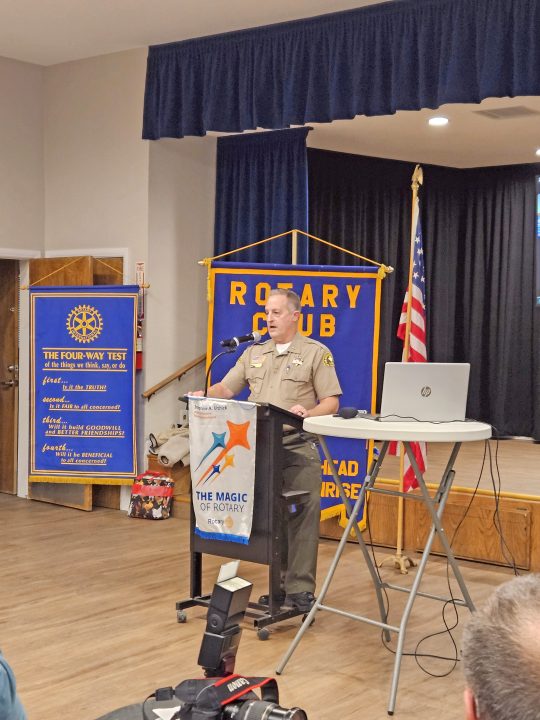
That was the word from Capt. Craig Harris when he spoke to the Mountain Sunrise Rotary Club, of which he is a member, on Jan. 8.
It was those calls per deputy that got the Twin Peaks station two additional deputies, bringing them up to 19. The station also has one lieutenant, five sergeants, two detectives and six professional staff.
Harris shared that he is proud to be a long-time resident of the mountain, having lived here since 1984. He has been with the sheriff’s department for 24 years; he will celebrate his 25th anniversary in April.
Before being promoted to captain and named commander of the Twin Peaks station, Harris served there as its lieutenant.
“I’ve been pushing hard the last couple of years to bring back a proactive approach to policing,” he said. “Covid put us on a back burner with no contact with the public. We were wearing masks and gloves and had to take a hands-off approach.”
Today he encourages his deputies to get out of their patrol cars and interact with the community – do the “old-fashioned foot beat. It’s amazing what you can see and hear when you’re out of the car.
“We are taking a proactive approach,” he said. “Being visible in the community is important. We want people to see us out there. We roll around even when nothing is going on. And we make sure people stop at stop signs.”
The deputies participate in community events, especially at the schools. “We talk about saying no to drugs. It’s important for the students to hear from the deputies. We have a lot of good stuff to talk about.”
A typical shift, Harris noted, had four deputies and a sergeant. “We get a lot of calls every day per deputy.”
In 2024, the Twin Peaks station filed 2,020 reports and made 1,125 arrests. They answered 18,403 calls for service. “We are pretty busy,” Harris said.
He had high praise for the various volunteer groups that back up the deputies: Citizens on Patrol, Search and Rescue, Explorers, sheriff’s reserve. “The volunteers donate more than a million hours every year,” Harris said, “We could not do our job without the volunteers.
“Search and Rescue is a big deal for us. They are an awesome group. We call them the ‘Subaru driving, granola eating weirdos.’ They go out in the middle of the night, in a snowstorm, to find someone.”
Harris then opened it up for questions.
Geoff Hopper asked about the population and the crime rate on the mountain.
After the last census, Harris said, the population is about the same: 35,000 to 45,000 full-time residents. “The population is pretty stable.”
One benefit of the short-term rentals, he noted, is the burglary rate went down as homes are occupied. “It’s hard for criminals to track when you’re there and when you’re not. We used to have a high burglary rate as many homes were vacant except for one weekend a month.”
There are still a lot of drugs on the mountain – “that will never go away,” Harris said. “Deputies are being more proactive – digging into cars, into pockets. We don’t want to show up on overdose calls. That’s awful for everyone. We find guns and drugs all the time on traffic stops.”
John Moore asked about Twin Peaks’ area of coverage.
Harris replied they cover down to Silverwood – where there are rangers who are law enforcement – to Snow Valley. “We cover 410 square miles including the forest area,” he said.
Maryann Dickinson asked about catalytic converter thefts, saying she couldn’t remember the last time she heard about one. Harris noted there was a law change last year making it harder for thieves to turn the catalytic converters in to recyclers so thefts are down.
Paul Fournier wondered if fentanyl is still a big deal, adding he had heard about a new variation that is 100 times stronger. “That’s turbo fentanyl,” Harris said. “We haven’t seen it up here. But we get fentanyl on a regular basis up here. We don’t test drugs in the field anymore because it is so dangerous. We package it and send it to a lab where it’s tested in a controlled environment.”
Harris added that the previous weekend on a traffic stop four people were arrested with fentanyl and marijuana pills they were selling.
Norbert Loewen said he often sees a sheriff’s car at Mary Putnam Henck Intermediate School, where he teaches. “We’re at the middle school quite often,” Harris said. “There is a lot of need for us to be there. But sometimes we don’t get a call – we just go, walk around the campus and say hello.”
Harris added they are at Rim of the World High School every now and then but it “has backed off. I hope the faculty has good relationships with the students and are paying attention to them.
“It’s fun to go to the elementary schools and interact with the kids. We go through rolls of stickers, MPH is the most challenging – there is bullying, depression. Sometimes it’s just a matter of talking with them; they don’t need to go to behavioral health. Occasionally they are afraid to go home because of perceived or actual abuse. It’s important to answer those calls, figure out what’s going on.”
John Moore asked about the deputies’ role during the Line Fire, adding he assumes they were “pretty stretched.”
“During a fire or major emergency,” Harris said, “our job as sheriffs is evacuations, security and reentry. We are a support system for County Fire during a fire so they can do their job. We jump in, send our folks.”
Harris added he goes out to get “eyes on it – the rate of spread, what will be affected.” He sends deputies out door to door, telling people to move and where to go. “You have to be the face of calm,” he said. “We have trainings a couple of times a year for forest fires and earthquakes. We do tabletop exercises tailored for each station. We are given a scenario and have to figure out what to do.”
When Moore wondered if the deputies encounter much resistance during an evacuation, Harris said that “we won’t put them in handcuffs if they don’t leave.” The deputies are issued county phones so they can list the GPS address, noting if the residents are staying, leaving or not at home. “That populates a real-time map so we can see our progress in a neighborhood.”
When Richard Savich asked if there has been any talk about opening up the unimproved part of Highway 173, Harris noted that Scott Rindenow is heading up a committee through the Lake Arrowhead Municipal Advisory Committee. “This would be a monumental undertaking,” Harris said. “It’s a great idea but I don’t think it would open up to the public. The talk is to do it for emergency responders.
“The road is not in good shape,” he added, noting he flew in a helicopter over the road and videotaped it. “Parts are completely washed out. Caltrans is open to the idea but where will the funding come from?”
Laura Dyberg noted that she and Jenny Hueter serve on the committee with Rindenow. “Caltrans is open to the idea whereas years ago they said it was too much money. Scott is getting letters of support from the CHP and Cal Fire, recognizing the need for the road as an emergency alternative.”


0 Comments