



By TIM WILCOX
Special to the Alpine Mountaineer
Where: Heaps Peak Arboretum
Length: 0.8-mile loop
Elevation gain: 122 feet (from mid-trail)
Challenge: easy
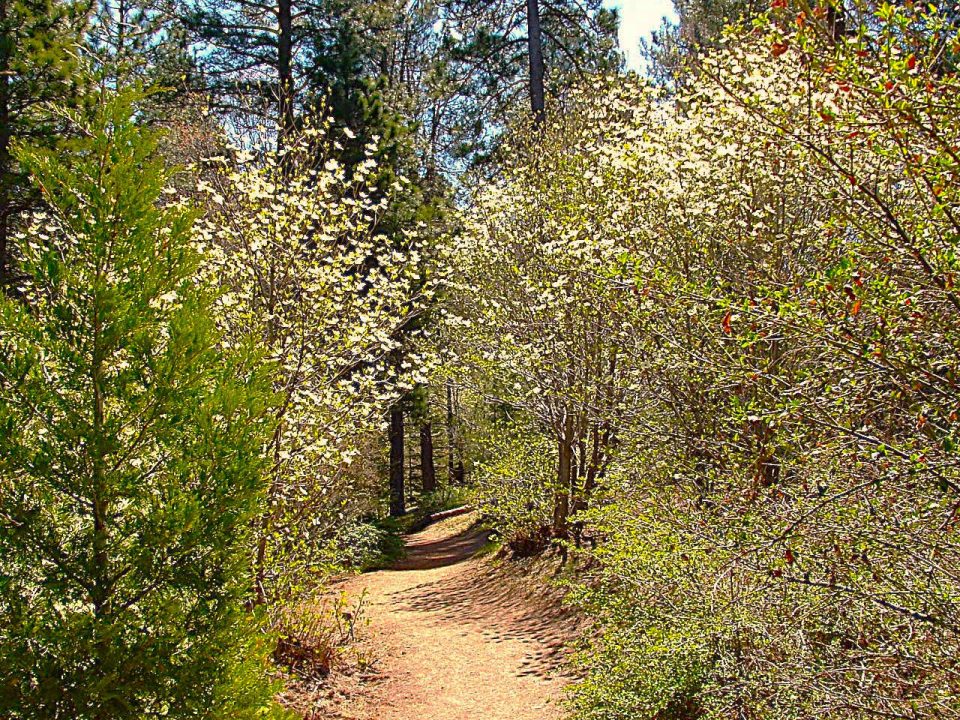
Nearly five months ago, when we last visited and wrote about the Sequoia Trail, winter had yet to supply any significant snowfall to our mountains. So, the trail was clear. Still, Heaps Peak Arboretum was basically colorless except for its ample population of pines and firs. Now, well into spring, the site is much greener thanks to fully leaved deciduous trees. Also, Pacific dogwoods (Cornus nuttallii) are staging their annual “faux flower” display here. As for the arboretum’s celebrated wildflowers, they’re simply waiting for a cue from consistently warm weather.
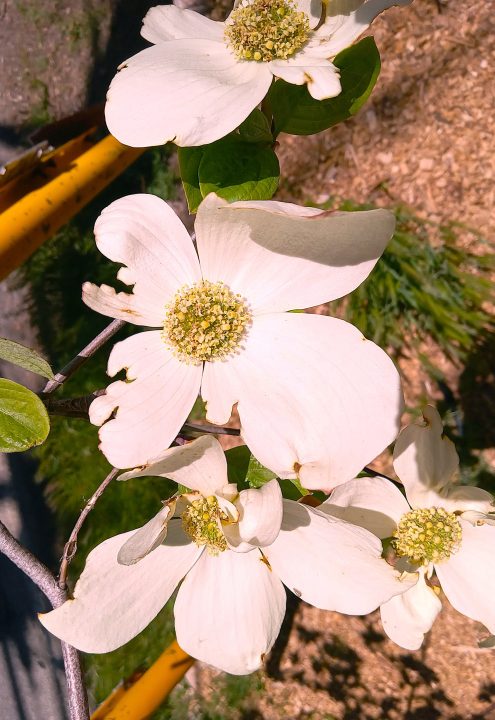
What appear to be white blossoms adorning Pacific dogwoods are actually modified leaves. These bracts typically are most striking around Mother’s Day.
Conducting an informal west-to-east trail census from Silverwood Lake to Green Valley Lake, we can confidently claim that this route has only one rival for the most popular trail in the western San Bernardino Mountains. If you guessed Heart Rock in Crestline, you’re absolutely right. These iconic hiking destinations are the two most frequently visited trails in our area. In particular, the Sequoia Trail is a favorite among local alpine-exercise enthusiasts and dog-walking devotees. Along with its 30-acre setting, it draws thousands of visitors each year from down the hill and beyond.
As we’ve mentioned before, a light-green brochure published by Rim of the World Interpretive Association (ROWIA), which manages the arboretum, invites you to conduct a self-guided tour of the Sequoia Trail. Keyed to the numeric posts along the way, its numbered paragraphs supply fascinating information for hikers of all ages.
For this encore visit, we won’t share a detailed narration of the trail from start to finish. We’ll simply note that the 0.8-mile, beaten-earth route descends gently to the halfway point (Joe’s Creek Bridge, just past the big boulders), then rises gradually through several switchbacks until it reaches the trail’s No. 1 attraction: the largest grove of giant sequoias (Sequoia gigantea) in the San Bernardino Mountains. These splendid trees are nothing compared to the world-famous sequoias up north, some of which are more than 3,000 years old. Sequoias aren’t native to Southern California, and the arboretum’s stand was planted in the 1930s. That means they’re babies. As you’ll see, however, they’re big babies.
As another “memo,” this is obviously a short trail, and more ambitious hikers are in the habit of tracing its contours two or three times. If you feel inspired to do so, consider changing directions on the loop – clockwise, then counter-clockwise – to make your outing even more interesting.
History of a mountain treasure
Finally, to augment appreciation for this mountain treasure, which is nearly 41 years old now, here’s a historical sketch that was originally composed for ROWIA by yours truly:
In the late 1800s, the site that’s now Heaps Peak Arboretum was anything but a haven for trees, shrubs, flowers and wildlife. Fred Heaps owned a ranch on this location, and when he died his nephew built a lumber-harvesting operation – an ironic use of land that would ultimately become the arboretum.
After the devastating Helva-Sugar Fire in 1922, seven acres of land on the Heaps Peak site became the California Forest Experiment Station. Trees from all over the west, both evergreen and deciduous, were planted for field testing along the denuded slopes. That experiment was a resounding success.
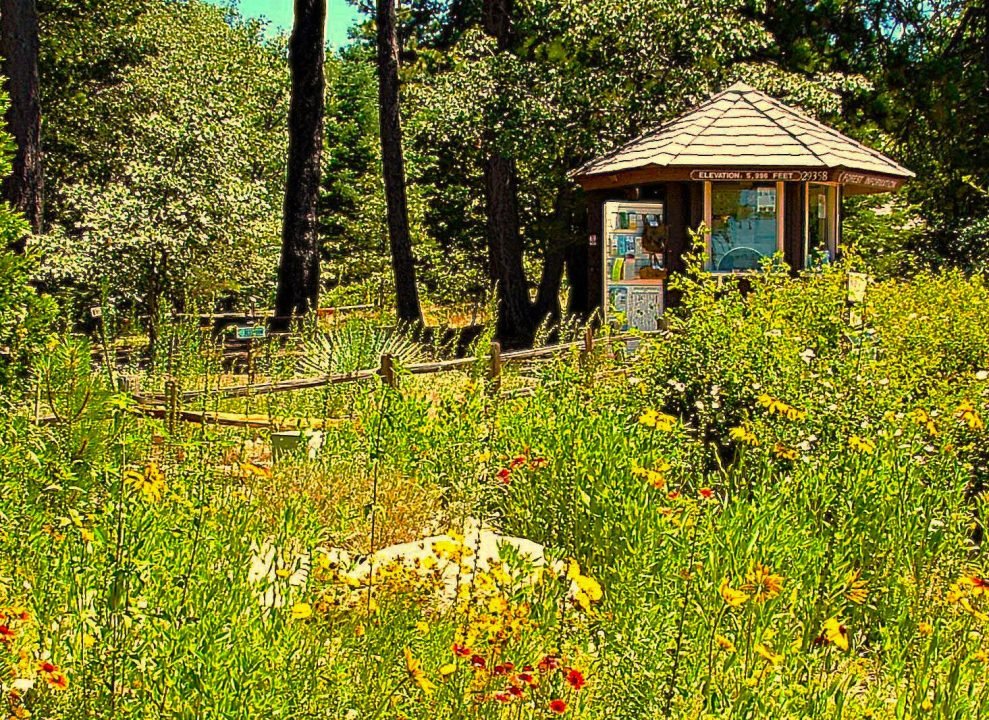
Wildflowers will proliferate in the arboretum’s gardens as spring segues to summer.
A significant investment of time and energy by members of the Lake Arrowhead Women’s Club and also local elementary school students helped restore the remaining 23 acres of the arboretum. Throughout the 1930s they planted countless conifer seedlings provided by the Forest Service. The trees took root. They grew and fostered new trees. That section of the forest was reborn!
All of the planting stopped, though, with the onset of World War II. There was another fire in 1956 and, sadly, the land then became an illegal dumping ground. But in 1966 the Rim of the World High School Interact Club returned to the area to prune and thin the young trees. In 1976 a landscape architectural firm was contracted to develop a detailed plan for the site. The firm designed a picnic area and nature trail, but funds were unavailable to build them.
Then, in 1982, the Forest Service authorized the Mountain Chapter of the San Bernardino County Museum Association to develop Heaps Peak Arboretum. Community members led by educator George Hesemann worked tirelessly to make their shared dream a reality. Officially opened on June 30, 1984, the arboretum is a beautiful and enduring example of what dedicated volunteers can accomplish.
NOTES: Open daily from dawn to dusk, Heaps Peak Arboretum is located at 29358 Rim of the World Highway. 18, east of Skyforest and past SkyPark about one-half mile. A Forest Service Adventure Pass ($5 daily, $30 annual) is required for parking in the arboretum’s large lot. Volunteers in the site’s information booth welcome visitors from 11 a.m. to 3 p.m. weekends. FYI, this is our final “Let’s Go Hiking” column for the foreseeable future. Thanks for reading and happy trails! —TW



0 Comments