



By RHEA-FRANCES TETLEY
Historian
Following his birth in Canada, David Seely led a colorful life as a barge pilot on the Mississippi River, marrying in 1846, prospecting for gold with brother Wellington in California in 1849-50 where they were moderately successful and leading the Mormon wagon train to San Bernardino in 1851.
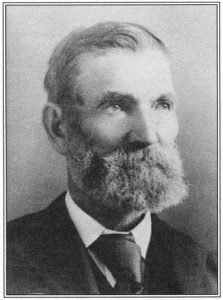
David Seely, mountain sawmill owner from 1853 to 1890, in his official county supervisor photo.
He was motivated and worked to create San Bernardino County from Los Angeles County on April, 26, 1853, and was elected the county’s first treasurer, the same year the Mormon Lumber Road was constructed up the mountain by the Mormon colony enabling David and Wellington to build a water-powered sawmill on Seely Flat.
The Mormon Church severely censured him in June 1855 and removed his title as “Mormon Stake President” over a water-rights dispute he had with the upstream Jewish sawmill owner, because Seeley hit him with a board, almost killing him. Seely, despite having a strong lifelong temper resulting in numerous lifetime conflicts, was disappointed with this censure after all he had accomplished for the colony’s benefit.
Two years later, in 1857, Brigham Young recalled the “religiously faithful Mormons” to Salt Lake City to protect its capitol. Wellington immediately left; David chose to stay behind to oversee the operations of their profitable sawmill, then left with his son to Salt Lake City with a wagon load of merchandise. He arrived after the threat was resolved, always intending to return to his family left behind in San Bernardino. This infuriated church leaders, kicking both of them out of Salt Lake City in 1858.
Seely, a prosperous farmer and owner of many timber tracts in the mountains, was elected Second District (including the mountain areas) County Supervisor from 1869 to 1873. He was an advocate for progress, taking a leading role in the construction of the county courthouse and pavilion. As chairman of the board of supervisors from 1871 to 1873, Seely supported the construction of free public roads into the mountains. He helped establish the San Bernardino Society of California Pioneers, leading some of their yearly camping outings into the mountains.
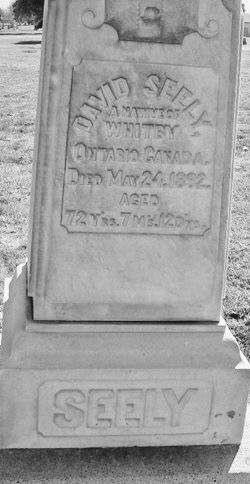
David Seely’s tombstone in the Pioneer Cemetery in San Bernardino.
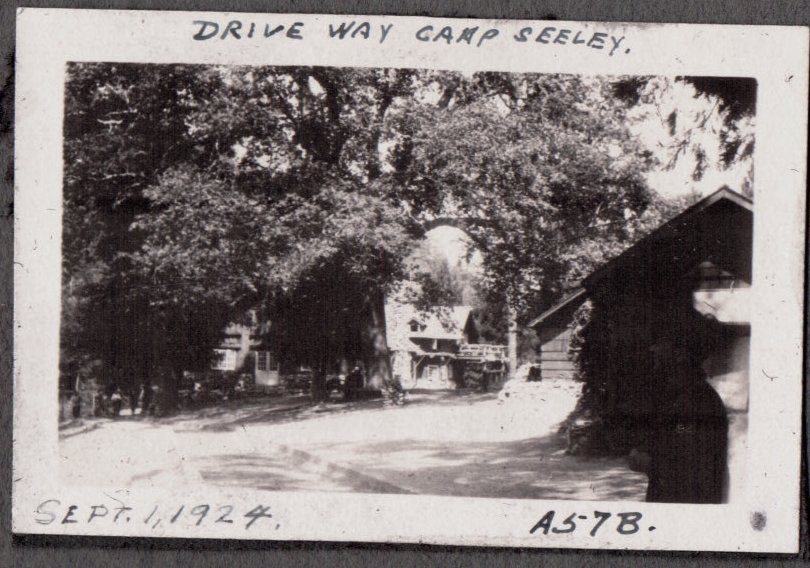
The name Seely was misspelled on documents when Los Angeles purchased land for Camp Seeley in the Seely Flats area in 1914. This mistaken spelling became the accepted usage in such places as Seeley Way, Seeley Flat Road (aka Highway 138) and even Camp Seely for many years.
In the late 1880s Seely owned a 26,000-acre lumber tract in the mid-crest area of the headwaters of City Creek (Running Springs area today). Seely believed a road up City Creek Canyon was necessary, but San Bernardino County did not intend to build an expensive road up that steep canyon.
In an effort to get lumber to the box factory in Highland, Seely hired his son-in-law, Thomas McFarlane, to design and build a road up the City Creek Canyon in May of 1890. It was to have a maximum 10-percent grade so a rail line would be possible.
“A rail transit line was being constructed to Highland, to move citrus fruit to market, so a rail spur built up the mountain that would quickly transport lumber down the mountain could be a valuable asset for future mountain economic development,” said Seely. McFarlane began clearing the route and designed bridges for the road.
Seely, feeling his age, decided to sell the City Creek acreage to the Danaher Brothers in June of 1890 for the Highland Lumbermill; unfortunately, the Danahers never built the rail line.
President Harrison signed the Federal Forest Reserve Act in 1891, leading to the establishment of the 737,280-acre San Bernardino Forest Reserve in 1893.
David Seely died peacefully at the age of 72 at his home at 6th and C Street in San Bernardino on May 24, 1892, surrounded by his family: wife, Mary, four daughters and two sons. Though he never lived full-time in the mountains (few did during those early years), he was considered an independent-minded mountain pioneer who not only created San Bernardino County but started the mountain lumber industry.


0 Comments