



By RHEA-FRANCES TETLEY
Historian
The Arrowhead Reservoir Company (A.R.C.) wanted to copy the successful year-round flow of irrigation water Dr. Barton had created for Redlands, when he built Big Bear Lake a few years before. The A.R.C.’s proposed Little Bear Lake water project (aka Lake Arrowhead) would bring irrigation water to San Bernardino.
After the death of Governor Waterman in 1891, the A.R.C. convinced the Waterman family that they could build a high-quality road through their canyon which, with high tolls, would discourage public use. The road would enable the A.R.C. to transport building materials up the mountain, unimpeded, for the construction of the Little Bear Reservoir water project.
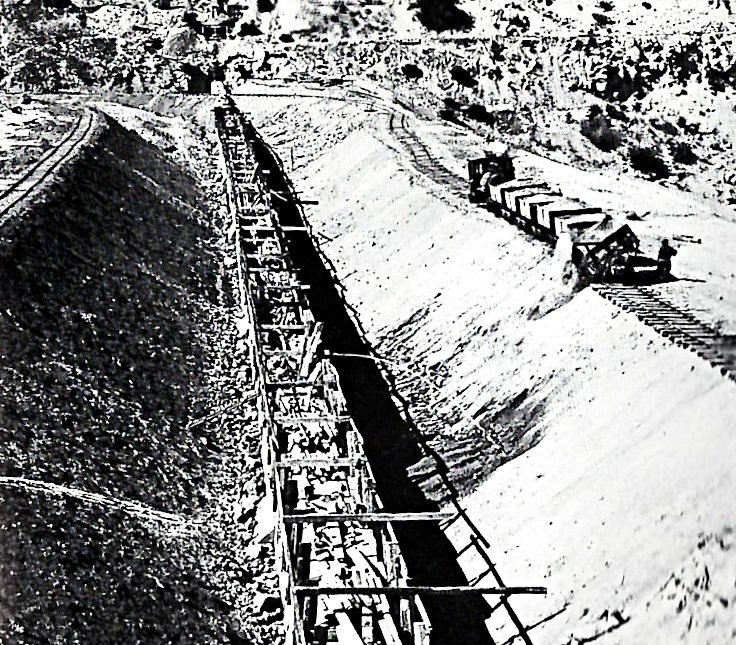
The Little Bear cement-core dam with hydraulically compacted fill dirt being placed on both sides of it. There is a diorama of this process in the Mountain History Museum.
The A.R.C. predicted and promised their investors, who were located in Ohio, that the water would start to flow as soon as 1892-1893. Under the direction of Ohio investor Colonel Adolph Wood, the A.R.C. purchased 4,300 acres of land, mostly from lumbermen, planning to divert “some” water from the Mojave watershed to the San Bernardino Valley.
The A.R.C. planned to construct three reservoirs with a canal between them to transport the water by a tunnel to San Bernardino by the summer of 1892 to irrigate 120,000 acres. Those reservoirs would have been at approximately the current locations of the Grass Valley golf course, Lake Arrowhead and Lake Gregory.
The investors saw big profits possible and immediately expanded the project into a seven-lake project, adding proposed reservoir lakes at Seeley Flat in Valley of Enchantment (VOE), Summit Valley (Las Flores Ranch), Deep Creek and Cedar Springs (Lake Silverwood), creating the largest water project in California. They now intended to harness all the water flow from Little Bear, Holcombe, Crab, Deep, Huston, Hook and other creeks, diverting it for irrigation in San Bernardino and Riverside Valleys, possibly as far away as Pomona and Pasadena.
The Arrowhead Project, named for the arrowhead scar on the hillside over their Twin Creeks Canyon Road, through Waterman’s Canyon was heralded as the largest and most ambitious water project in California.
This massive project required new roads and 60 miles of tunnels to prevent water evaporation or ice problems in the winter. This extensive project required significant capital, as the investors were anxious for a quick return on their investment.
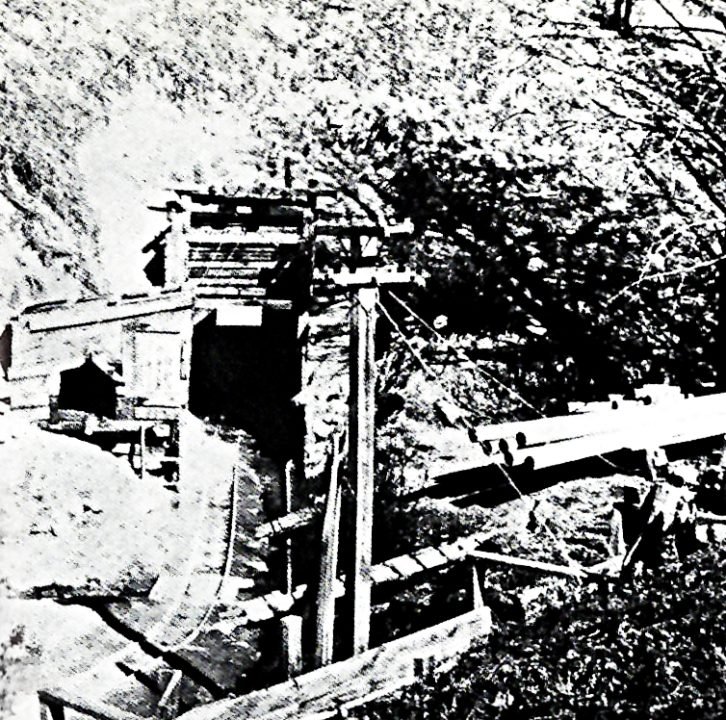
The opening to Tunnel #2 at Grass Valley in 1893.
In 1892, the Arrowhead Reservoir Toll Road was under construction, designed to bring up all the heavy equipment that would be needed to build this dam project, including the huge steam shovels, all hauled by oxen and horse-power. Simultaneously, the Willow Creek Tunnel #1 was being dug by hand-power and controlled blasting. It is estimated that 8,000 cubic yards of rubble was removed from that 5,000-foot-long tunnel.
In 1893, geology reports stated the Little Bear Dam couldn’t be built as a cement dam like in Big Bear, because the rock base was not solid enough. The dam was redesigned as a cement-core dam with hydraulically compacted fill dirt on each side of it. The digging for the dam’s base began in 1893.
Several camps with framed tents and framed beds with a mattress were set up for the workers with cooks at each of the work locations. Those digging Tunnel #1 had their camp at Willow Creek. For Tunnel #2 the camp was at Grass Valley. Connector Tunnel “C” was to be dug under Deer Lodge Park to connect Tunnels #1 and #2.
The workers received free housing and earned 45 cents an hour for 10-hour workdays, or $4.50 a day, which was 15 cents an hour more than valley wages. All the food they could eat cost them $1 a day, so they cleared $3.50 a day for about 10 months of the year. (Snow closed down the project during the winter.)
Everything was progressing smoothly in 1893, until it wasn’t.


0 Comments