



By Mary-Justine Lanyon
Every Girl Counts – the program for girls at Mary Putnam Henck Intermediate School sponsored by Soroptimist International of Rim of the World – wrapped up on March 18 with a program that had the girls completely captivated.
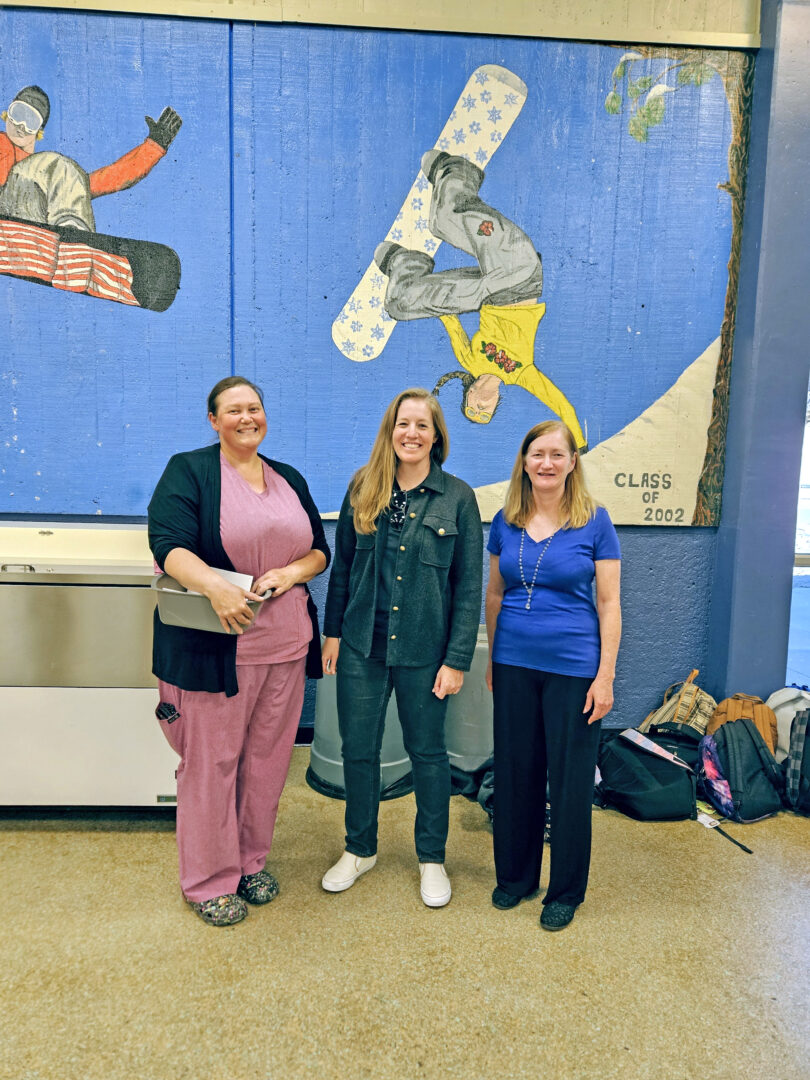
Three women shared about their careers and how they got there. The girls peppered the women with questions about becoming a pharmacy technician, a prosecutor and a music supervisor.
Pharmacy technician Kris Hannah
Kris Hannah – a pharmacy technician and operations manager at Mountains Community Hospital – told the girls she had been in nursing school when she met someone in pharmacy school. “I was intrigued,” she said.
The pharmacy technician program is just seven months long. Hannah, who has to renew her license every two years, has worked at several hospitals. She told the girls she prefers that worksite to a retail store because of the variety of tasks she performs.
In addition to filling prescriptions for the emergency department, the operating room, patients in the acute care wing and Skilled Nursing Facility residents, she refills the automatic medication dispenser, packages medications in individual doses and does the buying for the pharmacy.
When asked about her favorite part of the job, Hannah said it is compounding IVs, which has to be done in a sterile environment.
She works 12-hour shifts three days a week on site and then works remotely for four hours.
“You have to learn most drug names,” she said, “so you know where to find them.” The most challenging part? Learning to pronounce those names.
Prosecutor Rita Spiegel
While at UC Santa Barbara, Rita Spiegel took a criminal justice class taught by a judge. “I knew that’s what I wanted to do,” she said. She went to law school at the University of Chicago and then moved to Texas, where she took the bar exam, which she passed on her first try.
Spiegel was hired by the district attorney’s office where she initially handled drunk driving cases. She progressed to misdemeanor cases like shoplifting, then to felony cases and the fraud unit.
Her favorite assignment, Spiegel told the girls, was as chief of the homicide division.
“I always loved to read,” she said. That love was essential to her job as she had to read police reports and witness statements. Most cases, she said, end with a plea bargain. All that reading helped her decide what kind of plea bargain she should offer to the defense.
Spiegel gave the girls two different murder scenarios, having them decide how justice would be done.
“A trial is like a play,” she said. “You have to worry about your lines, your actors (the witnesses), the costumes (one witness wore bunny slippers to court), the props (make sure they work properly).”
What did she like best about her job? “It was never boring. You never knew what was going to happen.”
The role of a prosecutor, Spiegel explained, is not to send people to jail. “The role of a prosecutor is to see that justice is done.”
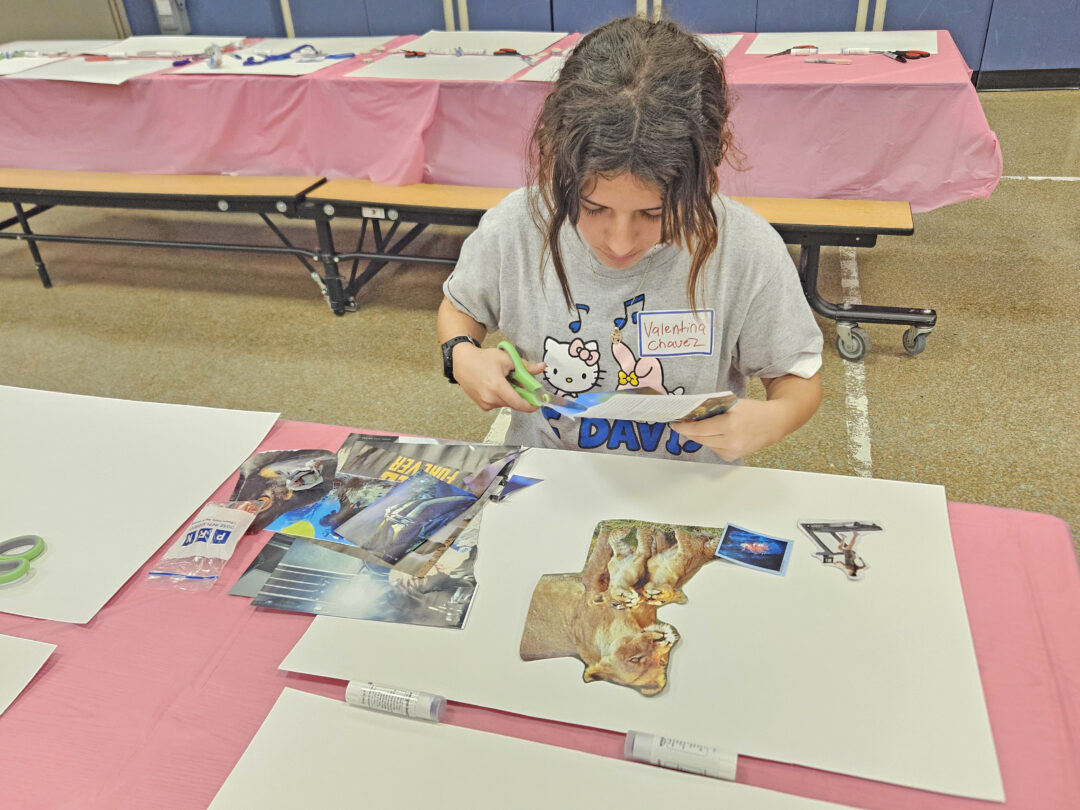
Valentina Chavez works on her vision board.
Music supervisor Natalie Wali
“I have the most fun job and work with incredible people,” Natalie Wali told the girls.
As a music supervisor, she was responsible for the music in all the Mission Impossible movies. “I recorded the theme with a new orchestra,” she said.
“My job is to make you feel something,” Wali said. Her job has taken her on film sets and all around the world. She has worked with people she only dreamed of working with.
The job, she said, “fell into my lap.” She was fortunate to have an aunt who was working on a TV show. “I took her to dinner and told her I wanted to be a composer. My aunt said I should consider being a music supervisor.”
Wali’s aunt set her up to meet with a music supervisor and Wali was hired that day. “It happened over a cup of coffee. I trained for my job my whole life.”
Wali always loved music but had worried that, if she did it for a job, it would take the joy away. Nothing could be further from the truth.
The girls’ eyes lit up as Wali told them about some of the artists she has worked with.
She liked Beyonce’s song “Crazy in Love” but had a different idea of how it should sound. “I asked her to redo it – and she did,” Wali said.
She needed a song for a movie and thought Taylor Swift would be the perfect artist to write it. She asked and it happened.
When you watch a TV show or movie and hear a song, Wali said, “you may not have heard of the artist but the music makes you wonder who they are.”
Sometime Wali will think a person’s voice would be perfect for a project but they don’t have the right song yet. She will call that artist’s record label and ask if they will write one.
In addition to loving listening to music, Wali enjoyed making music. She played a lot of string instruments – piano, fiddle, cello, stand-up bass.
She started her career as a free-lance music supervisor, then worked for Warner Bros. and now works for a company that creates movie trailers.
Her advice to the girls? “You will figure out the thing you love.”
After each group of girls met with the three women, they made vision boards. Tables in the cafetorium were covered with pictures the Soroptimists had cut out – cooking, travel, family, art, fashion.
A vision board, Lupe McDonald, who coordinates Every Girl Counts, said “is a visual affirmation of things that inspire you.”
Junior Valentina Chavez – one of the Interact Club members from Rim High who was helping out that day – wants to study environmental science and was creating a vision board of animals.




0 Comments