



By Cari Slater
Special to the Alpine Mountaineer
The cafeteria/multi-purpose room at Lake Arrowhead Elementary School looked strikingly different than usual on Thursday, Feb. 22 when Mobile Ed Productions put on a special assembly called “SkyDome Planetarium” for all students in attendance that day. The SkyDome assembly at LAE was funded by the PTA, according to PTA President Tracy Gauci.
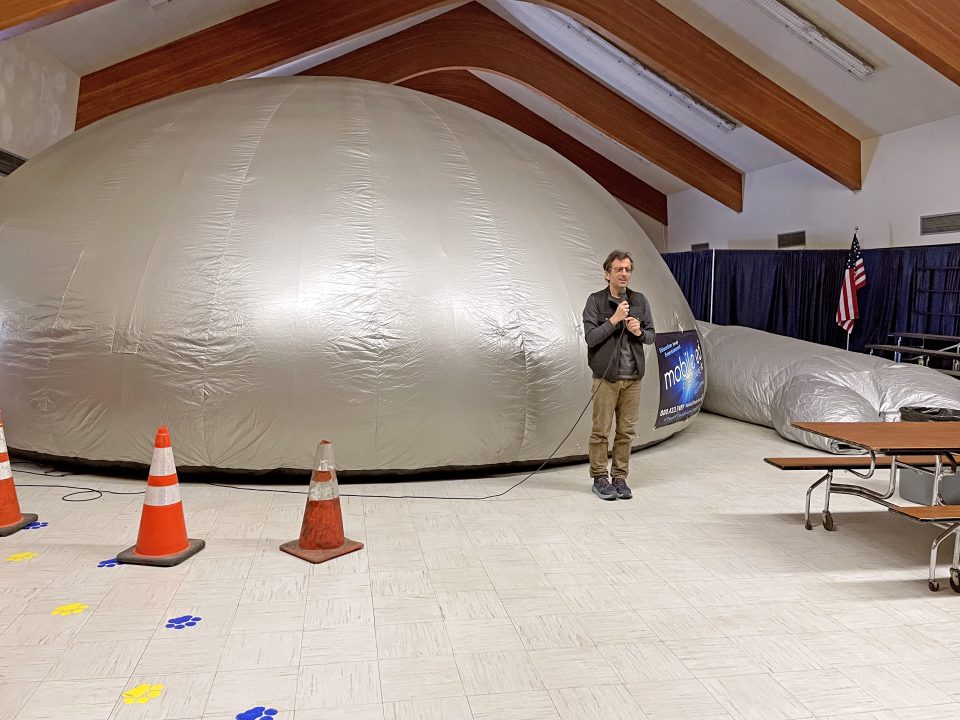
The intriguing inflatable dome set up in LAE’s cafeteria/multi-purpose room.
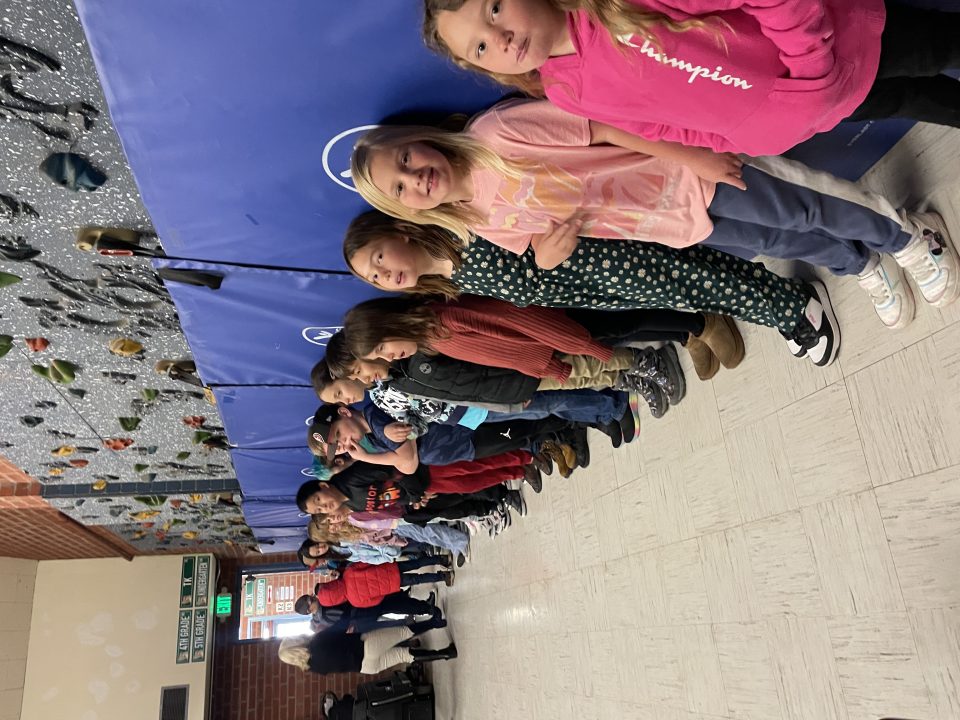
Students “oooed” and “aaahed” as they walked in single-file past the giant inflatable dome that was set up for the assembly experience.
Second-grade students River Boylin and Emma Briceno, whose class did not attend the assembly until later in the day, murmured about the strange looking dome as they grabbed lunch from the cafeteria line.
“I’m wondering that it’s going to be like inside,” said River. “I think it might be fluffy inside!” said Emma in response.
The inflatable dome, which rose approximately 20 to 30 feet high, was a planetarium with a tunnel entryway that students would have to crawl through to get inside for the experience. The excitement was palpable as students waited, wondering what was next, until all of the classes from their grade arrived for their timeslot.
When the last class arrived and lined up with the others, a tall man with a microphone introduced himself to the students as Professor Mario; he would later explain that the title is an honorary one, his real name is Mario Tomic. Tomic then explained the logistics of how everyone would enter the dome safely (he lifted the side of the dome for a child on crutches) and sit inside to prepare for the presentation.
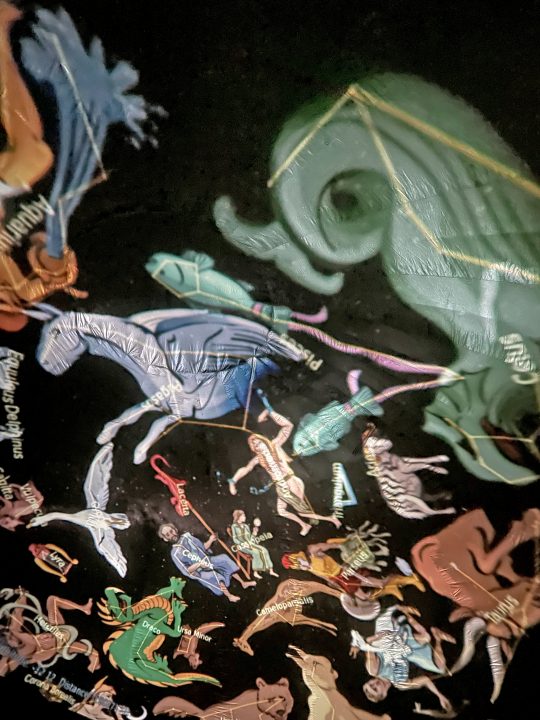
Projection of the constellation illustrations from inside the SkyDome Planetarium.
Once inside, the display was unremarkable. Tomic explained that the projection on the ceiling of the dome was the current day’s sky. He pointed out the brighter spot on the ceiling as our sun. It was not until he sped up the timestamp, that was displayed toward the bottom of the projection, that students started to stir with excitement. The inside of the dome went virtually pitch black but then, as one’s eyes adjusted, one could see tiny stars appear across the ceiling of the dome. The student audience was completely enthralled.
Tomic pointed out important stars like the North Star, which appears stationary in our night sky, and Sirius, the brightest star in our night sky. He mentioned famous astronomers such as Galileo Galilei, who discovered one of Jupiter’s moons more than 400 years ago with the use of a primitive telescope.
One of the highlights of the presentation was when Tomic showed students the constellations. At first, they appeared as the night sky covered in stars, but then the projection included line drawings connecting the stars of each constellation. Tomic explained that the constellations were named after mythological characters; at that point, the line drawings seemed to morph into beautiful illustrations of those characters. Students learned that constellations can be used as a tool to determine where other stars are located in the sky or even act like a compass helping people figure out where they were located or which direction they were headed on Earth.
One of the most exciting moments was when Tomic reversed the timestamp to display an astronomical event from 2012 – virtually time traveling! The unique astronomical event was when Jupiter cast its shadow on our sun. He also showed students how they could view the future night sky by speeding up time to the future.
During the presentation, Tomic shared facts about the vast number of planets, stars and moons that are in our galaxy. He stated there is no current evidence of another planet that can sustain life like the Earth. He then asked the students to consider what they think about the question of life outside our planet and posed an inspiring question to his child audience.
“We need a new generation of scientists to answer many great questions, like: Is there life outside of our planet?”





0 Comments