



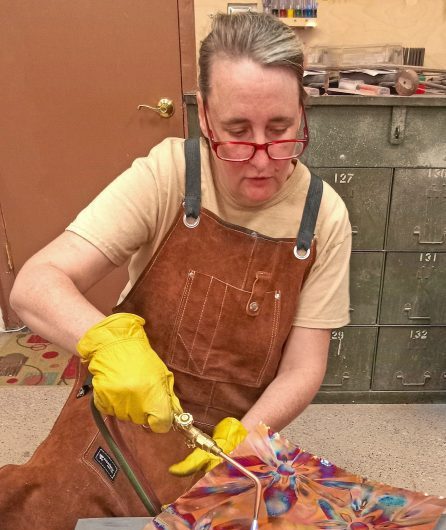
I love what I do! There are always new challenges and new discoveries. And when I’m not on the road, I’m usually here in the workshop every day, pushing myself to come up with fresh ideas and create new forms of art. – Sue Priest
By TIM WILCOX
Special to the Alpine Mountaineer
You might be surprised to learn that fine art can be created on sheets of copper. It’s an esoteric discipline with relatively few practitioners. Sue Priest is one of them and arguably among the most accomplished. Has she been at it for decades, her craft evolving and improving? No. It’s only been about six years, dating from the time she relocated to Running Springs. But that brief period has been enormously productive.
Sue’s “personal itinerary,” from first day to present day, is far-flung and fascinating. She was born in Nashville, Tenn., to parents who were educators in schools run by the Seventh Day Adventists. Because of their jobs, says Sue, “we moved frequently, and I lived in a lot of the U.S.” Then, leaping forward, she adds that “as an adult I continued living in different places and traveling a lot. There’s not much of the country I haven’t seen.”
Sue earned a bachelor’s degree in ecology and environmental science from the University of Maine in Orono with minors in Native American studies and studio art. Then, enrolling in the University of Florida’s online program, she acquired a master’s degree in forest conservation and management with an emphasis on ecological restoration.
A highly qualified ecologist by then, Sue invested some “prime of life” years working for several agencies of the federal government. Among them were the United States Geological Survey and Bureau of Land Management.
“All of it tied in with my lifelong love of nature and, of course, educational background,” she says. “Overall, I’ve dedicated more than 15 years to wetland work. No job was too small or too great. And much of it required wading through unknown territory in the public, private and nonprofit sectors.”
Her most recent “wading challenge” was in South Dakota with the Natural Resources Conservation Service. “It was a very interesting but also contentious assignment, because I was tasked with enforcing federal wetlands regulations,” she notes. “The landowners didn’t like it when I pointed out violations of law and insisted on mitigation.”
Unfortunately, an internal personality conflict was even more contentious. With a telling sigh, Sue shares that “it got to be too much for me and, after a year, I walked. I needed a place to restart my life and figure out where the heck I was going.”
At home in the mountains
That’s when Running Springs presented itself as the clear and compelling choice. “This was a safe place that I could fall in love with and just be outdoors and go for hikes in the forest,” she shares. It also happened to be the setting for her parents’ retirement home. Now in their 80s, they embraced Sue, offering her the separate and private lower level of the residence. She welcomed the open door. So did her four cats.
A large, well-equipped workshop connected to her space and originally used by her father proved to be a propitious perk for Sue. It became the setting for her remarkable blossoming as a practitioner of what she calls “copper flame art.”
Years before, while attending high school in Moreno Valley, Sue had dabbled in acrylics. She’d also worked with pastels, pen and ink, and other media. Then, upon moving to Running Springs, she began teaching herself silversmithing. Soon, however, she switched to a more affordable medium – namely, copper.
“That’s when I discovered its creative potential,” she says. Sue began with smaller copper pieces, making bracelets, earrings, necklaces and rings. Then she segued to full sheets of the substance and launched a painstaking regimen of trial and error, initially using a welder’s acetylene-air torch. The results were less than satisfying, and Sue wondered how other artists were able to “achieve such stunning pieces.” Then she was advised to use an advanced system with propane and oxygen. “That significantly increased the temperature of my flame and made a big difference,” she says. Of course, she’s extremely careful whenever she uses this combustible system.
With oxygen/propane torch in hand and flame expertly adjusted, Sue is able to elicit colors that vary predictably with the temperature of the flame. The artist explains: “Chemically, when you heat copper, you’re reducing and oxidizing it. When you do that, it breaks the oxygen molecules apart from the other molecules. They move to the surface and come into contact with atmospheric oxygen, producing the spectrum of colors depending on how long you hold the flame in place.”
Wide array of images
The surprising and eye-catching results are a wide array of representational and abstract images “painted” by the artist with a torch. The palette’s primary colors are orange, yellow, pink, blue, green and purple. For whatever technical reasons, red is absent.
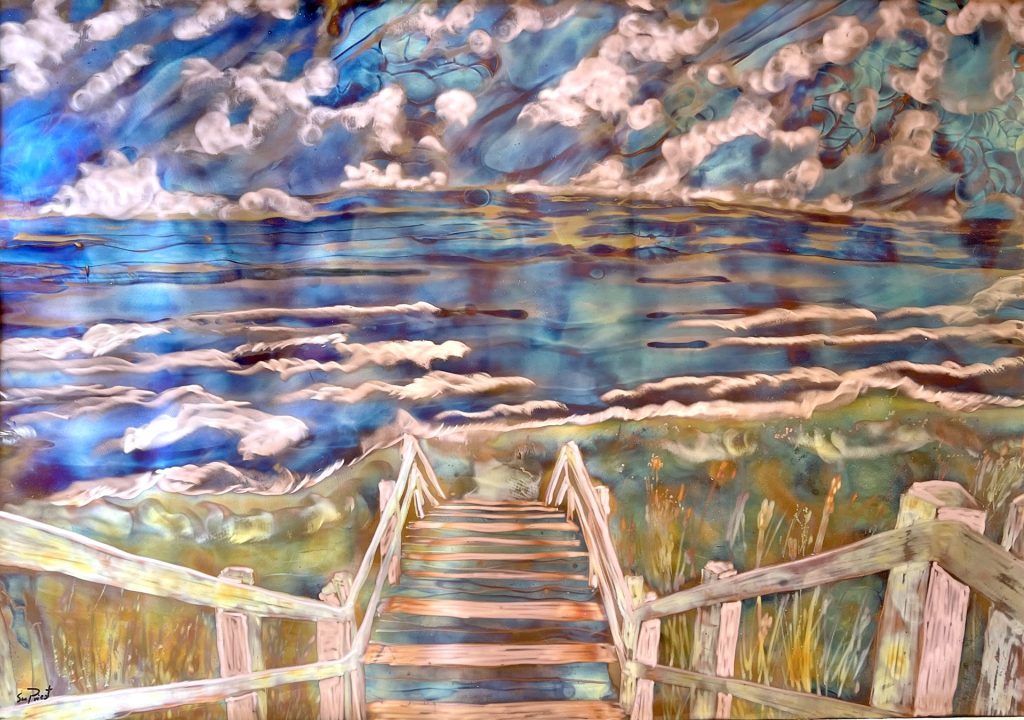
On the Edge of Vastness by Sue Priest, 23” x 33” copper flame art.
As a longtime nature lover and wetlands scientist, Sue is more inclined to producing representational pieces, such as land- and seascapes. Some include birds, horses and other animals. The larger artworks are rendered on much thicker sheets of copper, which are more versatile and durable than thin sheets. The former pieces typically require days of work to finish, while the latter can be completed in hours.
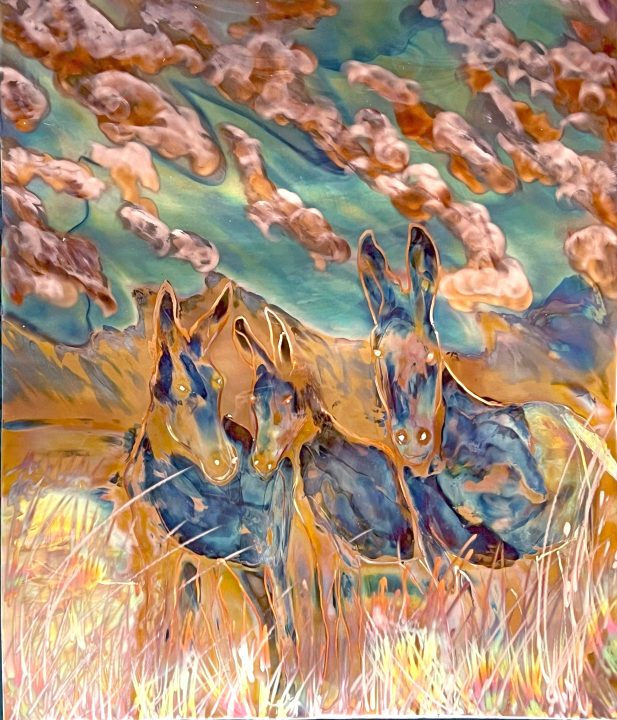
High Desert Dwellers by Sue Priest, 24” x 18” copper flame art.
Sue employs what she terms a “subtractive process,” using various grinders and sanders. “When I get my background all done, I grind and sand back to the original copper color,” she explains. “Then I rehit it with the torch. If you do that enough times, you get a striking layering effect.” It’s an organic process that produces a subtle three-dimensional impression. She surrounds most of the pieces with her own handcrafted wood frames.
Still many years from retirement, Sue is a professional artist. “This is how I make my living,” she says, sweeping her proprietorial gaze around the workshop with pieces in process and also scrolling through examples on her smartphone. “I participate in juried pro shows across the country,” she continues, “typically doing two of them a month.” These events feature a broad range of artwork, and participants pay a fee for booth space.
Whether the shows are near to home or far away, Sue drives to every one in her trusty Toyota RAV4, which has a cargo rack on top. Why? “Because I have to take my artwork and booth setup with me,” she responds. “Actually, the travel and events are usually a lot of fun.” How many miles so far this year on the road? “More than 20,000,” Sue says with a mock grimace, adding, “That’s a lot, and I’ve got four more shows before the year’s over!”
But she’s reporting, not complaining. “I love what I do. There are always new challenges and new discoveries,” Sue says. “And when I’m not on the road, I’m usually here in the workshop every day, pushing myself to come up with fresh ideas and create new forms of art.”
The artist has compiled nine life lessons, some based on her frequent experience of venturing into uncharted waters. Here’s No. 3: “Paddle gently, but firmly and with direction.”
Sue Priest’s copper flame art and jewelry are on display and for sale at the Mountain Arts Gallery on the lower level of Lake Arrowhead Village. Her website is www.suepriestart.com.


0 Comments