


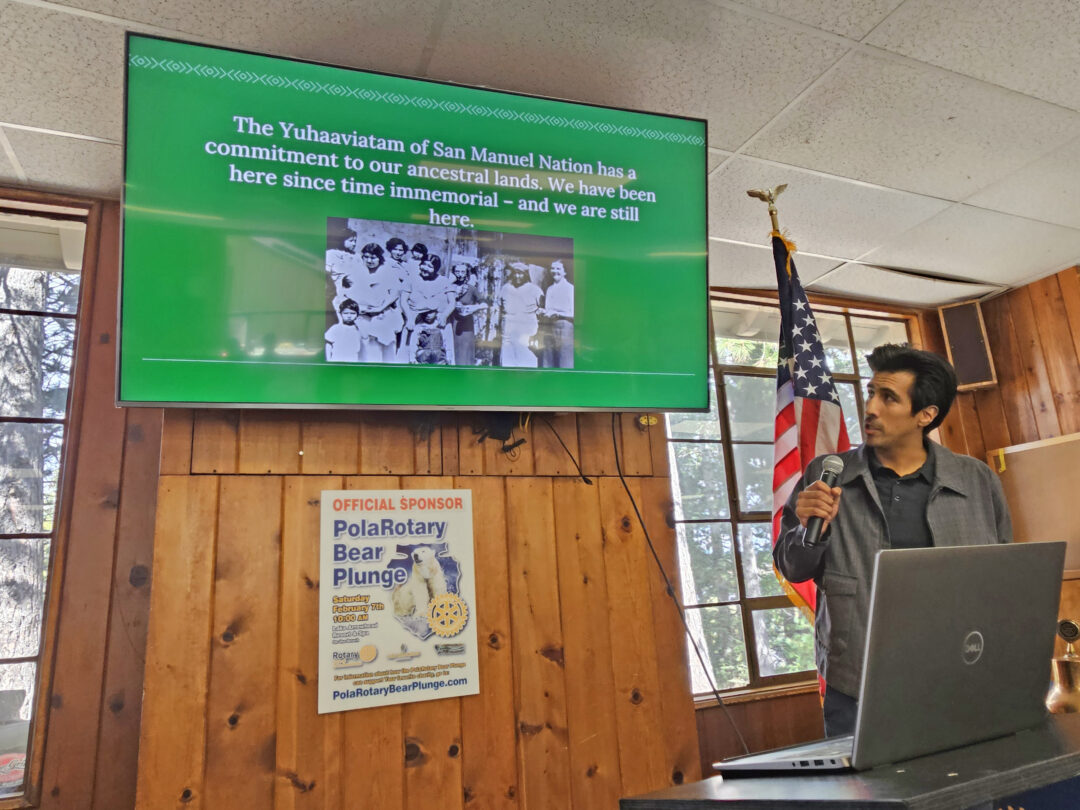
Since time immemorial, the Maara’yam people have inhabited the mountains, valleys and deserts of Southern California. The Yuhaaviatam (yu-HAH-vee-ah-tahm) of San Manuel Nation represent just one clan of the larger family.
The Yuhaaviatam – People of the Pines – have recently reclaimed their ancestral name. Joseph Maarango, the Culture Seat member of the Yuhaaviatam tribal council, shared this with members and guests of the Lake Arrowhead Rotary Club at their Oct. 21 meeting.
They are no longer to be referred to as the San Manuel Band of Mission Indians.
“Our cultural values reflect a deep interdependence to each other and to the land,” Maarango said. “They continue to guide us today.” He compared those values to the Rotary 4-Way Test, which he had heard recited at the beginning of the meeting. “That is how our family and our nation try to be,” he said.
Within the Maara’yam people there are, Maarango noted, 50 to 60 clans with unique names within their ancestral space. Unfortunately, he said, “some have been lost to us.”
In tracing the history of the Yuhaaviatam – and their resilience and determination to remain self-sufficient and sovereign – he said the Indian Reorganization Act of 1934 helped guide tribes in a more uniform fashion. The federal law reversed prior assimilationist policies toward Native Americans by ending tribal land allotment, promoting tribal self-government and establishing new economic and educational opportunities.
And in 1975 President Ford signed the Indian Self-Determination and Education Assistance Act, a federal policy of Indian self-determination, first declared by President Nixon.
But the Native American history is filled with stories of children being taken from their families and sent to boarding schools where their hair was cut, their traditional clothes were burned and they were given new English names. They were forbidden to speak their Native languages and punished if they did. All in an effort to assimilate them into Euro-American culture, while destroying their own.
Maarango’s great-grandmother was sent to one of these schools. She ran away, traveling 20 miles on foot when she was 13 to get back to her reservation.
Her story, her great-grandson said, “reinforces the importance for us to live in accordance with our history and culture.” And he stressed the importance of passing that history and culture on to others.
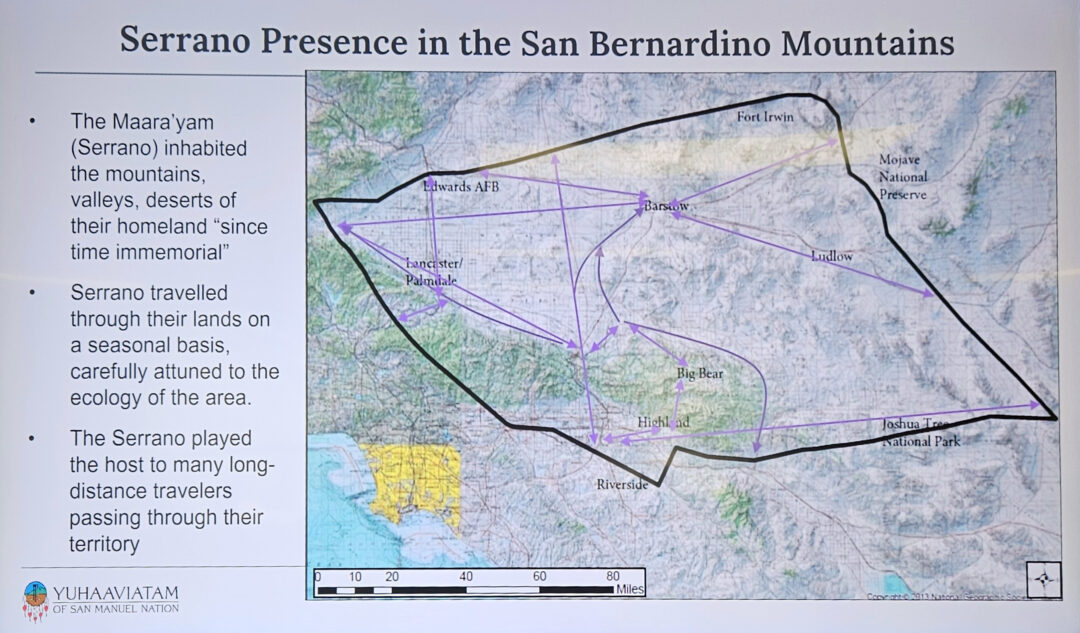
In the 1700s and early 1800s, the Yuhaaviatam came under the rule of Spanish missionaries and military who forced many Maara’yam to work as slave labor for Spain. They called the Native population Serrano or highlander. In the 1830s the mission era ended and the Native people returned to the land.
In 1866, Maarango said, militia members came to the mountain with the goal of “exterminating us entirely.” He displayed photos of articles about the genocide. Santos Manuel made the decision to move those who were left to the safety of the valley floor.
“We have made great strides in regaining our culture,” Maarango said, adding there are many Serrano speakers in his tribe. “I can speak a little. My 2-year-old daughter is attached to the language and speaks more than I ever did.”
Their knowledge of land, water, food and medicine “make us who we are and grow our culture,” Maarango said.
Today they are going through lots of red tape to reclaim ancestral items held in museums.
As he concluded his presentation, Maarango said that “my heart is grateful to be here in the mountains.”
When asked how they are keeping their young people involved, he said they have an advocacy program and a youth committee that models the governance structure of the tribe. Through this program the youth can learn about leadership positions. “It’s almost like a training space for our youth,” he said.
As for how many Yuhaaviatam members there are, Maarango said in the mid-1800s there were 30. “Now we are 10 times that.”


0 Comments