



By Mary-Justine Lanyon
Last March, Mountains Community Hospital surveyed a random sample of likely voters in the November 2026 election, asking them how likely they would be to vote for a bond measure to fund the repayment of MCH’s USDA loan.
That loan is funding the construction at the hospital. Those receiving the survey were told the bond would help repair and upgrade the 75-year-old facility, including: fixing deteriorating roofs, plumbing, electrical and safety systems; upgrade and expand the emergency room, medical technology and treatments; and maintain local access to life-saving emergency medical care for accidents, heart attacks, strokes and other emergencies.
A total of 348 interviews were completed. The initial ballot test showed 45.1 percent responding “definitely yes” and 31.4 percent “probably yes” to a measure that would levy $29 per $100,000 assessed value. The final ballot test varied slightly: 41.2 percent “definitely yes” and 31.1 percent “probably yes.”
Adam Bauer of Fieldman, Rolapp & Associates – who provide financial counseling to public agencies – recommended to Gerry Hinkley, the chair of the MCH board of directors, that the hospital do a survey of the entire community, requesting input on the issuance of the bond.
After talking with CEO Mark Turner, Hinkley called a special meeting of the board. “I felt I wanted the whole board to hear the suggestion and authorize the mailing of the survey,” Hinkley said.
At that meeting on July 9, Bauer reviewed the timeline from the survey through the mailer to the possible placing of a bond measure on the Nov. 3 ballot.
“Your USDA loan is as good as it gets,” Bauer told the MCH board, adding their timing in obtaining the loan was great. He also said the USDA loan is a no-risk option; if rates come down, they will honor the lower rate.
In January, Bauer and the board looked at the possibility of floating a general obligation (GO) bond. At the July 9 meeting, Hinkley asked Bauer if they would have to renegotiate the terms of the USDA loan. The answer was yes and that the terms would be better.
The current GO bond options being considered would be $20 or $25 per $100,000 assessed value. The annual levy for median home values would be $68 and $85, respectively.
Joy Kummer of TeamCivX outlined the communication plan for the board. The mailer would begin the conversation with the community, she said, introduce them to the potential ballot measure. The board would receive the community’s feedback in time for their vote at the July 30 board meeting on whether to post a bond measure on the November ballot.
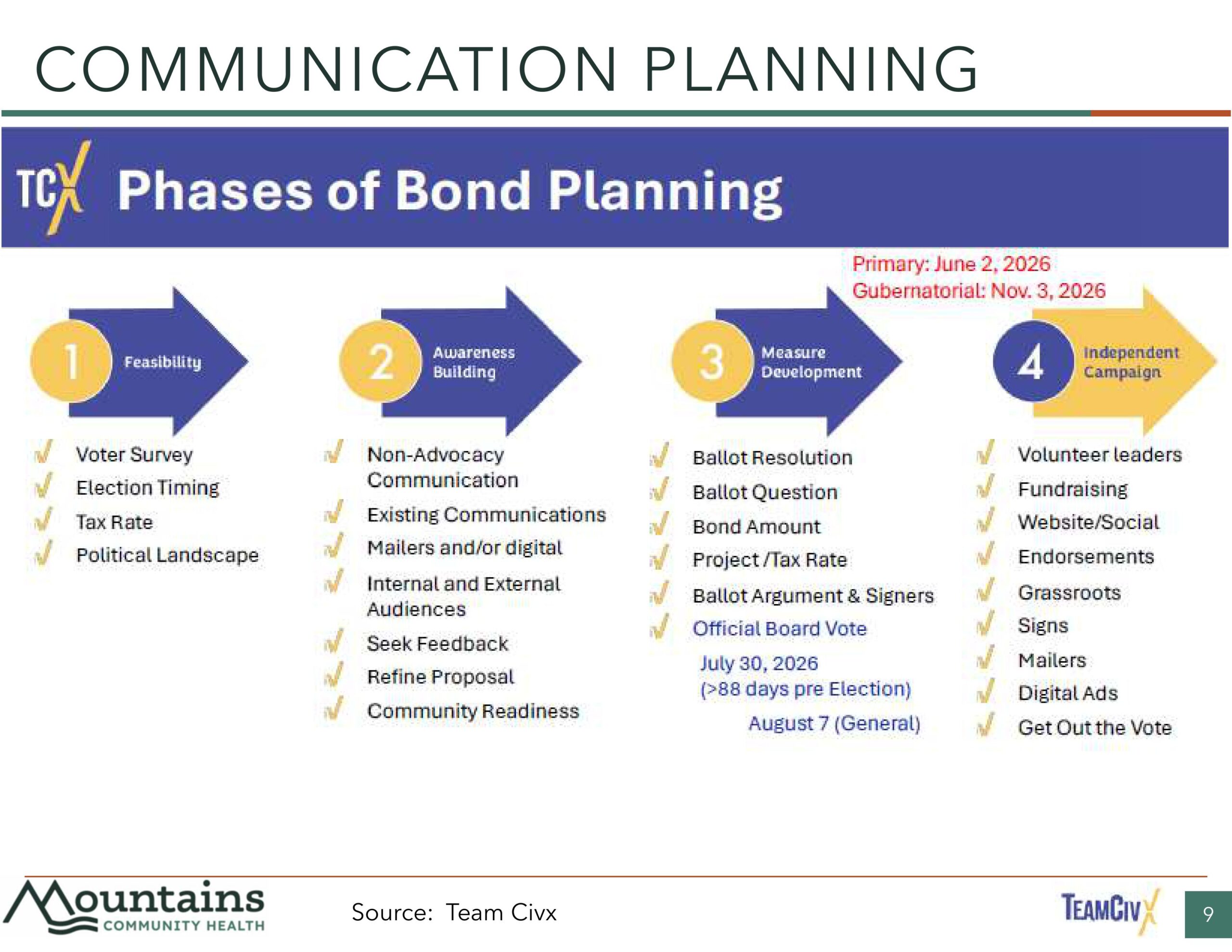
A graphic showing the phases of bond planning shows that MCH has passed the feasibility stage, accomplished with the March survey. They are currently in the awareness building stage. Through non-advocacy communication, “you inform the public of the potential of putting a GO bond on the ballot and receive their information to help you make the best decision.
“We want to make sure everyone has the same information,” Kummer said, adding the mailer, which will have a tear-off survey registered voters can return to the hospital, will give all members of the community the opportunity to give their opinions.
In the third phase, the board will consider whether to add a bond measure to the ballot and develop the language of that measure. Because Aug. 7 is the deadline to submit resolutions for the November ballot, the board must consider this measure at their July 30 meeting.
Attorneys like Vanessa Legbandt of Straddling Yocca Carlson & Rauth LLP will help develop the language of the ballot question.
When board member Barry Hoy asked how registered voters compare with property owners, Kummer said someone who owns a home in the hospital district but also owns a home elsewhere, where they are registered to vote, would not receive this mailer and would not vote on the measure, should it be placed on the ballot.
Kummer said the hope was to get consensus among the board at the July 9 meeting on sending out the mailer. “It’s important to communicate the highest amount you would consider,” she said. “The people surveyed in March heard $29 per $100,000 assessed value and were still supportive. If you communicate $25, that is below what was positively received in the survey.
The board unanimously approved sending out the mailer. They urge all registered voters in the hospital district to respond to it, giving them their feedback on the potential GO bond.



0 Comments