



By RHEA-FRANCES TETLEY
Staff Writer
Leisure Shores in Crestline welcomed Nancy Anderson, the former senior bear keeper at Wildhaven Ranch Rehabilitation Center in Cedar Glen, who spoke to a full room of about 40 mountain residents on peaceful co-existence with bears on this mountain.
For over 23 years, Anderson cared for and rehabilitated the bears that had been rescued. She is now a representative of BearWise.org, an organization that educates the public about bear behavior and how to avoid conflicts between bears and humans.
Anderson explained that bears have a strong sense of smell, which is seven times better than a bloodhound so they can smell barbecuing and baking and other food smells from very far distances. Since they are basically lazy, they will go where the easy food sources are located, which unfortunately for most of us, are in the residential areas of the mountains. It is important to quickly harvest fruit from trees and remove fallen fruit from the ground, since ripening fruit will quickly attract hungry bears.
Bears have been conditioned to believe the easy food is near people. Some of the short-term rentals have made videos of feeding bears in their yards, which in their minds attracts renters. But what that really does is habituate bear to associate people with food; that usually leads to a dismal future for the bear, as they stop foraging in the forest to seek the human food, seeking out trash cans and other easy food sources and this often leads to confrontations.
Anderson recommends if you know of a person feeding any wildlife, especially for videos, to be sure to inform code enforcement as feeding wildlife intentionally is illegal and can result in danger for all, the humans and the wildlife.
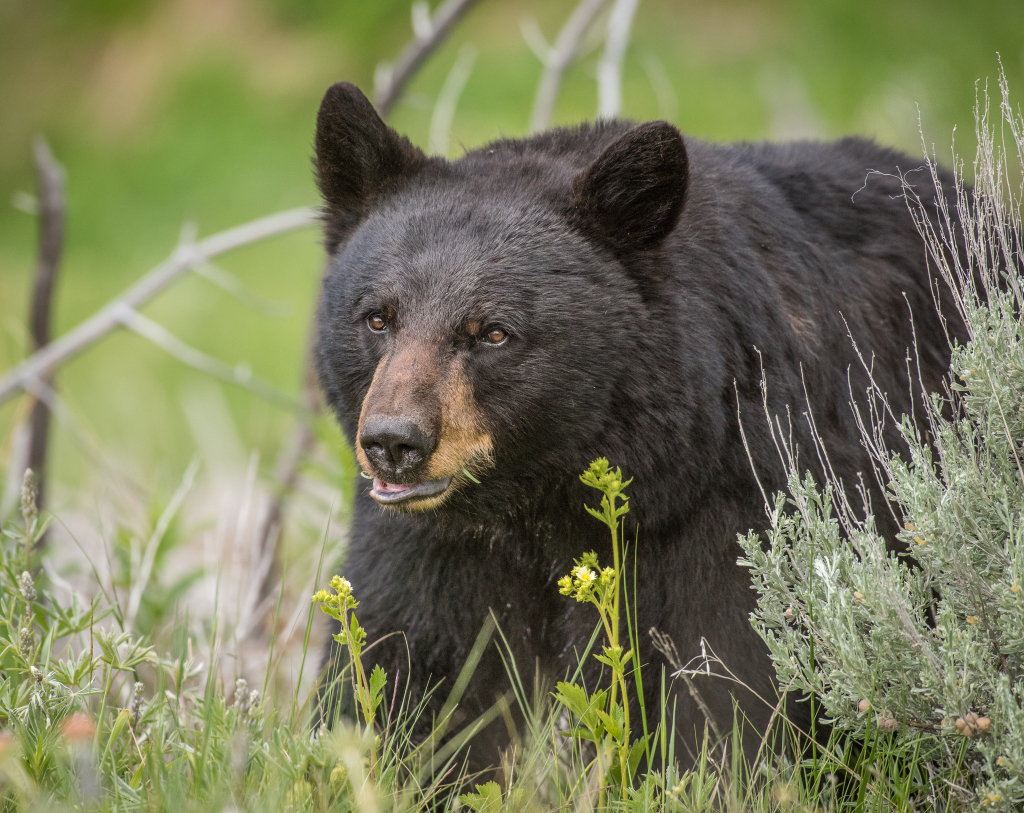
Although black bears are relatively docile and do not want confrontations, they are very big, powerful and can be dangerous. Black bear colors range from a light brown to cinnamon to black, often with a blaze on their chest. They are wild animals and their behaviors cannot be predicted. Never approach a bear nor run away from one, said Anderson.
If confronted by one, raise your hands with a jacket above your head and walk slowly backwards away from them. If you turn and run, they will chase you, since that is part of their predatory natural instincts. They can run 30 to 35 mph.
When frightened, a bear will climb a tree; do not stand at the base of a treed bear. And never go near the base of a tree with a baby bear in it as its mother will soon return; she sent him up there for protection and will see you as a danger to her cub.
Anderson said breeding takes place in the wild in May to June; females are fertile for only one to three days but may mate with numerous males in that time period. The males then go their own way and females give birth in January, hopefully not under your house.
The babies emerge from the den in spring and stay with the mother for about a year-and-a-half while she teaches the cubs to find food and survive. Then she abandons them, forcing them to survive in the wild. This is when many young yearling cubs are seen in housing areas if they discover how much easier it is to feed from homes than from foraging in the forest. Sometimes siblings may hang together for months after their mother goes away. Often it is these yearling bears that cause problems as they seek out their own territory and often seek the easy food sources.
Female bears mature into adulthood in three to four years; for males it takes four to five years. Female bears have a 50-square-mile habitat and males have a 300-square-mile territory.
If a bear is seen, use a spray of water from a strong hose, an air horn or even a bear whistle to scare them off and discourage them from approaching. When hiking or walking a dog, wearing bells is a good idea so the bears is not surprised by your arrival. Always carry bear spray or an air horn, especially at sunrise or sunset.
Bears are omnivores, meaning they eat both plants and animals, but 90 percent of their natural diet is plant based. Adult bears need 25,000 calories each day. Black bear’s natural diet includes berries, fruits, honey and they will eat meat, but rarely eat fish. Bird feeders are attractive to both birds and bears, so their use is discouraged in the mountain communities from March through November. And where bird feeders are used, bring them in at night, to discourage attracting bears.
It is important to drive slowly, especially at sunrise and sunset; many bears have already been hit by cars this year and some of them died from their injuries. Collisions with bears also cause great damage to automobiles. Female adult bears weigh 200 to 400 pounds and males are one-third larger.
“Do not leave groceries or animal food in your car, especially overnight, as bears can easily pull off the door to the car to get to it,” Anderson said. “Also, it is preferred to feed pets indoors and never leave bowls of pet food and water outside from sunset to sunrise, as bears will be attracted to it. Keep your pets safe by keeping them and especially feeding them inside.”
During the winter in this area, bears only semi-hibernate, or torpor, meaning they actually do not stay in their dens all winter, as they do in colder climates, so they are out and about when they smell good eats. However, it is especially important to not allow them to hibernate or sleep under houses and decks; now is the time to secure those areas to keep any wild animals from entering. Do not let them think they can stay, since this is your territory; insist they leave. They can destroy the underside or basement of a home, including the wiring, plumbing and support beams to a home.
Most bear problems are human caused by allowing them to become dependent on human food. It is a well-known statement that “a fed bear is a dead bear.” Nuisance bears when identified by the Department of Fish and Wildlife, such as those who enter buildings or attack humans, are destroyed. The D.F.W. no longer relocates nuisance bears; they issue bear depredation orders to kill them.
Southern California Black Bears are descended from 22 problem bears that were relocated to these mountains from the Yosemite area in the 1930s. There were few problems between them and humans until the human population expanded into more areas of the mountains.
“There have only been 10 deaths caused by bears in the last 100 years in all of Southern California,” said Anderson. It is estimated there are currently 400 bears in the San Bernadino National Forest and 72,00 bears in California, none of them grizzly bears as those were all killed by 1922.
More problems locally began when curbside trash pickup service was instituted, since bear boxes and other techniques used in other known bears areas, such as Lake Tahoe, Colorado and Mammoth, were not instituted here. It is important to bear proof your garbage. Trash day greatly attracts the bears, since they have good memories and know which day is trash day in each area. Put out trash barrels the morning of trash pick-up. Then keep the cans clean and deodorize them frequently, using ammonia or bleach. Keep the clean cans inside buildings between trash days. It was suggested to freeze left over meats and other smelly food items so the bears cannot smell it.
It is important to tell your neighbors when a bear is observed in a particular area so they can be aware and know to make noise as they walk in the area to scare the bears away before an encounter.
Dawn Selleck, who also worked at Wildhaven for many years, spoke on many of the other local forest animals which often come into the residential communities and how to deal with them.
Coyotes are a very adaptable, intelligent predator and can survive in most any environment, including in big cities. She said there are about 400 coyotes in these mountains. She explained how coyotes have the ability to adapt and make numerous vocalizations so even a small family of coyotes can sound like over a dozen. They communicate well with each other. They live in family groups with the males as a part of the pack. As predators they will seek out small rodents and even small pets for dinner. Coyotes will trick and lure pets who are out-of-doors unprotected, even in their own backyards, to follow them back to their den to “play” where they often become the family’s dinner.
Also on our mountain are bobcats and mountain lions which should never be intentionally attracted to the residential areas. These big cats are carnivores who think your pets are delicious. The bobcats eat larger rodents. They are nocturnal and normally seen at sunrise and sunset. The white spots behind bobcat ears make it easier for their cubs to follow them in low light. Mountain lions can easily leap 12 feet in a single leap and over almost all fences.
Raccoons are already living in the residential areas but should be discouraged from dumpster diving as it is not healthy for them to be eating human food, which can make them ill. Raccoons are intelligent and have a good memory of where they found food. Their front paws are sensitive. They also can carry diseases that can be transmitted to humans, so it is wise to be careful around them. They have two to five babies each spring who stay with mother for many months. They eat acorns, frogs, beans and our trash.
At the end of the program, Anderson suggested everyone check out the BearWise.org website to become even better informed about living safely in bear county.
Editor’s note: Nancy Anderson had also presented a program on bears at the combined Municipal Advisory Council meeting in early August with wildlife biologist Dr. Jeff Villepique of California Fish and Wildlife.





0 Comments