




That’s what Rotarian Mary Ann Dickinson asked in her presentation about data centers. She spoke to her club, the Lake Arrowhead Mountain Sunrise Rotary Club, on Sept. 9.
Dickinson has been doing research on data centers for the Lincoln Institute of Land Policy, which is based in Cambridge, Mass. The report will be published in October 2026.
Checking online, a data center is described as “a physical facility or building that houses computer systems, servers and network infrastructure to store, process and share digital information.”
What does a data center do? It stores data – keeping huge amounts of files, backups and records safe. It runs applications that power websites, email, streaming apps and business software. And it supports AI, providing the heavy computing power needed to train artificial intelligence models.
Since the advent of AI, Dickinson said, “they have become enormous because of the extraordinary energy capacity needed.” That need has made the facilities enormous, she added.
“We will need them,” Dickinson said, “as we transition to a digital economy. Everything is being processed in the cloud. We need to figure out how to construct them so they are sustainable.”
She shared a map showing the current locations of data centers. They started in Virginia with AOL, Dickinson noted.
Currently, there are more than 5,000 data centers operating in the U.S., with many more on the way. That number, she said, is expected to double.
“Remember when cell phone towers were an issue? This is a repeat of that phenomenon,” she said.
But data centers aren’t new, Dickinson noted. It’s the AI data centers and their “enormous appetite for computing power that’s new and a little frightening.”
The current electrical grid will be strained to provide the energy required. From a water perspective, these centers are very consumptive, Dickinson said. “They can consume up to 500 gallons a day to cool the chips and servers.”
Some of the centers are quite small, consuming 5 to 10 MW; others can consume 100 MW or more.
“No one is talking about the problems,” Dickinson said. “Very little information is being made available. Some officials are being made to sign nondisclosure agreements so they can’t talk to the townspeople. If people don’t know what’s going on, they get upset.”
A second map Dickinson shared showed where new centers are being built. The map shows a big concentration – 109 data centers – in Arizona. “Where Arizona will get the water is anyone’s guess,” she said. “They want to be known as a welcoming area.”
What has happened, she noted, is a number of legislative bodies have passed moratoriums on having data centers in their towns – either short-term while they figure out how to regulate them or long-term.
A third map showed the more than 150 legislative bodies that have passed moratoriums.
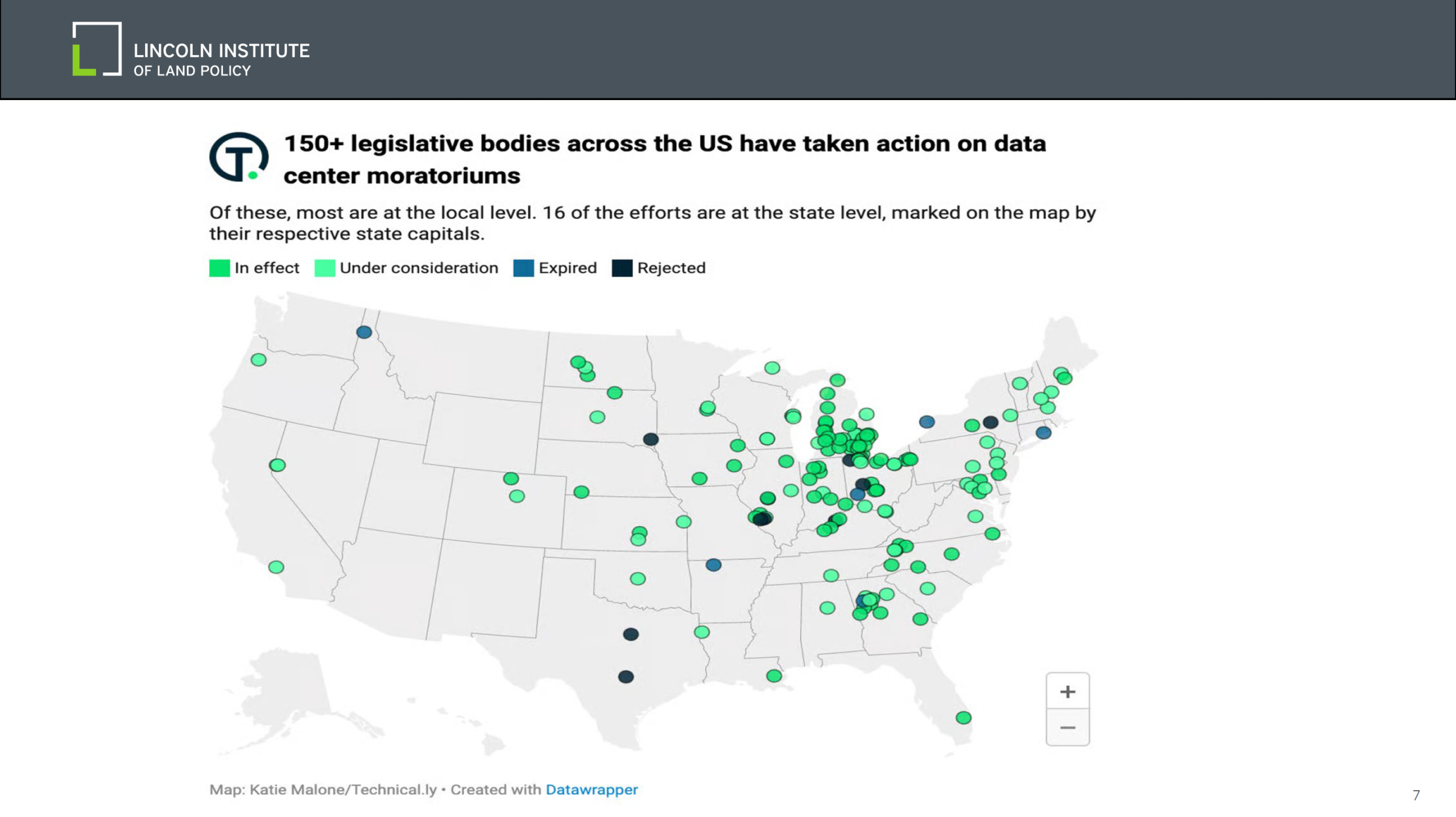
Legislative bodies largely concentrated in the eastern U.S. have taken action against data centers.
Dickinson pointed to the town of Mansfield, Mass., where a zoning bylaw regulating data centers was passed at their annual town meeting.
According to Town Planner Sarah Raposa, that bylaw was approved by the state attorney general. The bylaw allows only Tier I facilities, which use no more than 2 MW, and prohibits Tier II and III facilities. It establishes standards addressing electrical capacity, water use and cooling systems, noise, backup generators and emissions, site design and impacts on municipal infrastructure.
“Although electricity and water impacts tend to receive the most attention,” Raposa said, “we also included detailed noise protections. Continuous operational noise from cooling systems, transformers, mechanical equipment and similar infrastructure may not exceed 50 dBA between 7:00 a.m. and 10:00 p.m. or 45 dBA overnight.”
Raposa also noted that “no data center has been proposed or built in Mansfield since the vote. The bylaw was a proactive effort to establish clear protections before an application was filed, while preserving a narrow pathway for a small facility that might serve a legitimate local or network need.”
“Communities are beginning to decide what they want,” Dickinson said. “Then everyone is calmer.
“We will need data centers. We have to figure out how to make them work.”
Early data centers used air cooling, which Dickinson said requires more energy. As AI chips have intensified, they cannot be air cooled but have to be water cooled. The question arose of whether that water can be recycled.
In addition to the energy and water consumed, there is a third factor community members have objected to: the noise of the large cooling fans required in the data centers. Dickinson said there is a data center in the town where her sister lives. “It is extraordinarily loud,” she said. “It’s a racket – the whole back wall is giant fans running 24/7.”
One risk no one seems to be talking about, she noted, is the risk of abandonment. “You see it with shopping centers and industrial warehouses. Chips are evolving rapidly. The racks they are stored on will become obsolete. It will be cheaper to abandon the existing center and build a new one rather than renovating the existing one.”
Eight states – Georgia, Florida, Maine, Maryland, New York, Oklahoma, Vermont and Virginia – have called a “time out” on data centers.
The California legislature had passed a bill requiring data centers to annually report their energy and water use. It was vetoed by the governor as that is not required of other industries; he saw it as discriminatory. “When California won’t require disclosure,” Dickinson said, “you see what the problem is.”





0 Comments