




By RHEA-FRANCES TETLEY
Historian
Today, Papoose Lake sits calmly next to Lake Arrowhead dam, supporting the older dam. Although it didn’t take long to build, there were many complicated steps to go through, and there was a deadline set by the California Division of Safety of Dam (DSOD) or they would demand Lake Arrowhead’s level be immediately lowered.
The passage of ballot measures in November 1974 resulted in a $7 million bond for the construction of a dam downstream from the aging and earthquake-vulnerable Lake Arrowhead Dam, which sits under Highway 173. It also required the community to purchase the lake from its owner, Boise Cascade, for $500,000.
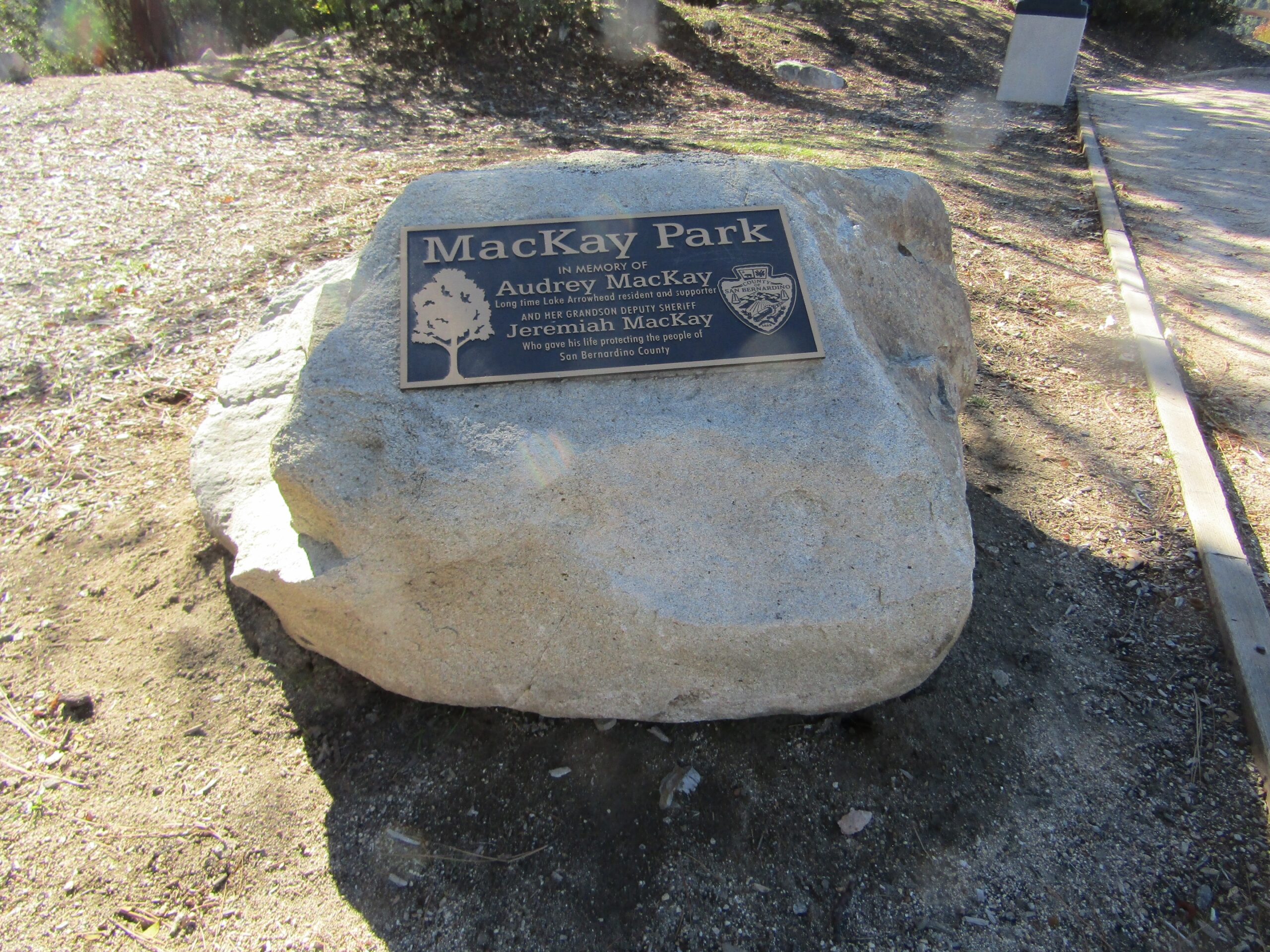
The plaque in MacKay Park which overlooks Papoose Lake, naming the dam after Audrey Mackay and the park after her and her grandson Officer Jeremiah MacKay.
The community’s property owners created the Arrowhead Lake Association (ALA) to accomplish that and then to manage their lake. The community had accepted an expensive burden to maintain the water in its beautiful private lake. The original estimate to build the dam had been $4.5 million but, of course, construction delays from weather and more raised the final price.
The DSOD maintained its order that Lake Arrowhead’s water level would be lowered 70 feet if the dam was not expeditiously constructed, with a completion deadline of September 1976.
The lowest bidder, Hubb Construction, was over the $7 million bond amount, so the landscaping and other “non-necessary elements” of the contract were deleted. As the dam was being constructed of large rocks and concrete, there were several plan modifications, mostly to keep the project under budget.
The CSA-70 D-1 discovered that the interest on the bonds was being deposited in the county’s general fund; they realized with those funds a landscaping/anti-erosion plan could be developed and implemented. They met with County Supervisor Nancy Smith and got the county policy changed, using those funds to hire forester Jim Asher, who created a three-phase plan. The interest flowed into the project fund beginning July 1976.
Then torrential rains in September 1976 from Tropical Storm Kathleen eroded the steep slopes of the project, creating deep ruts from run-off, especially above Torrey Pines Road. The Lahonton Regional Water Quality Control Board became alarmed and issued a cease-and-desist order to stop the flow of silt into Little Bear Creek. Remedial action was immediately undertaken.
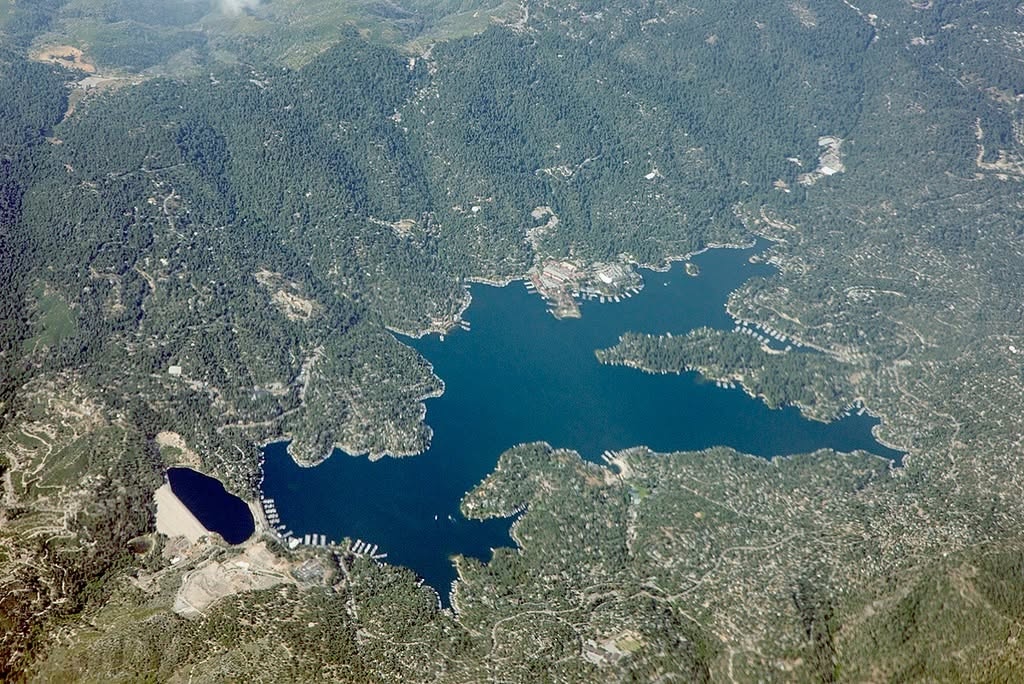
An aerial photo of the two lakes with Highway 173 going over the original Lake Arrowhead Dam.
In December 1976, rainwater and water siphoned through a 12-inch pipe from Lake Arrowhead began filling the lake area behind the new dam only three months after the deadline date set by the DSOD. The new lake, although deep, holds only 2,000 acre-feet of water.
However, it was obvious to all that the dam was not finished. In April 1977 Hubb Construction filed for completion of the contract, asking for final payment, despite complaints from ALA, CSA-70 D-1 and the Metropolitan Advertising Agency (which had bought out Boise Cascade). The objectors contended that all the work in the contract had not been done and both sides (of course) sued each other. The county settled the suits and additional work was done by another contractor and billed to CSA-70 D-1.
But this legal stuff didn’t hinder the excitement of the community. The Soroptimists, Boy Scouts, Baptist Church, Rim High and elementary students planted the 6,000 trees purchased by the Rotary Club and other groups to complete Asher’s landscaping plans and stop the erosion. The “El Niño” winter of 1977-78 saw over 80 inches of rainfall in Lake Arrowhead, forcing water to flow over Lake Arrowhead spillway near the UCLA Conference Center, into Willow Creek causing flood damage.
The county applied for federal disaster funds, receiving only $53,000 to cover over $400,000 in damage. This resulted in a service charge of $27 being assessed to all Arrowhead Woods property owners.
Lake Arrowhead’s chamber of commerce held a “Name the Lake Contest,” with a $100 prize. Lural Schafer, a member of the Club San Moritz in Crestline, won. She stated the name “Papoose Lake” was appropriate, since the lake was “on the backs” of Arrowhead Woods property owners. Christening ceremonies were held on June 2, 1979. The dedication plaque was stolen within weeks and was replaced by the chamber and attached to an even larger boulder and has since again “gone missing.”
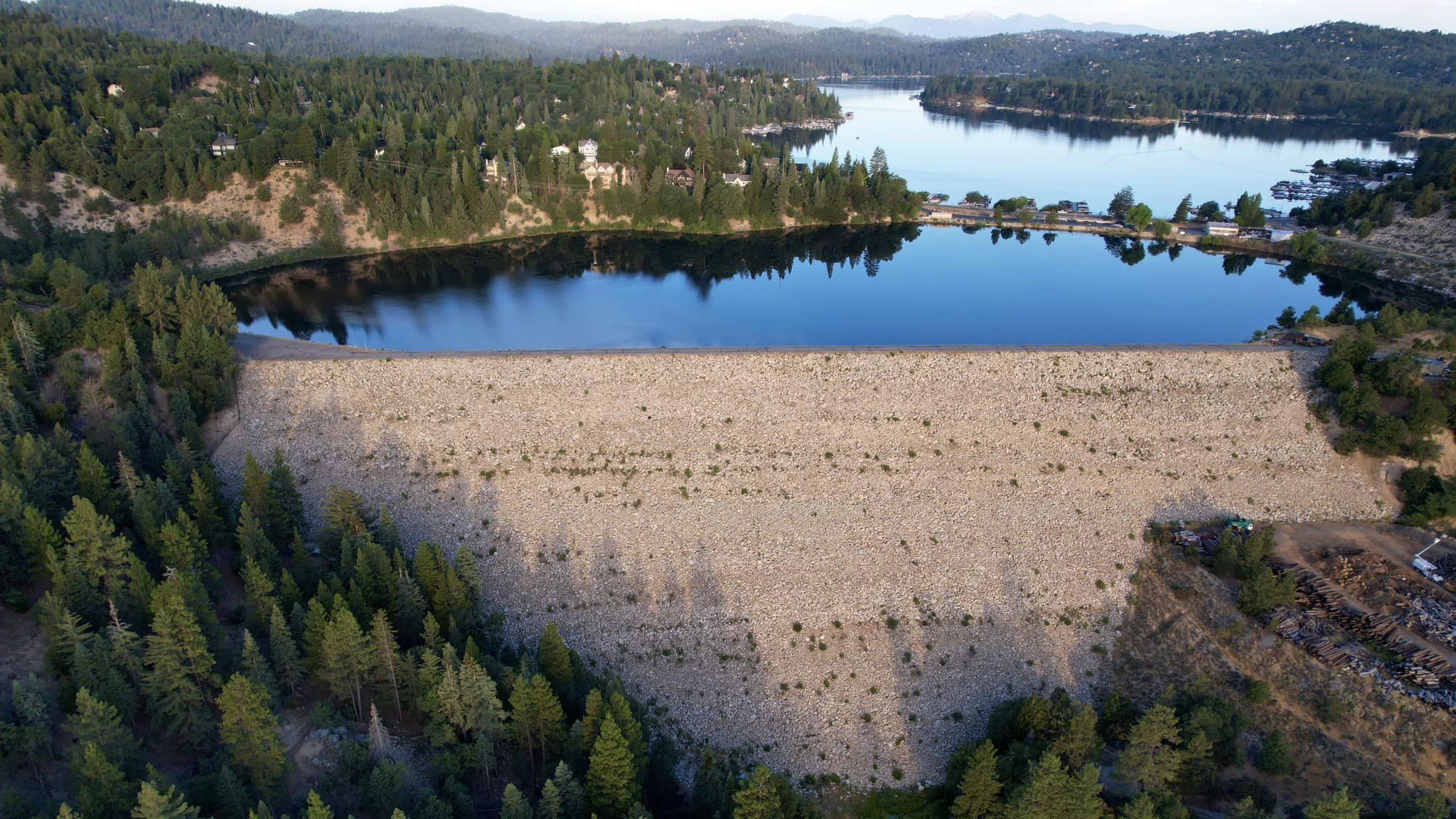
The Audrey Mackay Dam holding back Papoose Lake.
Since 1980, liability issues arose, so the 32-acre surface Papoose Lake is closed to recreational use; it is self-insured and has a fence surrounding it. The 160-foot-deep lake water is available only for fire-fighting use. It is so deep to fully support the Lake Arrowhead dam, putting equal water pressure on both sides of the older dam. The dam at Papoose Lake maintains a steady water release of 193-gallons-per-minute into Little Bear Creek, as required by law.
The dam’s indebtedness bonds were paid off in 1990.
Upon the death of original CSA-70 D-1 Commissioner Audrey MacKay, the dam creating Papoose Lake was named in her honor. MacKay worked as the administrator for Lake Arrowhead, beginning in 1946 when the Los Angeles Turf club owned Lake Arrowhead, through 25 different bosses, until her retirement, after the completion of Papoose Lake.
A monument was installed in July 1999 after her death, naming the new dam for her. She was Lake Arrowhead’s honorary mayor in 1958 and Citizen of the Year in 1976. Without her persistence and involvement in CSA-70 D-1, Lake Arrowhead probably would have been drained instead of Papoose Lake being built. There is an informational kiosk in MacKay Park telling the story of the unusual situation of two functional dams so close to each other.



0 Comments