



By Mary-Justine Lanyon
The issue of PFAS (per- and polyfluoroalkyl substances) in the water provided to its customers by the Lake Arrowhead Community Services District has been at the forefront of the district’s concerns since the issue was raised at its Nov. 14 meeting.
As the board considered awarding a professional services contract to Dudek to provide treatment options to remove the PFAS from the drinking water at the Dec. 12 meeting, Operations Manager Matt Brooks noted that “we have been hearing a lot about PFAS recently.” He acknowledged the district has detected “trace amounts” in the water.
The two treatments currently being used to remove PFAS, Brooks told the board, are ion exchange and granulated activated carbon. When President John Wurm asked what would be done with the treated water, Brooks said he wouldn’t have an answer until they got more into the process. General Manager Catherine Cerri said she had been told by an engineer that, if they do ion exchange, the treated water would be put into canisters and handled as hazardous waste.
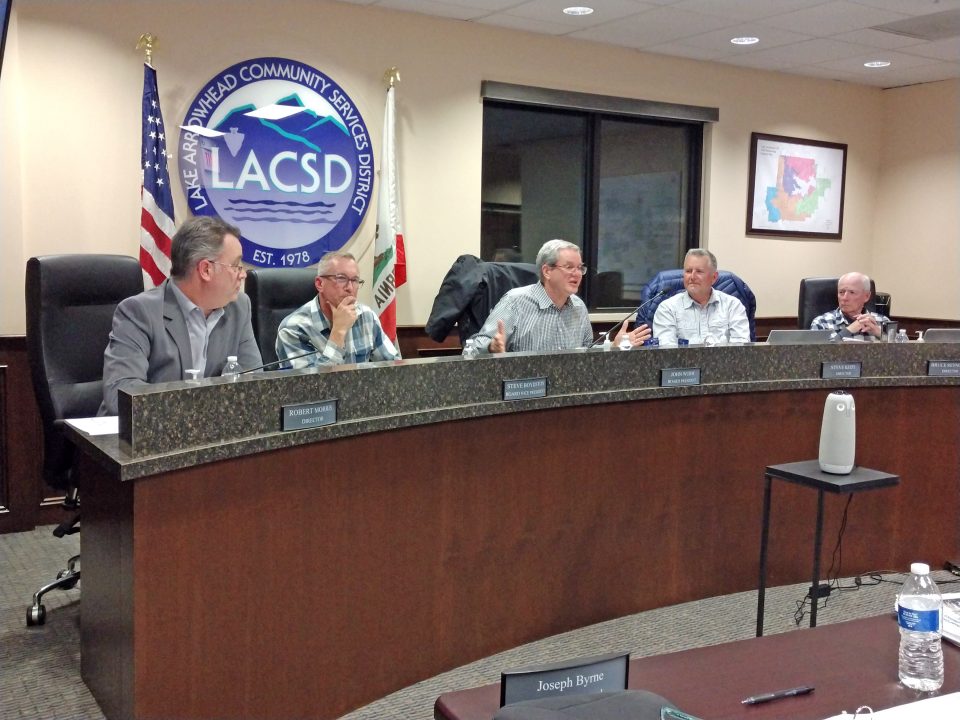
The board members made it clear to the large audience present at the Dec. 12 meeting that they are taking the issue seriously and are striving to better understand it.
“I’ve seen stuff circulated on the Internet by unreliable sources indicating we knew all about this, that we’ve been hiding it,” said Director Steve Keefe. “The first we heard about it was at the last meeting. All that is nonsense. If you showed up because you heard it’s a conspiracy, I’m here to let you know it’s not the case.
“We need to understand what we’re dealing with,” Keefe added, “as it’s all brand new.”
Wurm noted that “if there’s any danger or something the public needs to know about, of course we’ll provide the information.”
General Counsel Joseph Byrne told the board and the audience that “the EPA will determine the maximum contamination level. We will have to comply with that. It’s in all of us,” he added. “In clothes, in fire retardant. It’s very widespread. Most everyone has it in their water – it’s very prevalent.”
Byrne also said PFAS is more prevalent in wastewater, although it’s unclear why.
When Keefe asked if it has been detected in rainwater, Byrne said it has. “It is a forever chemical – very difficult to get rid of. Learning is going on at the national level.”
“The EPA has kicked the can on this the past two years,” Director Robert Morris said. “They are allegedly moving forward but nothing is happening quickly. It’s coming down to the grass roots level. We should all be concerned – we all live here.”
Garin Vartanian – who had raised the concerns at the Nov. 14 meeting – distributed copies to the board members of a certified letter sent to LACSD in 2020 ordering them to collect data in four quarterly tests.
Cerri reiterated what she told the Alpine Mountaineer in a Dec. 8 interview: “That was a study of wastewater.
“The EPA and the state are always studying contaminants of emerging concerns,” Cerri told this newspaper. “They have some suspicions PFAS may be harmful but haven’t come out and said what level is harmful. They send us sampling orders all the time – that’s routine.”
Cerri added that “we’re studying PFAS. The EPA is trying to figure out where they are coming from, as are we. The EPA had all wastewater agencies test for it in 2020. The state water board wanted to know if it was in wastewater. We tested and came back with some results for informational purposes. We had nothing to compare it to, no regulatory guidance. We had no idea if the numbers were high or low compared to other agencies.”
Cerri noted that “it wasn’t until this year – in March – that the EPA came out with guidelines for drinking water.”
LACSD’s first sample of drinking water for PFAS was taken in February 2023, with the results available in June. “We were surprised,” Cerri said, “because our water is so pure, high quality. This chemical is everywhere.”
At the Dec. 12 meeting, Vartanian suggested that the wells next to the holding pond at the Lake Arrowhead Country Club are most likely contaminated with PFAS. “You need to find the source; more likely than not it’s the treated wastewater,” he said, adding there is a closed loop: LACSD treats the sewer water which goes to the golf course.
“I highly recommend you test the well water,” Vartanian told the LACSD staff.
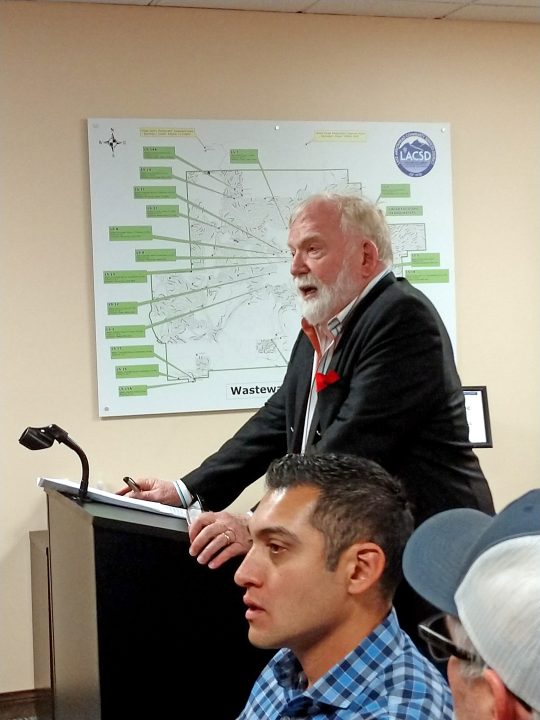
Former LACSD board president Ted Heyck raised questions about the levels of PFAS in the water the utility distributes.
Former board member and president Ted Heyck, who has been distributing information about PFAS with Vartanian, told the board that “reverse osmosis is the way you eliminate PFAS. It’s very expensive. Big Bear is putting it in. I suggest you dump the advice you’re getting and go talk to Big Bear – join with them, get a discount.
“Stop sending infected water to Grass Valley Lake,” Heyck said. “It comes back to you and you end up drinking it. You’re killing yourselves. Everyone here is pretending. The time is now to act.”
“You say take action,” Wurm responded. “That’s what we’re voting on – to hire an engineering firm who has the expertise. They will make recommendations. We will request they do it as quickly as possible.”
Following additional comments from audience members, Keefe asked the audience “to allow us to do what we do – provide accurate information based on what the reality is. We just found out about this. Maybe we knew about it in our wastewater but we had no idea it was in the lake or potable water. That’s why we’re scrambling.
“We brought it up at the last meeting,” Keefe added. “Someone in the meeting blew it up to the world, made it like the greatest catastrophe. We’re doing exactly what we need to do – assess it.”
When Heyck asked if the recycled water distributed to the country club had been tested, Brooks said it had been and the district is waiting for the results.
Cerri noted the district’s #1 priority is to remove PFAS from the drinking water. “If we can get rid of the source, that will save us money in the long run.”
When the contract with Dudek came to a vote, Keefe amended the motion to add a request for the firm to help determine the potential sources of PFAS. The contract was approved unanimously by the board.
The board also approved a resolution authorizing Cerri to file a financial assistance application with the State Water Resources Control Board for the “planning, design and construction of PFAS removal project.” And they approved a second resolution authorizing the advance of funds for the PFAS removal project, subject to later reimbursement from the state.
“What really bothers me,” Cerri told the Alpine Mountaineer, “is that we are really proud of the water we serve. This has been hard on our staff. We really care and take pride in what we do.”





0 Comments