


By Mary-Justine Lanyon
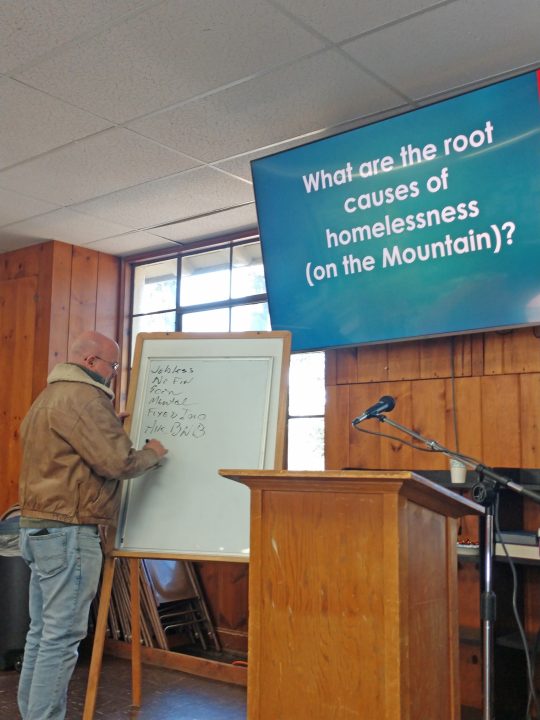
That was the question posed by Paul Fournier at the presentation on homelessness on Jan. 6 at the Lake Arrowhead Community Presbyterian Church.
Fournier, who is in charge of church and community relations for Lutheran Social Services, noted down the responses called out by attendees at the meeting: jobless, economic, mental health, fixed income, drugs, affordability of housing.
The primary cause on the mountain, Fournier noted, is the lack of a support system, whether that lack is real or perceived. “That is the biggest commonality among my clients,” he said, acknowledging that those people had other contributing issues.
He gave the example of a young woman, 17 or 18 years old, who was sure her parents would never take her back. “We called the parents,” Fournier said, “and they were astonished their daughter thought that. They said that of course they would welcome her back. We put her on a bus back home.
“Most of us have family we can lean on. Folks who become homeless don’t or think they don’t,” Fournier added.
Affordability of housing – whether due to houses being turned into short-term rentals or huge rent increases – is also a major factor in homelessness.
Domestic violence or the end of a relationship can also lead to people becoming unhoused. Other factors include: disabilities; limited work opportunities; seniors with income less than $800 a month; some drug issues; some mental illness; low fixed income; terrible credit and rental history.
Addressing drug issues and mental health, Fournier said that most drug abusers and people with mental illness are not homeless. In fact, he noted, 90 percent of each category are not unhoused.
So, what are the solutions?
“You can be someone’s support system,” Fournier said. “I know several people in this room who have played that role both personally and professionally. Be supportive.”
Shared housing is an option – “Take a large home and make it work for a number of people, who learn to live as a family,” Fournier suggested.
A church in San Diego that has extra acreage is planning to build senior housing there – one example of a church- or community-based solution.
Fournier pointed to a facility just opened in Victorville that has housing for individuals and families. There are medical services on the campus, help with identification and career resources. “It’s all in one place, not a bus ride away.
“That’s what Lutheran Social Services wants to do in San Bernardino,” he said. They currently have a shelter with congregate housing for 70 men who can stay up to 90 days. Their proposal is to add modular housing with individual sleeping pods for 60 more men; that housing would be available for up to a year. Their shelter is a low-barrier shelter – there is no sobriety requirement although guests cannot be drunk and disorderly.
Fournier also pointed to the solutions that have been developed on the mountain. The Mountain Homeless Coalition was able to purchase cabins in Big Bear, which are currently providing homes for the previously unhoused. They also have master leases for properties so, if there is an opening, they can house someone without having to depend on hotels, which are more expensive.
Sue Walker, the president of the Mountain Homeless Coalition, explained that the nonprofit came out of St. Richard’s Episcopal Church’s Outreach committee, which was investigating what they could do about the homeless.
“One person wanted to give them sandwiches,” Walker said. “I thought, ‘I think they need more than that.’”
St. Richard’s organized the first Point in Time Count on the mountain in January 2016. “We came up with nine people,” Walker said. “That may not seem like a lot but some people thought there were none. We knew the homeless were up here and thought we should do something about it. We formed the Mountain Homeless Coalition, which became a nonprofit in July 2017.”
They connected with the county and were able to apply for grants and connect with other groups.
The typical path for an unhoused person is to first be placed in emergency housing and then progress to transitional housing and finally permanent housing. “We’re fortunate to be able to fund that with the first month’s rent and the security deposit,” Walker said.
But to get to permanent housing, a person might need identification, child care, transportation, food, medical care. “There’s a lot to get them ready for permanent housing,” Walker noted.
The next Point in Time Count is scheduled for Thursday, Jan. 25. Volunteers, who will be placed into teams by Walker, will gather at St. Richard’s at 10 a.m. Those teams will go out from Crestline to Running Springs, talking to the homeless they encounter and asking them to complete a survey, which the volunteers will have on their phones.
Training for the Point in Time Count will take place at St. Richard’s on Jan. 16 at 10 a.m. To sign up as a volunteer and for more information, visit https://sbchp.sbcounty.gov/community-projects/point-in-time-count/.
For more information on the Mountain Homeless Coalition, visit their Facebook page: www.facebook.com/MountainHomelessCoalition.



0 Comments