



By Mary-Justine Lanyon
Here on the mountain, we hear a lot about preventing wildfires and being prepared to evacuate when one occurs. Residents who have lived here for a number of years have been through the drill – more than once.
A program hosted by RimReady.org addressed keeping your home safe from fire and steps to take to be prepared for a number of types of disaster.
Speaking at the Lake Arrowhead Community Presbyterian Church on March 16, Crestline resident Rudy Westervelt told the audience he created Rim Ready after last winter’s snowstorms – called by many Snowmageddon.
“We need to get our heads together as a community and prepare for disasters,” Westervelt said. He plans to hold quarterly preparedness trainings.
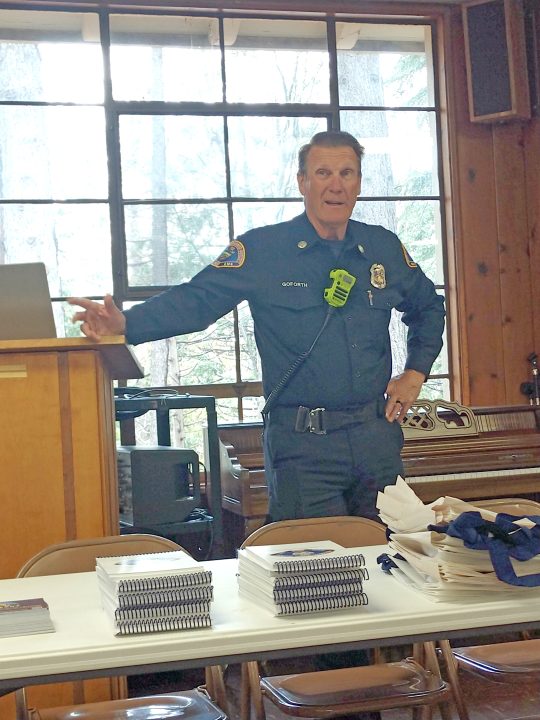
Capt. Tim Goforth of County Fire Station 91 began by saying he had recently been on his fifth fire from hot ashes. Folks made the mistake of cleaning out their fireplace, putting the ashes in a metal bucket. They put that bucket outside on the wood deck. The ashes heated up the bottom of the bucket and then the wood beneath it. Along came some wind that stirred up the ashes and the embers that lingered in them.
While you should clean out your fireplace, Capt. Goforth urges everyone to fill the bucket with water to prevent a house fire.
During Snowmageddon, the captain said, the “biggest issue we had was the 17 structures that were damaged or caught fire because of gas leaks. We’re not quite sure what was going on with the gas meters.”
One house they responded to was “completely obliterated.” All that was left, Capt. Goforth said, was a crater. Another house resembled a doll house, he said, with one side blown out, left lying against a hillside. “We could look right inside, like looking at the furniture in a doll house.”
He noted County Fire has been encouraging people to get shelters for their gas meters – a simple roof with a slope placed a couple of feet above the meter.
“Preparedness is the biggest thing,” Capt. Goforth said. “That storm last year caught a lot of people off guard. Stock up on water, canned foods, batteries, medications.
“That’s the other big issue we ran into,” he said. “People running out of their medications. We were delivering them by snowshoe or Sno-Cat.”
Capt. Goforth was accompanied by several other members of Station 91. Firefighter-Paramedic Cody Schnaufer urged everyone to make sure they know where their gas meters are and know how to shut them off. “The big issue last year was the winds and the amount of snow, which drifted. Some people didn’t know where their gas meter was so we had to dig around the house to find it.”
Engineer Robert Stine noted they sent crews to short-term rentals and the renters had no idea where the gas meter was. “SoCal Gas doesn’t have a map,” he said. “It was like finding a needle in a haystack.” He recommended that STR owners include a map of the electrical, gas and water shutoffs at the house in the binder of information they leave for their renters.
Another issue Capt. Goforth pointed to is chimney fires. Creosote builds up in the chimney and people don’t have the chimney cleaned. “They build the first fire, heat up the creosote and they have a blowtorch coming out of the roof.”
In addition to urging people to have their chimneys cleaned, the captain also urges everyone to not only have a fire extinguisher but keep it up to date and serviced.
The recent time change was the perfect opportunity for everyone to change the batteries in their smoke and carbon monoxide detectors.
When the Rev. Bill Stanley asked about the best placement for smoke detectors, Engineer Stine said the manual that comes with them should have installation instructions. “You always want them at an entrance point,” added Schnaufer. “It has to do with the layout of the room,” Capt. Goforth said, “Smoke will follow the path of least resistance.
“We know what snow and rain bring,” the captain said, adding it’s been a couple of years since we have had a significant wildfire season. “We’re coming up on that season when grasses will start blooming. Keep pine needles off your roof. Keep the downhill side of your property clear for at least 100 feet – fire will burn uphill.”
The fire crew also urged everyone to keep their clothes dryers free of lint. Most companies that clean chimneys will also clean out dryer vents, they said.
Also attending from Station 91 were Paramedic James Simpson and EMT Andrew Flores.
ADVICE FROM THE RED CROSS
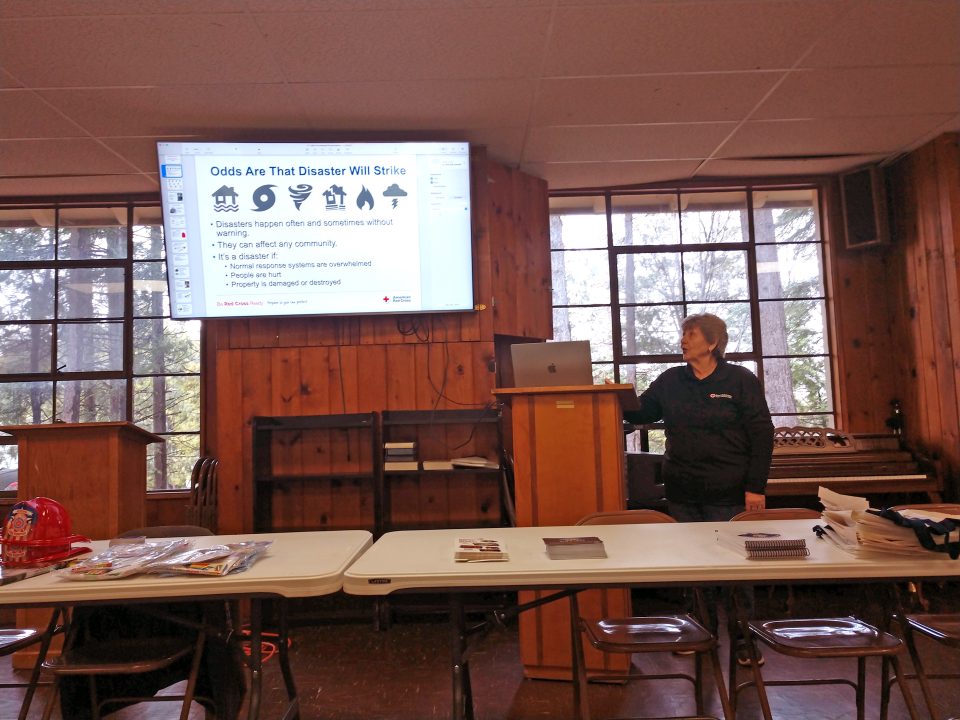
Georgia Duncan, a volunteer with the American Red Cross, urged everyone to be prepared when faced with a disaster like last winter’s storms.
The fire presentation was followed by advice from Georgia Duncan, a volunteer with the American Red Cross.
What are the disasters we face most often? she asked. The answer was home fires, extreme heat, wildfires and winter storms.
To prepare for storms like we experienced last winter, people need to prepare themselves and their houses. “If you are prepared,” Duncan said, “You will adjust and come back from a disaster more quickly.”
Everyone should have a supply of water (one gallon per person per day), canned food and medications. Don’t forget your pets, Duncan advised. And be sure to “trade out” the food and water so what you have is fresh and current.
She also said people should customize their preparedness kits for the season – jackets and perhaps space blankets in colder weather, an umbrella in the summer to be shielded from the sun.
An interesting idea was to download some favorite music onto your phone. Listening to it can calm you down during a stressful situation. “Listen, breathe, recoup,” Duncan said.
“Is there anything you wished you had during Snowmageddon?” she asked. “Think about it and make sure going forward you have it.”
Having an evacuation plan is critical. Where will your family meet? What is the school’s plan? How will you connect with your children? Do you have a way to communicate? Where will you go?
Having a battery-operated radio is a good idea, Duncan said. After an earthquake, mountain residents may be cut off and have no power; such a radio will help keep folks updated on the situation.
Above all, Duncan said, follow the instructions of authorities. If they tell you to evacuate, do so.
It is helpful, she said, to talk with children prior to a disaster and afterwards. “Help them build confidence so they know they can get through anything and you’ll be there for them,” Duncan said.
“What do you need to do to be Red Cross ready?”





0 Comments