


By Mary-Justine Lanyon
“It is the obligation of any water agency to look for local sources of water.”
Noting that Lake Arrowhead is full for the second year in a row, Catherine Cerri, general manager of the Lake Arrowhead Community Services District, said that “we know drought is imminent in California.”
To address the issue of finding additional sources of water, LACSD turned to the U.S. Bureau of Reclamation. The Reclamation team conducted a study and evaluated options available to LACSD.
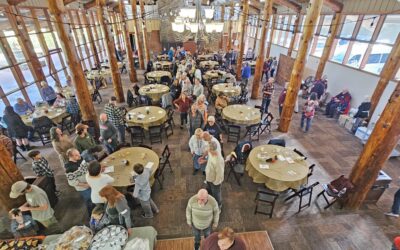
Several members of the team – made up of experts with experience in engineering, geology, water quality and project management – brought their findings to the LACSD board at a special meeting on May 7.
Del Smith, the team facilitator, said that it had been a good experience, working with Cerri and Operations Manager Matt Brooks.
“There is a lot of infrastructure for this district to manage,” Smith said. “Your water quality is some of the best in the state. That was one of the criteria we needed to consider.”
Smith added that if all the homes in the district were occupied, “your water supply would be strained.
“There has been a lot of conservation. You went from drawing 3,000 acre-feet from the lake to just over half. That is very impressive.”
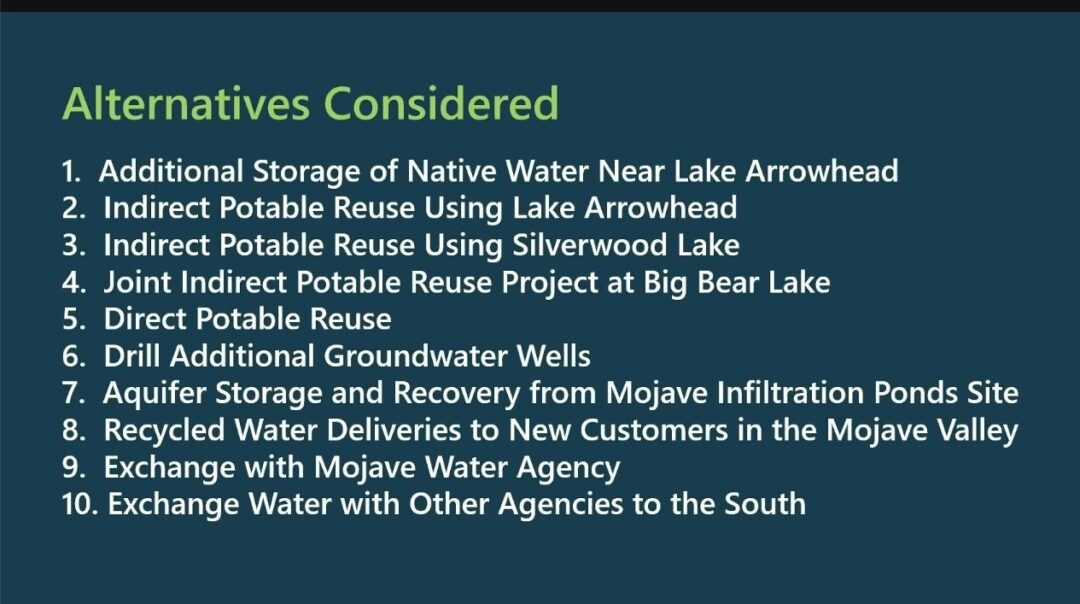
As the team looked at various alternatives, they took cost into consideration. The result was a list of 10 alternatives. Team members outlined the pros and cons of each.
There are three potential water storage sites: Willow Creek, which could hold 1,000 a-f of water; Grass Valley Creek, which could also hold 1,000 a-f of water which could be pumped up to Lake Arrowhead through the existing tunnel; and Little Bear Creek, downstream to the east which could store 1,300 a-f of water. Dams are expensive and approval takes a long time, Smith said. On the positive side, using native water would provide the highest water quality.
Indirect potable reuse came into play in three scenarios: using Lake Arrowhead, using Silverwood Lake and joining a project at Big Bear Lake.
The Silverwood project would store the water nearby while leaving Lake Arrowhead untouched. It would require negotiations and partnership with the State Water Project and CLAWA. The Big Bear project would also leave Lake Arrowhead untouched but would require complex pipeline construction.
Direct potable reuse would send effluent to either the Bernina or Cedar Glen treatment plant; new pumps and piping would be needed. While Lake Arrowhead would be untouched, public acceptance might be more difficult. This would also require the highest level of treatment.
LACSD currently has five wells that produce about 140 to 225 a-f a year. They could drill up to 15 additional wells with a goal of producing 750 a-f. While construction costs of wells are relatively low, deeper wells may produce water with higher mineral content that would require additional treatment. LACSD may have to acquire additional water rights and land.
LACSD could design an aquifer storage and recovery program in the Mojave River Basin at the Hesperia effluent management site. Water would be stored there and recovered during a drought. The recovered water would be pumped approximately 10 miles and 2,450 vertical feet to Lake Arrowhead for treatment.
While this would recover water currently lost in the Mojave Valley, the pumping and treatment costs would be high.
LACSD could deliver Title 22 recycled water to new customers for irrigation in the Mojave Valley; this would generate revenue to purchase State Water Project water in periods of drought, if it is available. However, this alternative does not address the need for expanded water supply. Multiple approvals and negotiations would be required.
The ninth alternative is to secure an exchange agreement with the Mojave Water Agency which would include: divert additional Grass Valley Creek stormwater to Lake Arrowhead; take deliveries from MVA from Silverwood Lake wheeled through CLAWA. LACSD could offer an exchange for groundwater rights; could agree to continue sending flows from the wastewater treatment plant.
Very little infrastructure would be needed to divert Grass Valley Creek water. Additional water stored in Lake Arrowhead would increase the lake level for recreational purposes. Storing native water in Lake Arrowhead would not degrade the water quality. No additional infrastructure would be needed to receive water from CLAWA.
The disadvantages include changing a diversion right could take years; continued maintenance and potential replacement of outfall pipeline will be required; requires an agreement with Mojave.
The final alternative was a water exchange with agencies to the south. This would leave Lake Arrowhead untouched; joining an existing program would alleviate some planning burden. However, a new five-mile pipeline would involve complex construction – steep terrain, large elevation drop – through an environmentally sensitive area. Negotiations and partnerships with multiple agencies would be required. And water received could be of a lower quality, leading to customer complaints.
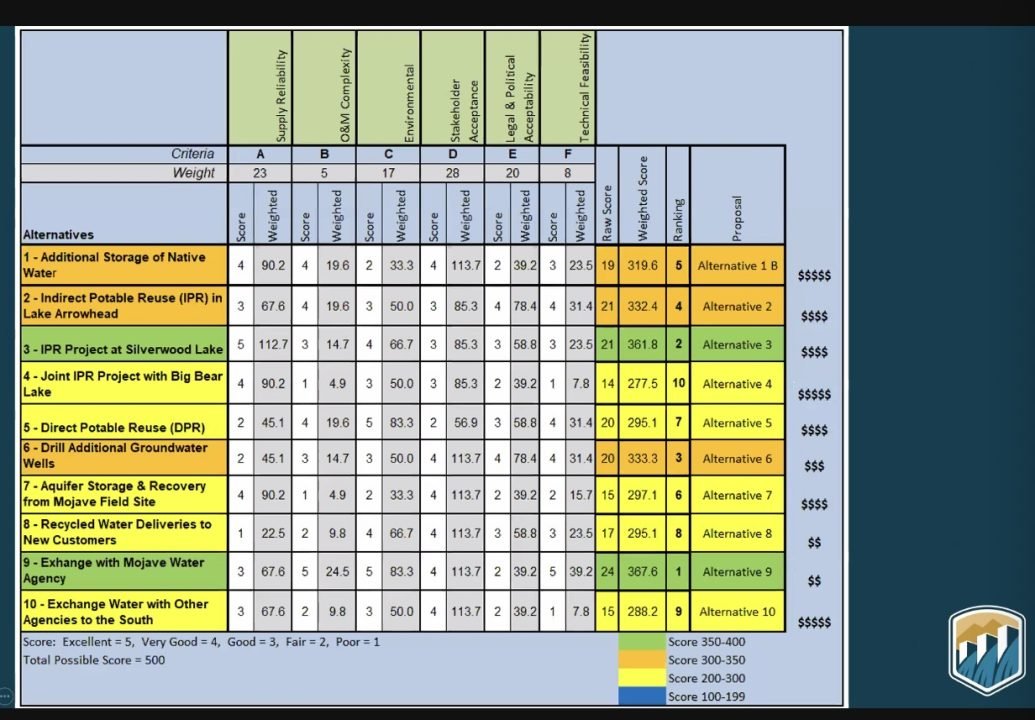
After studying the 10 alternatives, the Bureau of Reclamation ranked them for the LACSD board to consider.
As to what all this means, Smith then showed the LACSD board a graph weighing the 10 alternatives on a number of factors and ranking them. Ranking #1 is Alternative 9 – doing an exchange with the Mojave Water Agency. Running a close second is Alternative 3, an IPR project at Silverwood Lake and third is Alternative 6, drilling additional wells.
Cerri told the Reclamation team that they have had discussions with Mojave. Those discussions, she said, “never gained traction as they changed general managers. We plan to go back again.”
“We would love to capture more of that water,” Director Steve Keefe said.
A member of the Reclamation team said that “we also work with Mojave. We can help facilitate (the conversation). We’ve encountered the same issue with the change in GMs. As you are thinking about different alternatives, keep in mind Reclamation has a planning and design grant. That gives you an option to look at getting funding for planning.”
Director Bruce Reynolds asked if they could look at combining two alternatives. The answer was they could do that or even combine three. Reclamation has a project where two communities have come together and developed a joint powers agency. “Other agencies are saying that’s what they need to do – think outside the box.”
“Our special guests have presented good information,” said President John Wurm. “What’s our next step?”
“These alternatives are for the board to consider,” Cerri responded. “If there’s one you want us to pursue, we can do that.” She added staff can bring alternatives to the board, saying they think those should be looked at.
“We want to avoid spending a lot of time putting together a plan that won’t be accepted by the public,” was the comment from Director Steve Boydston.


0 Comments