



- Boys with a normal viewpoint were taken from the fields and offices and factories and classrooms and put into the ranks. There they were remodeled; they were made over; they were made to ‘about face’ to regard murder as the order of the day. They were put shoulder to shoulder, and through mass psychology they were changed. We used them for a couple of years and trained them to think nothing at all of killing or being killed. Then suddenly we discharged them and told them to make another ‘about face.’ This time they had to do their own readjusting without mass psychology, without officers’ aid and advice, without nationwide propaganda. We didn’t need them anymore. So we scattered them about without any speeches or parades. Many, too many of these fine young boys are eventually destroyed mentally because they could not make that final ‘about face’ alone. (Written after WWI by Major General Smedley Butler, U.S. Marines, Congressional Medal of Honor recipient)
Special to the Alpine Mountaineer
“My comrades, hardly strangers to pain before now, we have all weathered worse. Some god will grant us an end to this as well.” – The poet Virgil
For us reflective souls scoping life in the rearview mirror, we frequently come to grips with the war’s end. For combatants, that has a very long half-life in our dreams and daily intrusive thoughts. My hope when planning this journey is that it would vanquish some of those intruders. It did.
After a night in Hanoi, the next morning I flew to Hue City, the famed home of the Citadel, to meet up with my pals Peter Sternberg, a psychotherapist in our Elder Warrior Retreat program, and Jerry Lane, who served in the Navy on the USS Saratoga during the war.
The first full immersion into Vietnam was our ride up the Perfume River in a sampan, a flat-bottomed Chinese wooden boat, used mostly for fishing but sometimes serving as permanent habitation. In our day, they were transportation for the Viet Cong, who embedded with the civilians for cover. Was it creepy? You bet it was at first. I told Peter that I felt like I was in a scene in Apocalypse Now with Martin Sheen.
Our guide, Tuan Tran, a former ARVN (Army of Republic of Vietnam) soldier, whose father fought the French at Dien Bien Phu in 1954, launched his first round of history lessons aboard our boat ride.
All ears, all eyes, all smells, all memories came to visit. In the first 20 minutes of a narrative from a man who studied history at the University of Hue, I felt like I was getting the “Paul Harvey rest of the story” about the Vietnam War. We would get two more weeks of insightful historical vignettes from those who prevailed and how they strategized the outcome. Tuan offered a quote from Uncle Ho Chi Minh: “We did not need to win, we just wanted to ensure we did not lose.”
Three centuries of skilled guerrilla war tactics made for a formidable enemy and an unprecedented challenge for the American military command. These are the folks who vanquished or chased out three Chinese dynasties, the Japanese in 1945, the French in 1945 and, sadly, the United States in 1975.
Be reminded that Ho Chi Minh modeled the Republic of Vietnam Constitution after ours, with great admiration for Thomas Jefferson.
Our first stop after the immersion was the My Chanh Bridge. It was here that ARVN forces held the line and launched their counterattack to drive Ho Chi Minh back toward the DMZ. The American soldier heard very little about the dedication and courage of the South Vietnamese military facing a far superior fighting force – the North Vietnamese Army (NVA) – who were well trained and hugely financed by Russian aid and equipment.
Tuan would frequently praise the efforts of our 82nd and 101st Airborne, Army Special Forces and Marines who did their level best to train the ARVN troops but would sadly admit we learned very little from the French failures and their endless retreats from Viet Minh strongholds. A baffling conscious blind spot since we financed 70 percent of the French military actions in Vietnam.
One of my motivations for this journey was my own reconciliation with the collateral damage we inflicted. In layman’s terms, that is called atrocities, with many more then we were told, with the exception of the Winter Soldier hearings, where most of those giving testimony were marginalized and demonized. The number of these incidents was way more than the signature one called the My Lai massacre. Many of them were designed by the Republic of Korea Marines, who were famed as one of the most ferocious and brutal fighting forces on the planet.
During one day patrol off Hill 10, I encountered the Blue Dragon unit of the Republic of Korea Marines and witnessed them “zippo” a village, place a Viet Cong suspect on his knees and drown him with their canteens. This scene was a mental screen saver for years. The rather sardonic quip at the time was, “Those guys never got copies of the Geneva accords. Truth is that if the Korean Marines were anywhere near a five-mile radius, we could take of our boots and go to sleep.
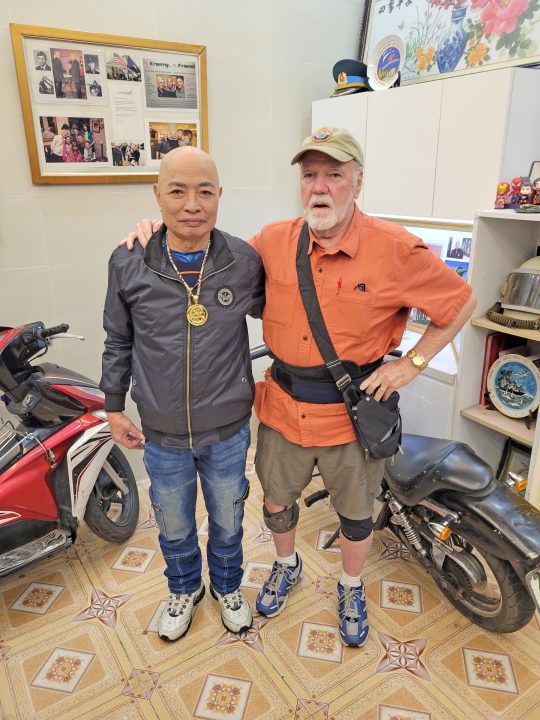
I released this psychic intruder with a ritual created by Peter and some incense at a nearby pagoda that was part of a cemetery for all the civilians lost in the Easter bombing in 1972, long after the Marines left Vietnam. As I reflect now, I believe the ritual worked as it was coupled with a rather impulsive act of forgiveness with Tuan and myself hugging each other in sorrow for the innocent lost lives. I plan to show the video recording by Peter to my children, grandchildren and great-grandchildren.
During the NVA’s Easter offensive of 1972, thousands of local refugees – most of whom were old people, women and children trying to flee south – were mercilessly slaughtered by Communist NVA troops. Often those trapped by a downed bridge would seek refuge from our own bombings by fleeing into underground bunkers that were everywhere. Their resurfacing and continuing to flee is when General Westmoreland’s legendary phrase “Kill everything that moves” kicked in.
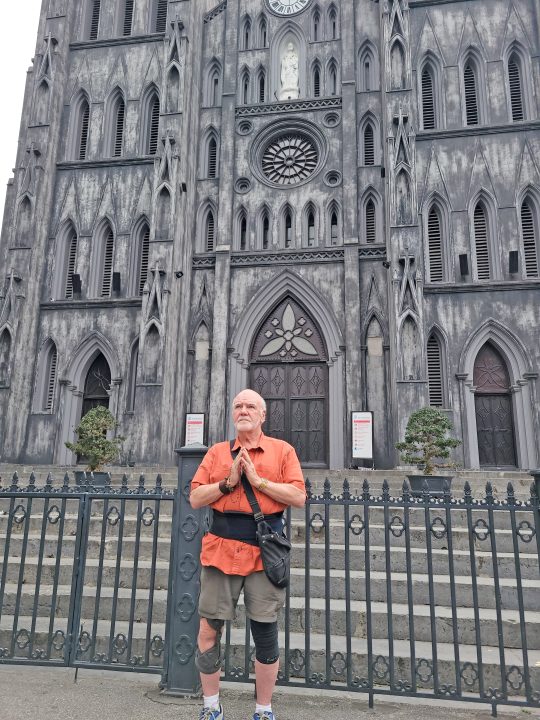
St Joseph Cathedral in Hanoi, which survived the Easter bombing in 1972.
Can you now see why the desire for collective forgiveness was in order? That ritual was conducted after returning to Highway 1, known as the Highway of Horror, with a stop at Long Hung Catholic Church where both the ARVN troops and the NVA sought refuge as they retreated. The massive number of bombs dropped exceeding WWII and Korea combined did not pick sides – all 7,000 tons of them. The church stands today with scars from grenades, rockets and bullets. Nearby is a museum with all the shell casings. Sobering and packed with wonderment of how these people survived and have created a thriving economy without a cent of reparation monies like the Marshall Plan.
Having established a palpable level of trust between us and our guide, Tuan, we had a gargantuan laugh when we momentarily were not sure where he was when we returned to our van. He arrived and said, “No worry, I will not leave you in a lurch like America did in 1975.” The consequent laughter at the raw truth was proof that we were all sympatico. It felt good. On this day after visits to other battle sites the laughter was a welcomed antidote to the visual residuals of war.
It is not possible to convey the penetrating potency this 14-day journey offered to my body, mind and soul inside a few installments. The striking prosperity of this country left me with a replacement memory, relegating the crummy stuff to float out to sea.
My flight out of Hanoi banked over the South China Sea to Tokyo. In our day we called it the “Freedom Bird” back to the world, as we called America. None of us would be considered heroes in the homeland. It would take 50 years to utter a heartfelt, “Thank you for your service.” No crowds, no parades, no chiming of church bells, just jeers and dark looks. A shock to the soul. Our only victory is that we survived.
My daughter and grandson met me at LAX, with a big Welcome Home sign – 56 years later, that is as good as it gets. Amen.


0 Comments