


By Mary-Justine Lanyon
That is the question on the minds of not only local school administrators and trustees but on the minds of school officials nationwide.
At the April 18 meeting of the Rim of the World Unified School District board of trustees, teacher Debbie Bennet raised the question.
“We have a serious threat to our students’ success and it’s right in front of us,” she said. “Cell phones. Cell phones distract and have a negative impact on learning, writing skills and overall academic achievement.
“It is not enough to ask that cell phones be left in backpacks,” Bennett added. “The urge is so strong to check them for messages that there are now 12-step programs to deal with electronic devices.”
During the time for remarks by the trustees, Jordana Ridland said she believed there would be a recommendation coming to the board on cell phone usage. “It’s hard to learn and focus when students are getting notifications all through class,” she noted.
At the May 16 school board meeting, Shannon Hansen, the assistant superintendent for personnel and pupil services, presented the results of a survey the district had conducted on student cell phone use. Those results may be used to update school policy.
The high school and intermediate school produced the highest response as might be expected since those students are the most likely to have cell phones.
A lot of comments, Hansen told the board, had to do with emergency situations. If students need to use a phone during school hours, he said, they can go to the office – something several staff members pointed to.
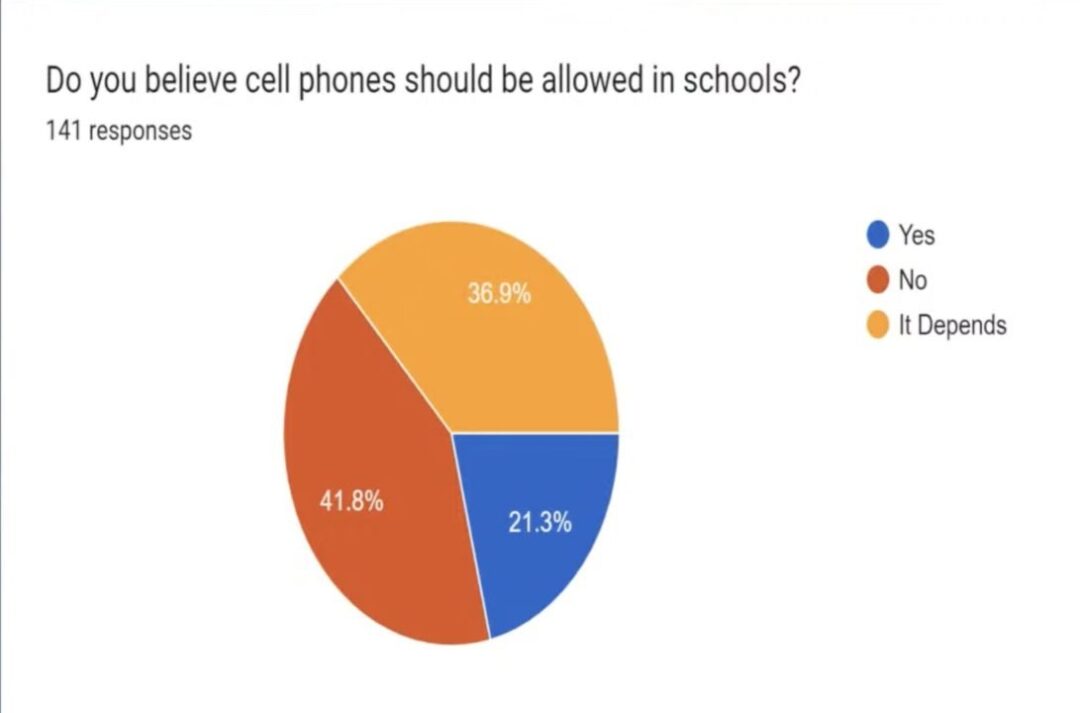
In answer to the general question, “Do you believe cell phones should be allowed in schools?” 41.8 percent of the 141 who responded said no, 21.3 percent said yes and 36.9 percent said “it depends.”
Sixty staff members elaborated on what they meant by “it depends.” Some suggested the school have cell phone lockers so students can’t access them during class. At the same time, students should have access to Chromebooks to access the technology they need for learning.
Some staff members thought students should be able to access their phones during breaks and lunch. Several suggested students leave their phones in their backpacks.
At least one person commented, “If teachers can’t put them away, students won’t.”
Emergency situations came out on the top of potential benefits of allowing cell phones in school, followed by communication with parents or guardians and access to educational resources.
Several potential drawbacks scored nearly equally: distraction in class, disruption of classroom environment, cheating/academic dishonesty and cyberbullying.
In a piece on the Today show on May 22, reporter Vicky Nguyen visited a school in Dayton, Ohio, where cell phones have not been allowed in the classroom this past school year. As students enter the school, they place their phones in manilla envelopes marked with their names and grades.
“A number of schools have passed bans,” said Ohio Governor Mike Dewine. “I think it’s the right decision.”
Nguyen interviewed the Spanish teacher who said that “it’s not enough to ask students to turn off their phones or put them in their backpacks. There are constant notifications, which interrupt the whole learning process. If it’s in the backpack, they know it’s there.”
The reporter spoke with four students about the policy. One boy said that, initially, he didn’t like it. “I was used to having it in my pocket. Taking my phone away was like losing a limb. At first, I didn’t see the reason for taking my phone but now I see the benefit in the classroom.”
The camera panned the school’s lunchroom, which was bustling with conversations. Now the students are talking with one another, playing games. Prior to the cell phone ban, the lunchroom was silent as every student was on their phone.
The Dayton superintendent of schools addressed parents’ concerns about not being able to reach their students in case of an emergency: “There have been emergencies throughout the history of school. We have always been able to contact parents.”
Early testing in the Dayton school system has already shown increases in reading and math in every grade from seventh through twelfth. They are seeing higher GPAs, fewer mental health consultations and a 40-percent decrease in bullying – something also seen in a recent study done in Norway.
Now, said the Spanish teacher, “they are being children. These are the last years of their childhood and we want them to live it.”
Any changes in Rim’s policy, Hansen said, “will not be done in haste. They will be well thought out. We want what’s best for the students, staff and community.”




0 Comments