



By Mary-Justine Lanyon
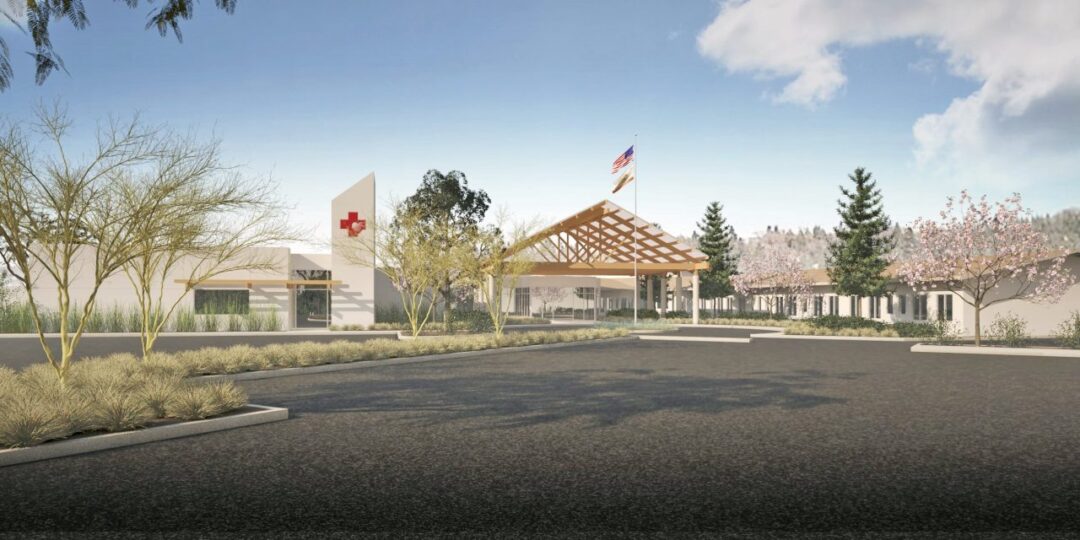
Senate Bill 1953 requires hospitals to comply with seismic safety building standards by 2030. To that end, Mountains Community Hospital has been working with JLL (Jones Lang LaSalle) on the design and with G.L. Hicks Financial on USDA funding for the project.
At a special public meeting on June 7, representatives from JLL outlined the three phases of the project.
Phase 1, explained Jay Gibson, will be a seismic retrofit of the existing hospital building. Phase 2 calls for the building of a new acute care wing. And Phase 3 will be the conversion of the existing acute care wing to additional rooms for the Skilled Nursing Facility (SNF).
The design work will take place between now and the spring of 2026, when JLL expects to see some “hard core” construction happening. “There will be barricades set up, traffic control and pedestrian protection,” Gibson said.
With any project this size there are environmental considerations. Brent McManigal of Fennemore Law said they have had to look at historical ramifications, tribal resources and any impact on endangered species.
“This is not a historically significant building,” McManigal said. “Its appearance over time has been lost by upgrades. It does not have significant cultural importance.”
In addition, he noted, “all construction will take place on previously disturbed land so there is no worry about endangered species.”
There have been conversations with both Yaamava and Morongo. “Both were very supportive,” McManigal said. “They have asked us to have monitors on site during ground-disturbing activities in case we run into any cultural items.”
As for the funding of this project, Gary Hicks is overseeing an application with the USDA for a 35-year loan, which will be at a fixed rate. He expects to get approval in the latter part of September 2024 at which time the interest rate will be set; the rate is currently at 3.5 percent. “This is favorable financing from an interest rate perspective,” Hicks said.
The USDA loan requires the recipient to be in a rural community with a population of 20,000 or less. The recipient must demonstrate the ability to repay the loan.
This debt – estimated at about $40 million – “will be secured by revenue from the hospital district,” Hicks said. “It will not be secured by taxes so residents should not expect any new taxes.”
This USDA loan is a “takeout” loan, not a construction loan, Hicks noted, “so the hospital will need an interim loan, probably from a bank. USDA has to consent to any additional debt incurred. “
The loan will include early payment provisions with no penalty.
The only disadvantages to the USDA loan Hicks sees are that it takes a long time – nine to 12 months – to secure commitment and the recipient has to comply with Build America Buy America act. All raw materials must come from the U.S.
Hicks said he hopes to secure funding from the USDA as early as mid-September 2024.
CEO Mark Turner pointed to several benefits to MCH’s patients, the SNF residents and the community.
“We will be able to serve more of the community,” Turner said. “We have a long waiting list for the SNF.”
The new acute care wing will have air conditioning, something that is absent in the current facility. Chief Operating and Nursing Officer Terry Peña noted that air conditioning is “really important when you have a fever and are not feeling well.” She also said the heating system, which is currently tied to the SNF, will be able to offer more balanced heat to all the patients and residents.
Peña also pointed to the hospital’s current lack of isolation rooms. “During COVID we turned the hallway into what we could for isolation. Beyond COVID, we always have patients who need to be isolated.” The new design will include isolation rooms.
In addition, she said, the nurses station is now separated from the patients by the fire doors. “We need to get the nurses closer to where the patients are,” she said.
Board member Gerry Hinkley told the panel he was interested in the possible disruption of SNF operations. “Can we maintain the current census?” he asked.
“The plan is you will be able to operate business as usual,” Gibson said. Hicks added that “there will be no work on the existing SNF unit.”
Hinkley also asked Hicks how comfortable the hospital board can be that they will be able to secure financing. “I feel very comfortable,” Hicks said. “I have had several conversations with the underwriter.”
Board member Cheryl Robinson expressed her concerns over parking during construction. “That theme has been a constant in conversations,” Gibson said. “We have some ideas about temporary parking and have two design proposals from the team. We are creating parking for us to stay out of the way of the hospital and for you to use as well.”
As for the indigenous people monitoring – a question raised by community member Barry Robinson – McManigal said that is a common request. “Their representative will be there, watching the digging. We pay for them to be there.”
Hicks confirmed to board member Barry Hoy that all the money will be federal, not state.
“I want to reinforce the board’s support of this project,” said President Kieth Burkart. “It meets our mission statement to provide high quality, essential care to our residents and visitors. We get positive feedback from people who come from elsewhere and get treated.”
Barry Robinson expressed concern for the amount of noise the SNF residents may hear. “The seismic work we’re doing is not sexy work, it’s noisy,” said Gibson. “We have to open things up. There is a fair amount of noise with structural work. But it won’t be 24 hours a day – less than eight.” Hicks added that “there will not be any seismic retrofit work done in the SNF; it will be in the adjacent building. There may be some overflow noise but not in the immediate area.”
The board voted unanimously to approve Resolution No. 2024-03, authorizing the submission of an application to USDA.




0 Comments