



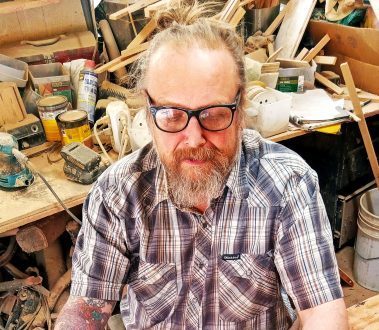
It’s very rewarding for me to take wood that’s destined for the chipper and turn it into something that’s both beautiful and useful. I view repurposing of natural resources as a high calling. – Graeme Gale
By TIM WILCOX
Special to the Alpine Mountaineer
Let’s begin with an important question: How the heck does this guy pronounce his first name, anyway? “It’s Gray-em, as in graham crackers,” he explains, adding, “My parents told me that it’s Scottish, which doesn’t explain anything, because we don’t have any Scottish people in our family.”
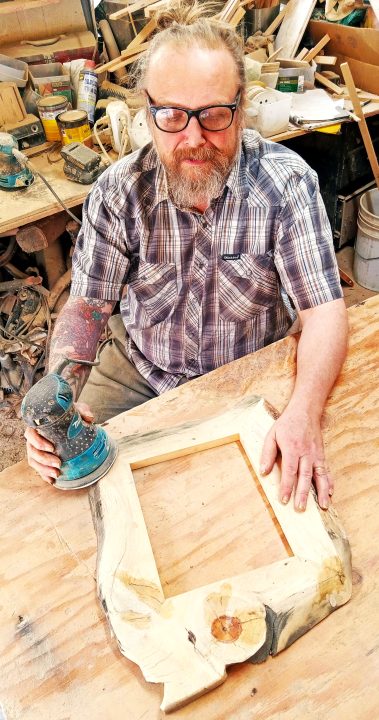
The artist invests hours every day in his garage workshop. Here he’s using an orbital sander to finish a sugar-pine frame. (Photo by T. Wilcox)
Graeme is actually British with an appropriate accent to prove it. He was born in 1963 in Brighton, England, a seaside resort some 50 miles south of London. His father was a truck driver and mother, a secretary/receptionist. He left school at age 16, which was quite common in those days, and got a job in a factory making glass slides for blood tests.
“It wasn’t exciting,” Graeme admits, “but I just wanted to get out into the workforce.” He tolerated the factory job for five years followed by three odd-job years. Then a stroke of good fortune: Graeme received an unexpected check from the mortgage company that had sold the apartment he’d rented. The windfall inspired him to undertake a trans-Atlantic adventure.
“I decided to buy a plane ticket to America and do some exploring,” he says. The year was 1988, when he was nearly 25.
Eventually he ended up in Los Angeles and got a job in a record store on Venice Boulevard. After working in several such stores, he landed at Record Rover, also in West L.A. and owned by Lisa Cook. From 1996 to 2001, she and Graeme ran that store.
Intense competition from large retailers, such as Best Buy, forced them to close the business and spurred the couple toward a completely new chapter. They got married in 2001 and the next year moved to Lake Arrowhead. They’ve been here ever since.
The MAN connection
Lisa is an accomplished and iconoclastic oil painter, with the female form and New Orleans being her primary sources of inspiration (Aug. 1 “Portrait of an Artist”). She and Graeme were among the founding members of the Mountain Arts Network (MAN) in 2006, with Lisa serving as vice president for three years.
“When we joined MAN, I wasn’t doing any art,” Graeme admits. “Instead, I was just there as a supporting spouse, helping move stuff and setting up the shows. But then one day Lisa asked me, ‘Can you make a frame for this painting?’ I said, ‘I have no idea, but I’ll try.’” He did and, eventually, was able to meet her exacting standards.
Another admission from Graeme: “I didn’t have any woodworking skills at the time. I was teaching myself, and it was basically trial and error. At first, I worked mostly with a hand saw and a drill. Then, when I discovered I could actually make something that turned out decently, I added other tools, such as power saws and orbital sanders.”
The stage was set for a subtle, but irreversible, transition from avocation to vocation. Graeme began visiting a wood yard in Lake Arrowhead and collecting scrap lumber. Now closed, it was just off Highway 173 between North Bay Road and Deer Lodge Park. “They allowed me to take anything that was going into the chipper,” he says. “That was much better than letting it go to waste.”
Then, laughing as he frequently does, the ponytailed artist explains: “There wasn’t really any downside. I could do all the experimenting I wanted and, if something didn’t turn out right, the worst that could happen is that I’d toss it in the fireplace.”
Unusual and eye-catching
Increasingly, however, his creations turned out more than merely right. They were unusual and eye-catching. Oh, and they attracted buyers as well.
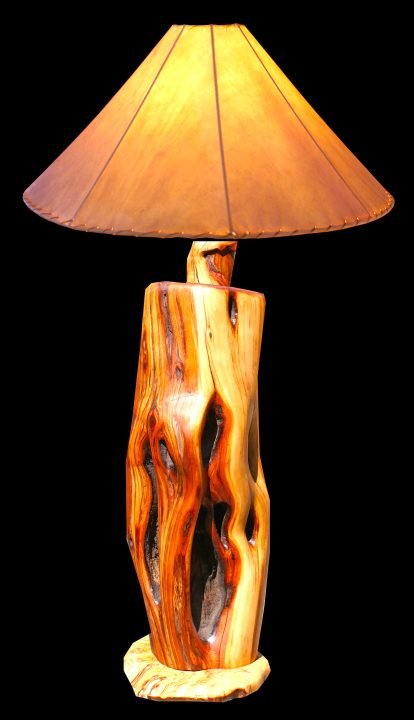
This lamp was made from a raw manzanita stump. The purple-gray bark was sanded off to reveal the interior golden brown, purple and blonde striations.
Graeme discovered the organic allure of manzanita and, for starters, began making lamps. “Useful manzanita is dead with a gray surface,” he notes. “But as I sanded it, I discovered much to my surprise that the wood underneath was different colors and really quite beautiful.”
His signature manzanita lamps started out as one-piece creations. Then they became more elaborate with various attachments. Each was not just unusual, but unique. The term “manufactured” was banished from Day One. “I haven’t even made two lamps that look exactly alike,” Graham insists.
That essential rubric applied (and still does) to the pieces that followed over the course of subsequent years: bookshelves, benches, chairs, tables and more. Scrap lumber – including pine, fir, oak and cedar – continued to be the primary ingredient with manzanita playing the role of non-scrap decorative sibling. Graeme finishes his creations with various stains and linseed oil. He also makes sure that they stay together.
“In the beginning I’d worry that everything was going to fall apart,” Graeme admits, “so I got in the habit of going a little overboard with wood glue and screws.” Sturdy is the operative term.
So is spontaneous. “I’ll step into my workshop, look at the wood and see what I want to do next,” Graeme says. “Again, I don’t order the lumber. It’s what’s available at the yard.” The technical term is “off-cut lumber,” and the current supplier is in Rimforest.
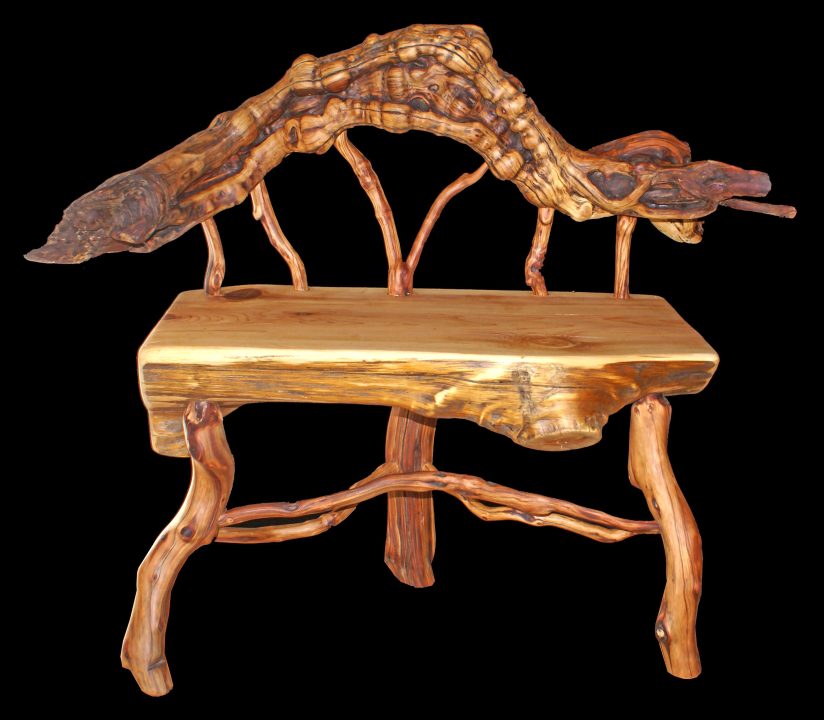
Graeme used rough chunks of manzanita branches for this chair’s strikingly organic backrest and sturdy legs. He crafted the seat from cedar wood. (Art photos by Lisa Cook)
Graeme’s art is profoundly practical. “I’d say that 95 percent of it is pragmatic,” he estimates. It’s the kind of thing that people use for everyday living. His creations are also conversation pieces: “Where did you get that lamp?” “Who made that chair?” “I’ve never seen a table like that before.”
He’s clearly conservative in the sense of not wanting lumber to be wasted. “It’s very rewarding for me to take wood that’s destined for the chipper and turn it into something that’s both beautiful and useful. I view repurposing of natural resources as a high calling.”
With a flair for the whimsical, Graeme collects pinecones and acorns in his yard, cuts them in half, glues them to old house-siding shingles and surrounds the assembly with a custom wood frame (still a major specialty). He and Lisa call these creations “Framed Yard Debris” and, according to Lisa, they sell really well.
The artist spends hours every day in his garage workshop, inspecting, envisioning, sawing, sanding, assembling and refining his creations. “I love being out here,” he says, “even on chilly days in winter. I listen to music – recently, from the 1930s and ’40s and also ’60s tunes that they called ‘Mod.’ I play my favorites over and over again, and I sing along.”
Graeme prefers keeping his garage door open. “But if it’s really cold outside or early in the morning, I’ll close it,” he says. “I don’t know what the neighbors think of my music and my singing!” Whatever the case, it’s a daily hands-on labor of love for the man from Brighton, England, with the distinctive first name.
Graeme Gale’s creations are on display and for sale at the MAN gallery in Lake Arrowhead Village; Hearth & Sage General Store in Crestline’s Top Town; and Artisans, Inc., in Big Bear Village. For email contacts, he relies on his wife’s address, lisalcook@charter.net.




0 Comments