




In many cases the key to excellent photography is not the high-end camera with more than 400 menu items and the ability to track a bird’s eye in flight. Instead, it’s the practiced and perceptive eye of the photographer. – Bryan Allen
By TIM WILCOX
Special to the Alpine Mountaineer
Visiting all 63 national parks in the United States is an ambitious and worthy goal. Bryan Allen is well on his way to achieving it. He’s been to 48.
The first was Rocky Mountain National Park in Colorado. Just out of high school at the time, Bryan had never experienced anything more than hills. He recalls waiting at the park’s entrance for a ranger to open the gate. That was shortly after sunrise, and the light on the mountains was magnificent.
It was a life-shaping moment—an epiphany—for this young man from Northville, Mich., just west of Detroit. He grew up in that small town, the youngest of four children. Bryan’s father was an engineer, holding degrees in mechanical, physical and chemical engineering. His mother stayed at home to anchor the family.
But back to the “epiphany” in Colorado: “That experience ultimately inspired me to move west,” says Bryan. So in 1978 at age 21, he left Michigan with a friend and drove cross country in a 1967 Rambler that he’d purchased for $99. His destination? Southern California. There he ended up for no particular reason in Venice Beach. “I’d never heard of it,” Bryan confesses. “But I found a cheap apartment and couldn’t have ended up in a better place.”
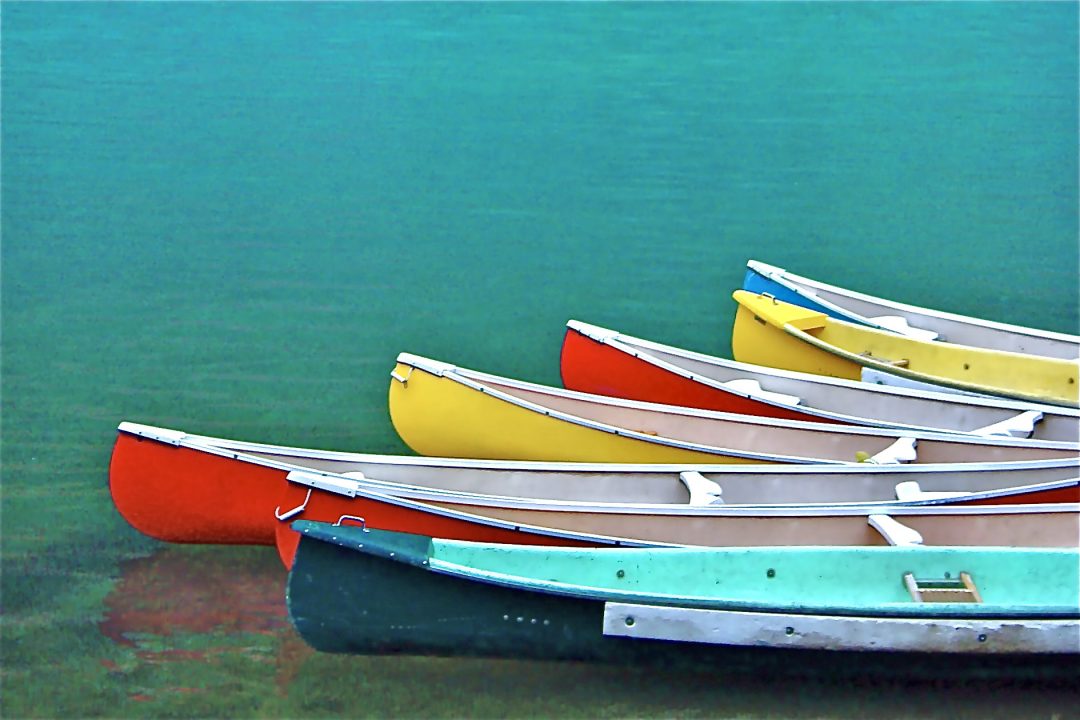
Polychrome canoes on still water at the Icefields Parkway in Alberta, Canada, are the subject of this image by the photographer.
Describing a circus-like scene on and near the beach, Bryan found the colorful and eccentric, but never boring, denizens to be endlessly entertaining. Initially, then, he avoided searching for employment and spent time exploring his environs, usually with a camera in hand.
“I had my first camera when I was 11,” he recalls. “Then I got serious about photography in high school, taking classes in the subject and using the photo lab a lot.” (Eventually, he’d take more courses in photography at San Bernardino Valley College.)
A job on ice
Inevitably, the bon vivant lifestyle had to end. So the winter-sports-savvy Michigander found a job at an ice-skating rink in nearby Culver City. Teaching skating and coaching hockey, Bryan made a favorable impression on the proprietors, who had previously owned the old open-air ice rink in Blue Jay (now the site of Rite-Aid). Sharing with his bosses that he’d love to live in the mountains, Bryan secured a referral from them and, sure enough, was hired in 1982 to manage the Blue Jay operation. Interestingly, he rented a home in town owned by a Culver City co-worker whose husband played Col. Klink on the TV comedy Hogan’s Heroes.
When the original Blue Jay rink closed, Bryan moved several hundred yards east to the Ice Castle (now the site of Lake Arrowhead Community Services District headquarters). He was a manager there for many years and actually ended up coaching ice hockey and teaching power skating in several locations – including Blue Jay, Riverside, Ontario, Pasadena and Van Nuys – for a quarter century. His most well-known student was actor Russell Crowe.
All this time the photographer in him was alive and well. With national parks on the agenda, Yosemite, Glacier Bay and Denali (the last two in Alaska) are his enduring favorites. Besides nature photography, he continued capturing candid shots of individuals, recalling with a quick laugh that “Venice Beach really changed me.” Chuckling again, he adds: “When you see someone juggling a bowling ball, a peanut and a chainsaw, you’re never the same again!”
He was able to sell some of his outdoor images, character studies and even shots of people’s pets. “At least I could pay for my camera equipment,” Bryan says.
Significantly respected photographer
How did the obviously skilled hobbyist become a significantly respected photographer? “More and more people began encouraging me to show my work,” Bryan says. So about 12 years ago, he was juried into the Mountain Arts Network (MAN) gallery in Lake Arrowhead Village. Bryan and his images have been a prominent presence there ever since.
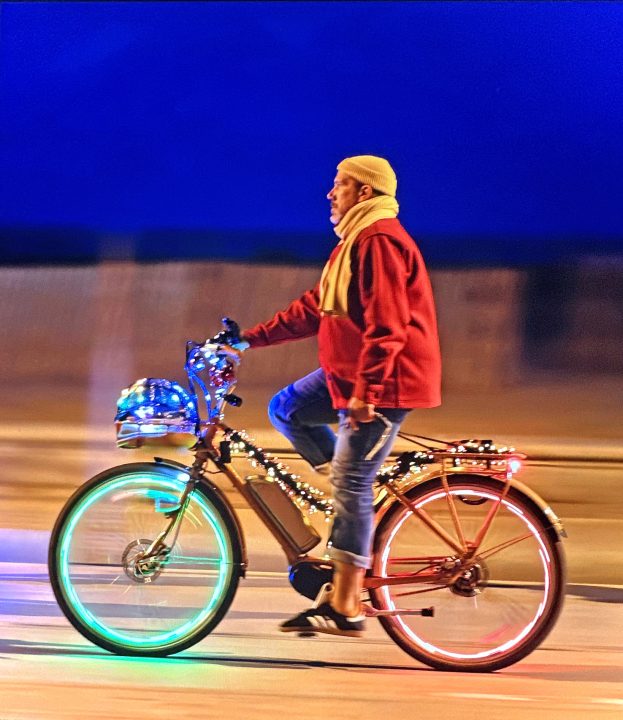
Seizing the moment of photo opportunity, the artist captured a colorful cyclist peddling along a beach sidewalk in Santa Monica.
Photos of natural settings and idiosyncratic individuals are mainstays, of course. Many are whimsical, too. Bryan mentions an image of a child’s wagon filled with liquor, aptly titled “On the Wagon.” Then he shows his visitor a shot of a giraffe leaning over a tall fence and stretching its neck to the grassy ground below. Next there’s a photo of a hefty splash-contest contender followed by a canine peering out of a car window and appearing to be at the wheel. He also shares more serious and striking shots of birds of prey, an enormous owl, canoes in placid water, roads winding to distant vistas and more.
None of these images is posed. Instead, they’re spontaneous. According to Bryan, the secret is always having a camera ready.
On a more intentional business note, Bryan is the official photographer for portable ice rinks that are set up in various locations such as Riverside, Los Angeles and San Francisco during November, December and January. Those operations as well as ice-skating shows on Royal Caribbean ships are part of Willy Bietak Productions, owned by a famed Austrian skater and Olympian.
What’s most challenging for this artist, as far as the process of photography is concerned? Bryan ponders for a moment, then responds: “When it’s a candid shot, taking out some of the things that are distracting, such as a bright light, a telephone pole or a wire. That requires painstaking work with sophisticated photo software.” He accomplishes this task at the studio in his Crestline home, which boasts splendid views of the San Gabriel Mountains to the west.
Bryan mentions that digital cameras, which he uses exclusively now, are increasingly complicated. “I count at least 400 items on my Sony,” he says. Then, poised to make a crucial point, Bryan declares: “In many cases the key to excellent photography is not the high-end camera with more than 400 menu items and the ability to track a bird’s eye in flight. Instead, it’s the practiced and perceptive eye of the photographer.”
Goal-oriented as ever, the artist must visit 15 more sites to complete his in-person sweep of the country’s national parks. He’ll have his complicated camera in hand, of course. Even more important, he’ll be equipped with an exceptionally keen eye for the interesting, the unusual, the beautiful.
Bryan Allen’s photography is on display and for sale at the MAN gallery on the lower level of Lake Arrowhead Village. Contact him at photobryan@ymail.com. Bryan’s also a member of the Mountain Arts Photographic Society, a MAN affiliate. Visit the group’s website at www.mountainartsphoto.com.


0 Comments