



By RHEA-FRANCES TETLEY
Historian
John Rowland of the Workman-Rowland party, which arrived in 1841 to Mexican California, was more interested in his other businesses than personally operating his sawmill on the mountaintop, so he hired Jonathan James to be the sawmill’s manager. James then hired a large crew to harvest the stand of sugar pine trees on what became known as James Flat (now under Lake Gregory), named because James was the first lumberman in the area.
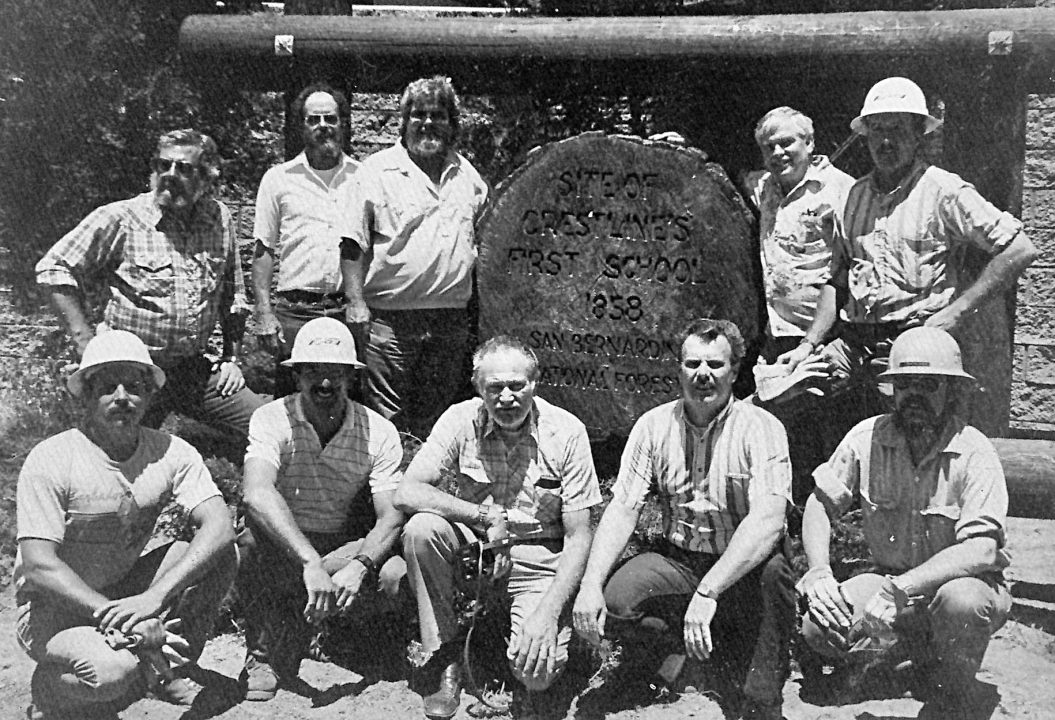
The second of three monuments placed honoring the first school. This one was installed in 1990 by the Crest Forest Historical Society assisted by the Edison crew who replaced a previous log monument marking the location of Crestline’s first school started by Jonathan James. Standing (l-r): Larry Bonham, Kent Dunn, Richard Guill, Tom Powell and Charlie Clifford. Kneeling: Lee Deckerhoff, Vince Jacobo, Dan Staple, Dennis Cole and Lou McGahan.
Jonathan M. James was an immigrant from Tennessee, whose lumber camp was reportedly pleasant, well-ordered and well-fed. He lived at the sawmill with his wife and four young boys, a daughter and a yellow dog.
Within a few years, James bought into Rowland’s operations, creating the Rowland-James sawmill. The two-year-old Salamander Mill, also on James Flat, burned in 1854, was rebuilt and burned again in 1859. James Flat was later called Huston Flat when Huston began a lumbermill there. Decades later, Arthur Gregory operated a box sawmill there, removing the remaining trees before he flooded it with Lake Gregory. James moved the sawmill to the Little Bear area (today’s Blue Jay) after he finished his first cut through the area.
Because education was a priority for these loggers, the James Sawmill set up a classroom for the James’ and any other logger’s children, hiring a school teacher in 1858, initiating education in the mountains and becoming the first documented school in the mountain area. J.J. Willis, the brother of San Bernardino Judge Henry Willis, was initially hired by James as a bookkeeper and log scaler for the lumbermill, but became the teacher during the “sawing season,” as he was well qualified.
J.J. taught in a plank and log cabin built as the school, between 1858-1860, on James Flat and then, when the sawmill moved to the Little Bear Valley area, the school was relocated, too. The James children were so well educated that they attended universities when they grew up. The James Mill schoolhouse was located somewhere close to the current location of the Huston Flats electrical substation (where the monument is on Lake Drive in Crestline). (Since 1850-60s logging roads were temporary, with no relationship to current day roads, exact locations are imprecise.)
A baby daughter was born to a worker’s family at the James Sawmill on Sept. 3, 1859. The James family was saddened when their 8-year-old son was crushed by a falling tree. Mrs. Jonathan James delivered another daughter, Margaret, on Jan. 12, 1861.
Many were marooned on James Flat by the 1862 Noachian flood, which also washed out the Mormon Lumber Road. James moved his operation to Little Bear Valley in 1865, setting up a steam-powered circular sawmill, near today’s Blue Jay. The school and mill were also moved. When James was elected to the California Assembly in Sacramento in 1867, he sold his sawmill to Caley, Jonathan Richardson and Issac Roper for $3,000 in gold coin, plus one-third of the lumber cut for three years.
In 1869, when returning from Sacramento, James entered into a partnership with Dr. Dudley Dickey, building the first Grass Valley sawmill. Six months later, he sold that sawmill to Reuben Anderson and Barnabas Carter. This Grass Valley sawmill was the one eventually sold to the Tyler Brothers.
Dr. Dudley Dickey was also president of the Mountain Turnpike Company and with engineer Edward Daley, they were responsible for the building of the Twin and City Creek Turnpike (aka Daley Canyon Lumber Road) used for transporting lumber off the mountain’s “mid-range” through Daley Canyon to Del Rosa, opening in 1870. The Little Bear Valley sawmills thrived only because of the Daley Lumber Road.
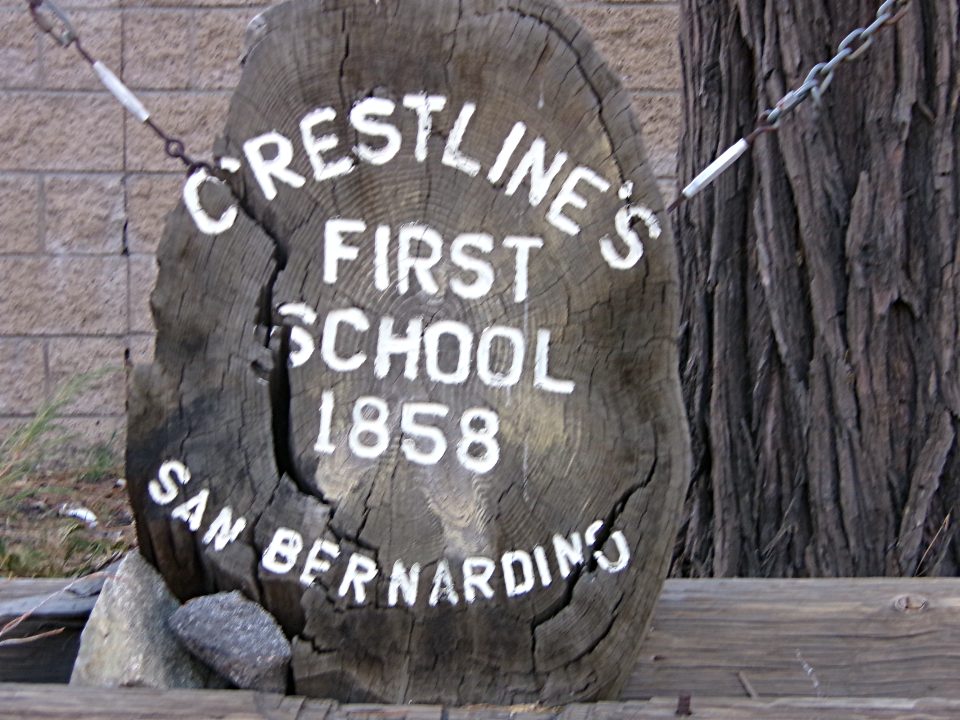
The current monument marking Crestline’s first school located in front of the Huston electrical substation on Lake Drive in Lake Gregory Village.



0 Comments