


By RHEA-FRANCES TETLEY
Historian
Part 2 of 3
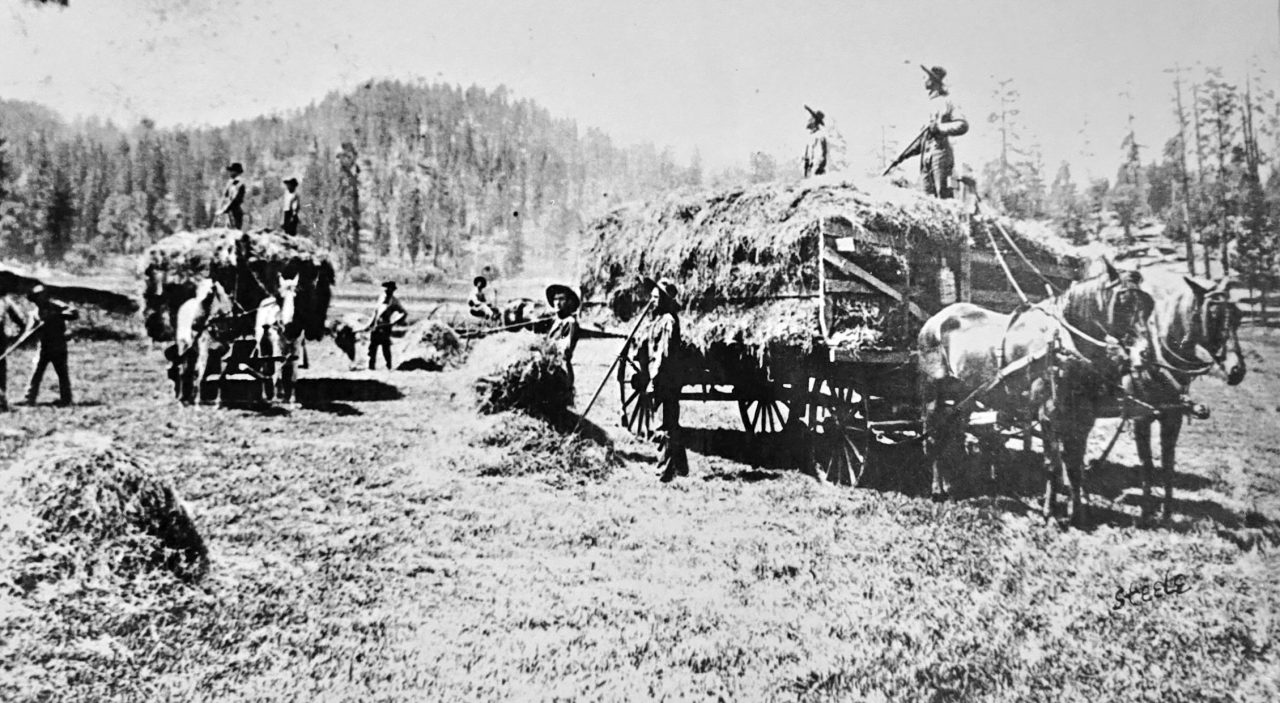
Harvesting hay for the working animals of the Talmadge Sawmill.
Francis (Frank) Talmadge led a life of adventure, hard work, financial success leaving a legacy impacting the mountain area into the middle of the 20th century.
Talmadge worked in and helped others build their sawmills while he earned enough funds to open his own. He lived year-round in the mountains with his wife, Nettie, and children, including John (aka Peg), the first white baby born in Little Bear Valley.
The January 1867 burning of Bill Caine’s cabin (not far from Talmadge’s own family cabin) and the burning of the Benson-Pine Sawmill by a hunting party of Piute Indians, who were angered because the loudness of the sawmills scared away the game, distressed Talmadge. He quickly organized Caine, Jonathan Richards and George Armstrong, chasing the Indians on horseback. They caught up to eight of them between where the Willow Creek tunnel and Hamiltair Peninsula are today. Shots were fired and Caine’s horse was shot out from under him, causing him to lose his rifle in the snow. Talmadge hid behind a large tree, shooting and killing a Paiute. This angered the Indians even more.
Another Indian, believing Talmadge would not have enough time to reload, leapt out at Talmadge, preparing to fire on him, but Talmadge’s “Foxsong,” a two-barrel shotgun, killed the surprised Indian instantly. The Paiutes retreated and the lumbermen returned to Talmadge’s, fortifying it while Richards took the back roads down to San Bernardino to summon help.
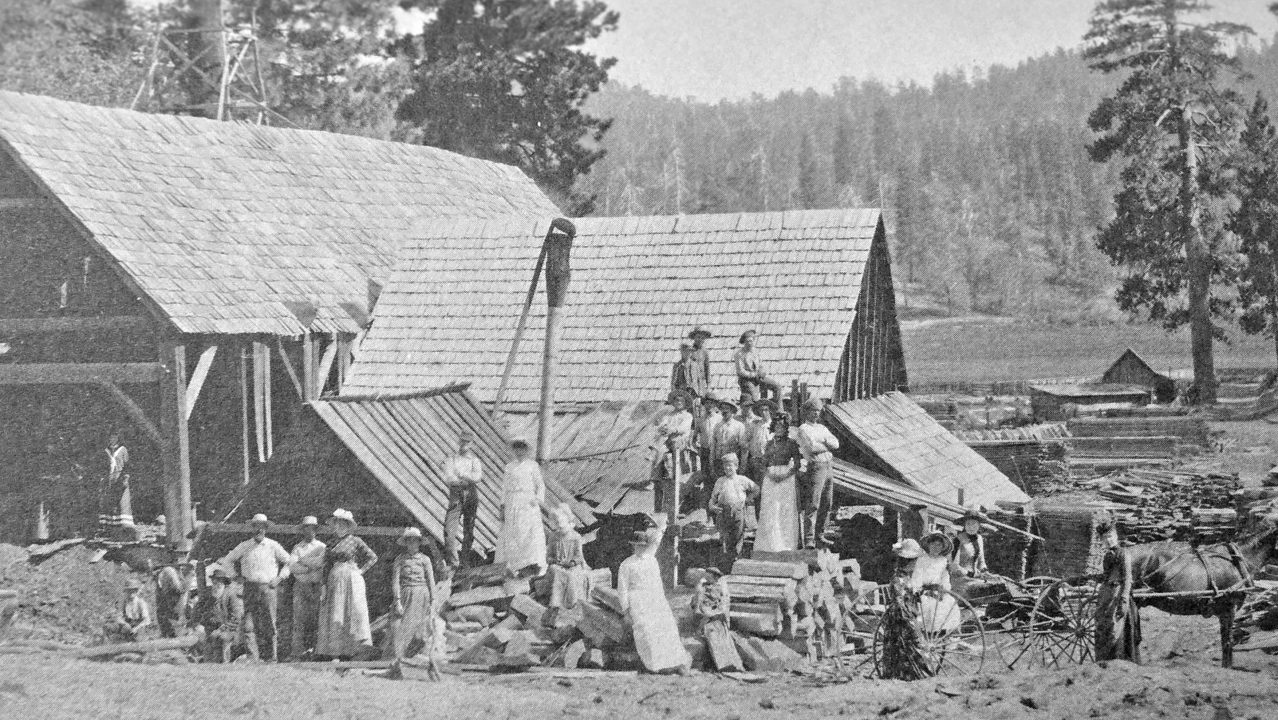
The Talmadge family sponsored many parties and barbecues over the years. This is a family photo taken at the sawmill in the 1870s, showing many family members and friends up for a weekend of fun. In the background is Little Bear Valley, now 150 feet below the surface of Lake Arrowhead.
A small search party the next morning discovered Caine’s rifle and the location of the Indians. With reinforcements, Talmadge’s “army” of about 10 lumbermen found 50 to 60 Paiutes returning to the area, climbing up a ridge above Little Bear Creek. Over 100 shots were fired during the Battle of Indian Hill.
During the battle, two lumbermen were wounded: Bill Caine, with a ball in his leg, and John Welty, with an arrow to the shoulder. One Indian was killed, with about six injured before they retreated to the desert. The lumbermen returned to Talmadge’s sawmill to tend to their wounded. This was the last time the Paiutes returned to the mountain area. The sheriff removed all the other Indians from the mountains a couple weeks later.
Talmadge filed timber claims on another 320 acres of land, located in Little Bear Meadow, that cost him $1.25 an acre, for a total of $400. By 1876, he had 980 acres of land he was haying, sawing and living on. In October, he held a gala house-warming and mill-raising party where folks came to help raise his new mill frame.
The highlight of 1879 was the wedding of Talmadge’s daughter, Edna, to Charles Daley, son of Edward Daley, patriarch of the road building family in Del Rosa. Edward Daley had built the Daley Canyon Road, which linked Little Bear Valley sawmills directly to the valley below, in 1870.
The next year, after he’d built a new house for his wife, Nettie, and their six children, Talmadge held another party, inviting everyone from the mountain to attend. The Talmadge parties were always festive affairs, as they often built a dance floor and had music.
The Talmadge Sawmill was a real family operation. By 1886, Talmadge had all three of his sons managing various operations at the mill. Will, the oldest son, (aka Teet) was in charge of loading the logs onto the solid-wheeled logging wagon, moving them to the mill. After the wood was milled, middle son, John (aka Peg), had the duty of transporting the lumber down the narrow Daley Canyon Road to San Bernardino. Frank Jr., Talmadge’s youngest son (nicknamed Fish), was in charge of the day-to-day operations of the sawmill.
Next week, the conclusion on the life of Frank Talmadge.



0 Comments