



By RHEA-FRANCES TETLEY
Historian
Did you know that two Crestline roads are named from William Knapp’s lumbering days? Obviously, Knapp’s Cutoff is named after Knapp, but who was he?
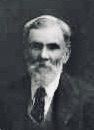
William Knapp
Knapp lived 30 years in the San Bernardino Mountains, ranching and lumbering. He permitted the lumbering companies to use that shortcut over his land to get from Seely Flat to Huston Flat and beyond. He was well-known as a rancher, lumberman and fighter for what was right and not being ripped off by large companies.
Born in New York in 1840, William and older brother Albert established a big cattle ranch on the Old Salt Lake Trail, at Vegas Station, where Las Vegas is now.
Vegas Station became a supply and resting stop from 1864 to 1879 for the freight wagons between Salt Lake and San Bernardino. There Knapp met Sheldon Stoddard and other freight teamsters, living a real western life including interactions with Native Americans. His friendship with them saved many a freighter from encountering “Indians problems” on the trail.
He moved to Nevada City, Calif., and then to the San Bernardino Mountains around 1883. Knapp was known for his excellent ranch in the mountain area near Huston Flat, growing three kinds of apples, including the Ben Davis; the Kentucky Red, which were solid deep crimson in color; and an apple that was reported by the San Bernardino County Sun newspaper to be “12 to 15 inches in diameter, the Hartford Green. It had a firm texture, a fine flavor and was perfect to keep or ship. The Ben Davis is nearly as big and a perfect beauty, with a pure white skin and, here and there, a blotch of bright carmine.” He also raised green egg-plums and was known for selling fresh fruits and vegetables to the camps, lodges and inns from the 1890s to the 1910s.
In 1895 Knapp objected loudly to the Arrowhead Reservoir Company’s toll road rates at a San Bernardino County Board of Supervisors meeting. He had attended numerous rate hearings on the toll road as the owner of the Knapp and Baker Lumber Company and traveled it often, down from his ranch. Knapp knew the supervisors had reduced the road’s toll rate; however, in August, he claimed the toll gate operator had “held him up” by not charging the reduced toll and he was “plum agitated.”
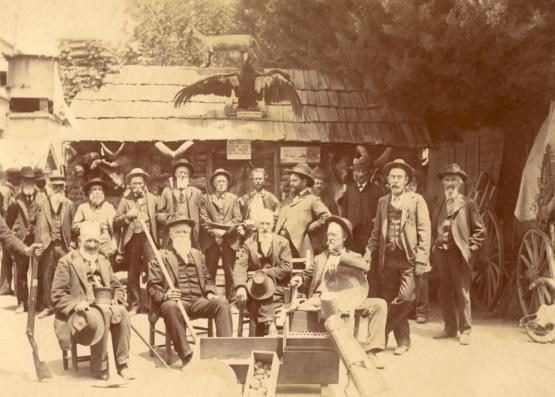
Pioneer cabin in Lugo Park
“I don’t wear no ‘spenders, but I still notice that my pockets is light enough that it don’t require no belt to hold up my pantaloons after I get through that gate,” Knapp complained. The courts had thrown out the supervisors’ rate reduction, so they could do nothing.
Knapp was an active member of the San Bernardino Society of California Pioneers for approximately 30 years. It was from Knapp’s sawmill that the logs for the Pioneer Society’s log cabin were obtained. Pioneer Society members (including John Brown, Sheldon Stoddard, J.B. Smithson [owner of Smithsonia, which became Pinecrest when purchased by Dr. John Baylis in 1906] and others) went to his mountain ranch to cut pine trees to build the log cabin for the 1908 “Festival of the Arrowhead of San Bernardino.” After its construction for the festival, the cabin became the Pioneer Society Museum in Pioneer Park, burning in 1973.
Knapp invited the Pioneer Society to camp on his property during one of their yearly summer mountain campouts, resulting in the naming of Pioneer Camp Road.
Knapp’s Cutoff, is still used over the divide between Lake Gregory Village and Valley of Enchantment, through Knapp’s former property.
William Knapp died in March 1913 at the age of 72 and was buried in San Bernardino after a Pioneer Society funeral, next to his son, John, who died in 1886, and an adopted son who died in 1906.



0 Comments