




By RHEA-FRANCES TETLEY
Historian
The Highland Mill was built in the early 1890s by the Danaher brothers. They had to build a road with a trestle bridge over a deep gorge to get to the previously inaccessible virgin timber area near current day Running Springs. They had hoped to build a train track up the mountain to transport the lumber, but the deep gorge canyons and steep grades made that impossible. Instead, they built a bridge, the most modern sawmill on the mountain and continued to purchase as much land as they could. This over-extended their credit.
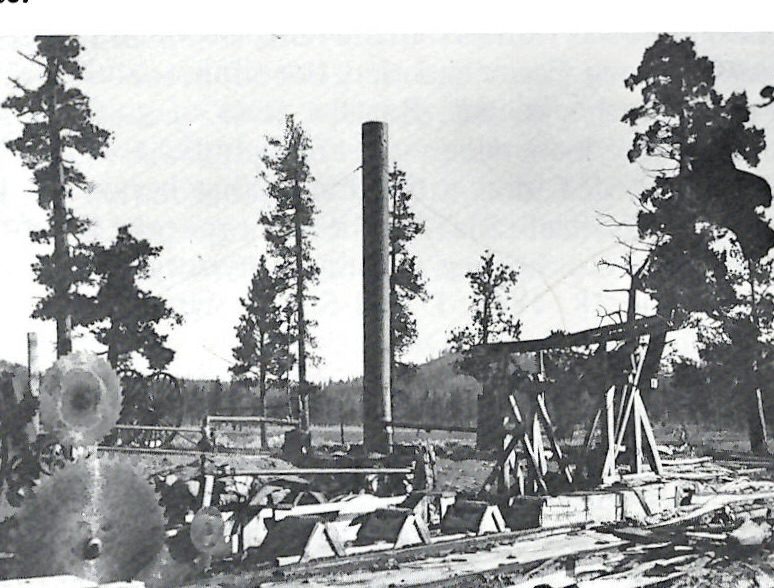
The Danaher Lumber Mill before the roof was built.
The third cut of lumber was used to build housing for the approximately 100 employees before winter set in. The rest of the lumber was hauled down the new road to build a box mill in Highland, next to the Molino Train Station on the Santa Fe Rail Line, which served the citrus growers in the Highland area.
Despite the heavy snows in January 1892, the Highland Mill was already producing 35,000 feet of lumber per day. Unfortunately, the new sawmill’s roof collapsed under the heavy snow load. The mill was re-roofed and lumber production continued. Most of this cut of wood went to build the Molino Box Factory. The boxes were built to pack the citrus fruit from the Highland area for shipment.
Finally, in the spring of 1892, the Highland Lumber Company Toll Road, up City Creek, after smoothing over the rough spots, was opened to the public. The toll was 25 cents per animal and 50 cents for a wagon and team. It quickly became popular, but it could become a terrifying experience for those tourists who discovered themselves encountering a fully loaded sawmill wagon lumbering down the steep upper road sections without much braking power. With the opening of the road came the establishment of the Danaher Post Office on April 23, 1892.
Concurrently, with the City Creek Road being built, the Knight and Metcalf Wagon Road through Green Valley to Fawnskin on the north side of the new and filling Big Bear Lake was under construction with the intention of connecting with the City Creek Road. The road to Big Bear Valley was opened in May 1892. The two roads met at a spot near the Long Point Highland Sawmill, near the future town of Fredalba.
The Highland Mill suffered greatly under the heavy debt load caused by the massive capital improvements necessary in building the road ($50,000) and the mill, plus $50,000 for the new 260 hp steam engine, the construction of the company town and paying their employees. Unfortunately, they were only cutting 35,000 of their potential 60,000 feet of lumber per day.
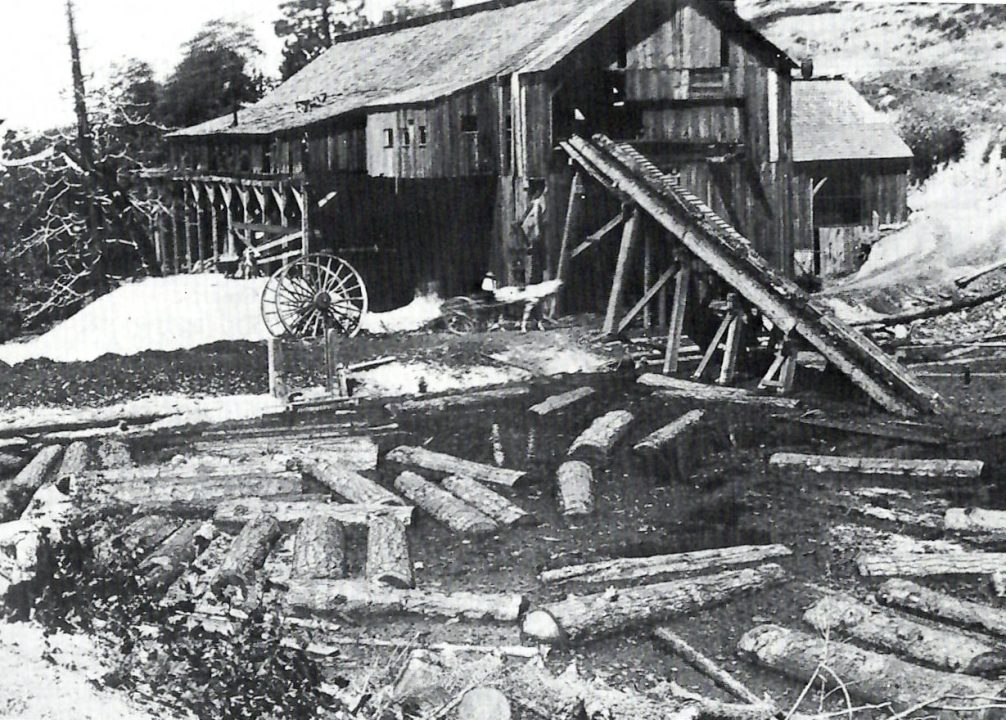
The enclosed Danaher Highland Mill.
The interest payments on the Danahers’ loans were burdensome. The national economic depression of 1892-93 was also a factor, which forced the replacement of Highland Mill President C.D. Danaher by Louis F. Ward. But this change in management did not solve the underlying financial problems. The mill ceased operations at the end of 1892, only one year after opening.
Albert Smiley, from Redlands, rode up the City Creek Road and decided, in 1895, to purchase 262 acres of forested land from the Highland Mill. The Smiley brothers already owned the famous Mohonk Resort in the Adirondack Mountains of upstate New York and decided to build a similar resort about a half mile east of the closed Highland Mill for his son, Fred, to manage. The resort was named Fredalba Park (a combination of Fred and his father Albert Smiley’s first names).
In 1899, the sawmill’s shareholders sold the Highland Mill, the Molino Box Factory, City Creek Toll Road and 6,000 acres of land to a Michigan corporation, the Brookings Lumber Company. The Danahers later successfully opened another sawmill on the American River east of Sacramento.



0 Comments