



During The Gilded Age, persons of wealth had access to most anything they wanted; they created clubs and organizations to associate with others of their class and interests. As the Arrowhead Reservoir irrigation project was begun, the creation of the Arrowhead Mountain Club was suggested at the announcement banquet. Members from wealthy families who wanted their vacation clubhouse and cabins to afford them a luxurious stay while in the mountains created the Squirrel Inn resort.
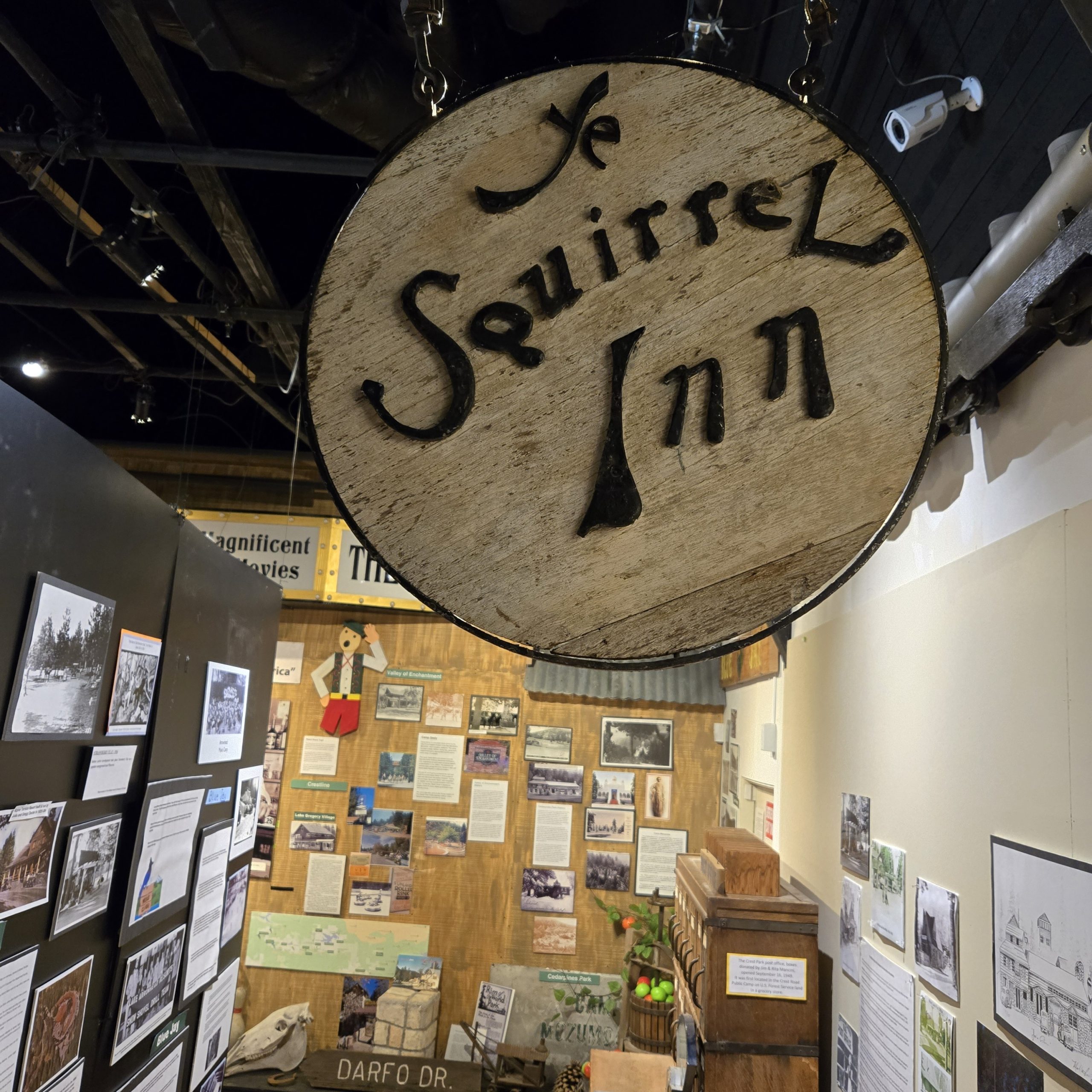
The round Squirrel Inn wooden sign is on display at the Mountain History Museum.
The 1892 Squirrel Inn clubhouse/lodge, built with wood from the Grass Valley Sawmill, was inspired by the Arrowhead Reservoir Company officers so, with the building of a better mountain access road and the establishment of the forest preserve, the members had a perfect resort destination. Its concept and location were inspired by a phrase in the popular book The Squirrel Inn by Frank Stockton, who wrote a novel about the elite visiting the mountains to “enjoy rusticating during the summer.” The Squirrel Inn was built at the “point of the last valley view,” along the Arrowhead Toll Road.
The main lodge building was built as described in the popular novel, with the location and view as the Squirrel Inn in the book, with family-owned cabins built around the central lodge building where the cooking and dining room were located. It had a private smoking room for the men and a sitting room for the ladies, both off the central assembly/living room.
The Squirrel Inn became renowned as the West Coast’s “Aristocratic Haven of the Gilded Age.” The annual club dues were $500, which included a stable for their horses, with grooms and meals in the central dining room, with top quality chefs. It was considered “too common” to have cooking facilities within one’s own cabin.
The Squirrel Inn building itself was built of logs squared off on three sides, leaving the round, rustic bark for the exterior side with nice, smooth interior walls that were securely weather-tight. The corners of the buildings were stacked log cabin-style. The gables of the building and the roof had cedar shake shingles. Upstairs were guest rooms for visitors.

The squirrels were revered as sacred objects at the Club and used as décor on the mantle and once a year on the dining tables during the annual Changing of the Squirrel Dinner.
The Arrowhead Mountain Club and Squirrel Inn were known for the stuffed squirrel hanging from a pole, next to the Squirrel Inn sign. Each second Saturday in August, a ceremonial “Changing of the Squirrel Dinner” was held, installing a new stuffed squirrel to the sign. Then the squirrels were displayed on the mantle, as “sacred objects,” an idea stolen directly from Stockton’s book; the number of squirrels equaled the number of years of the club’s existence.
The Squirrel Inn was considered picturesque and was lavish in its architectural design. It was featured in the August 1898 edition of The House Beautiful magazine. The magazine considered itself “a magazine for art and artisanship.” It described the interior décor, using oil lamps and heating cabins with woodfires and using blue and brown denim upholstery, with elegant Japanese carpets, rustic furniture made by local artisans and a multitude of mounted animals befitting the hunting lodge theme. The massive granite fireplace and mantle were impressive from the moment a visitor entered Squirrel Inn. Usually, there would be a fire going, with “a kettle on” for the weary traveler or local visitor.
Over the mantle, there were pictures of President Harrison and Secretary Noble, along with the “pen that signed the Forest Preservation Act of 1893.” Also decorating the lodge were huge pinecones, a stuffed great horned owl, a pair of snowshoes and a gnarled knot of oak, which resembled a buffalo head.
The Arrowhead Mountain Club members considered themselves conservationists, pointing with pride to hosting naturalist John Muir during his tour of the Forest Reserve, along with Clifford Pinchot, chief forester of the National Forest Reserve. They hosted another Forest Commission visit in 1896.

Each year a new squirrel was created and kept, each labeled by year, 1895-1904.


0 Comments