




When Chief Daniel Munsey of the San Bernardino County Fire Department wanted to create a Forestry Fuels Management unit within the department, he knew just who to call.
“Chief Munsey wants County Fire to help improve both the county’s interaction and its participation with all of our other partner groups and agencies,” said Assistant Chief Peter Brierty, who is heading up the new unit.
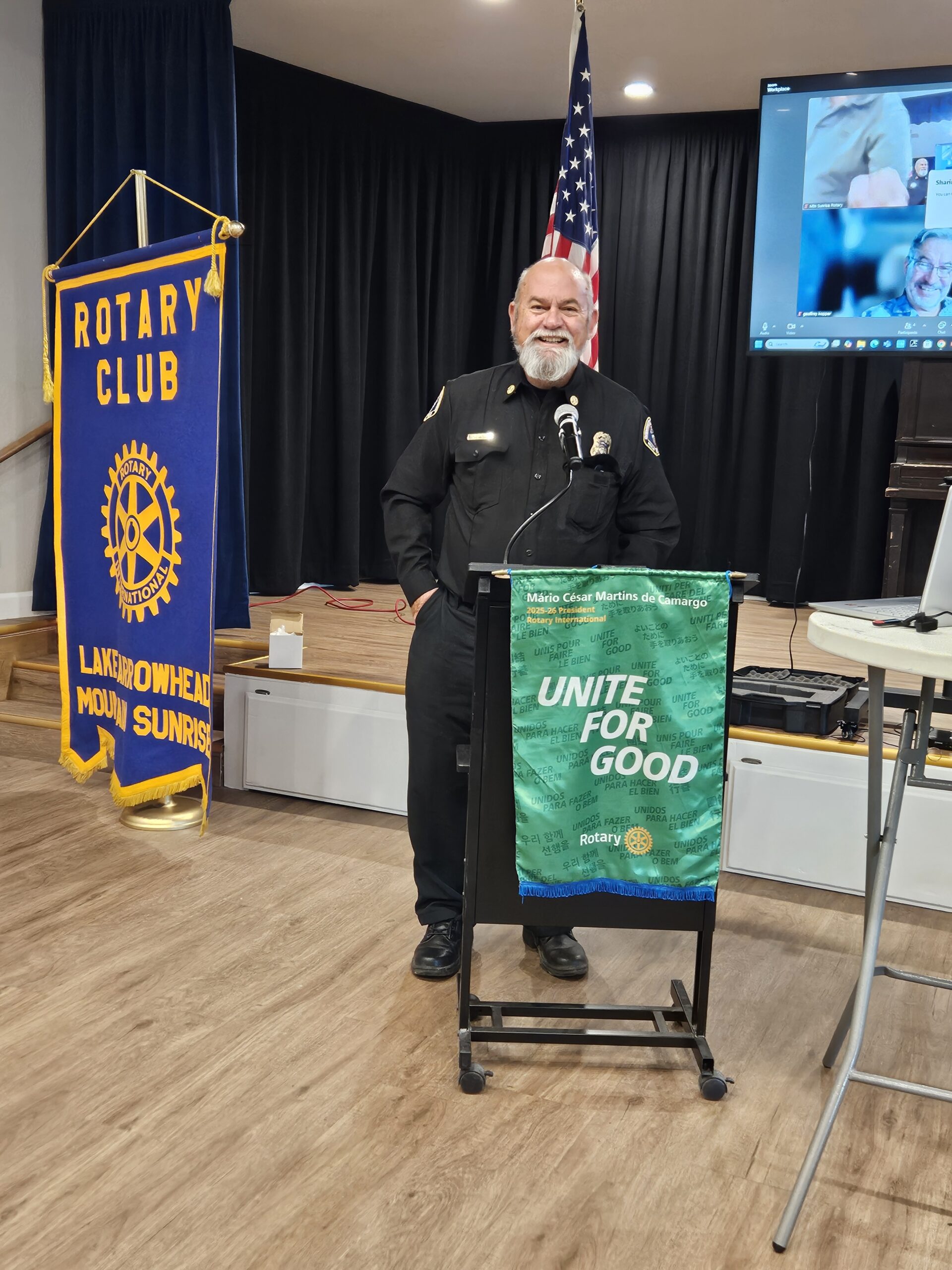
Assistant Chief Peter Brierty has been tapped to create a Forestry Fuels Management unit with County Fire.
Chief Brierty addressed the Mountain Sunrise Rotary Club, sharing with them the thinking behind this new unit.
“Fire doesn’t look at little yellow lines on a map,” Chief Brierty said. “It doesn’t observe administrative lines.”
He referenced the Mountain Area Safety Taskforce, created years ago by Cal Fire’s Glenn Barley and his counterpart in the Forest Service. “When you come into a meeting,” Brierty said, “you leave your shoulder patch at the door. We have to work together.”
What the agencies discovered after the Old Fire in 2003 was that the debris from that fire ended up down the hill. The Forest Service, Brierty noted, is part of the Department of Agriculture. The Natural Resources Conservation Service (NRCS) is a sibling agency. “If their job is to keep soil where it should be,” Brierty asked, “why do we let the forest burn and let soil go elsewhere?”
The NRCS’ response was that they had not considered that – “let’s see what we can do,” Brierty reported them as saying.
But how could that be accomplished? The answer, Brierty said, is to thin the forest.
When a fire burns hot, he added, it “glassifies” the soil. What you get is compacted debris flow, which is like concrete.
Several years ago, when a group came to Brierty saying they didn’t want loggers in their community, saying that “they destroy everything,” Brierty took them to an area behind Strawberry Peak. “They said this is what a forest should look like,” Brierty said. His response: “This is a finished project. This is what we do. If you do it right, you prevent air pollution and reduce the potential for catastrophic flooding.”
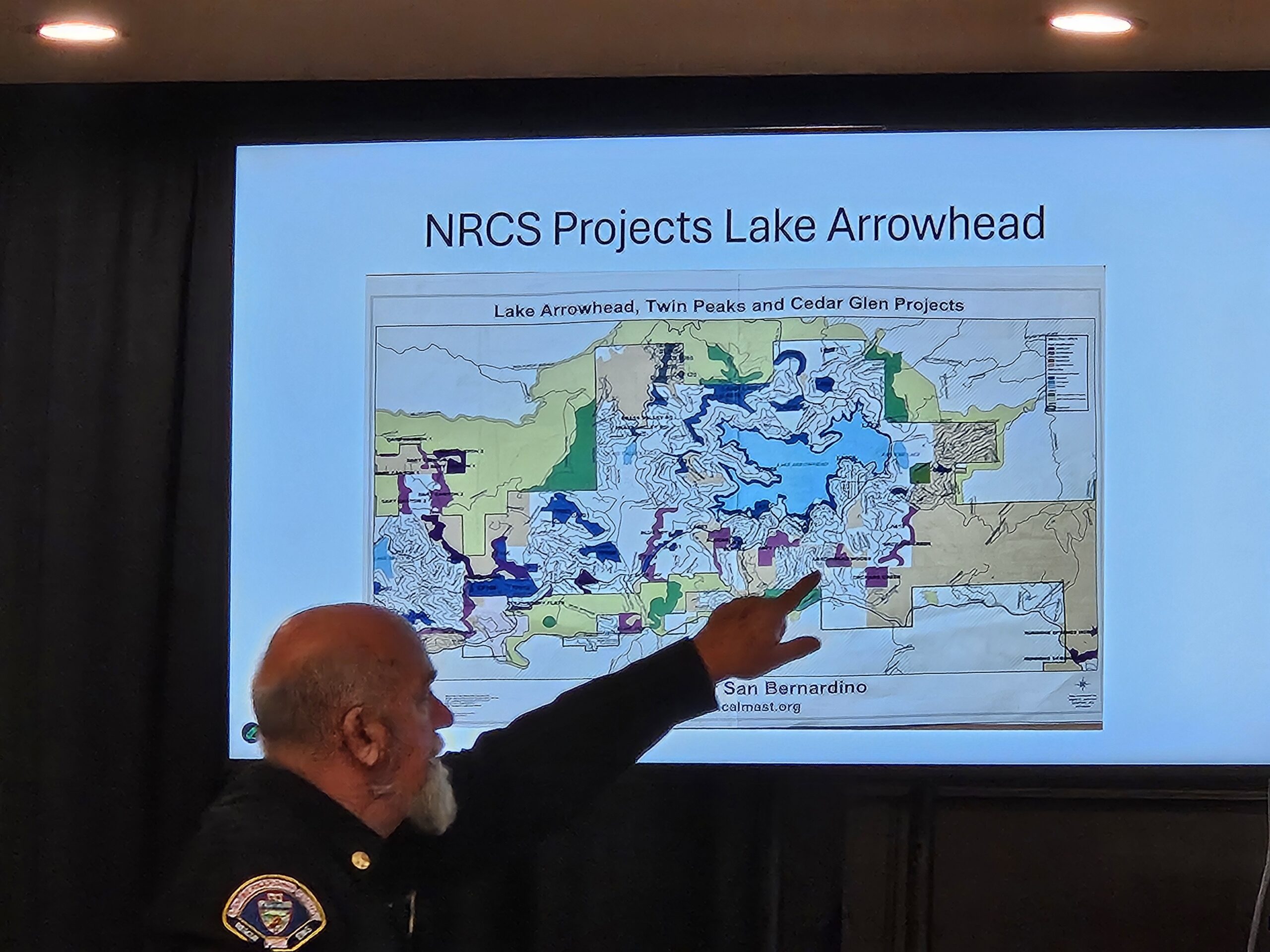
Peter Brierty points to some of the NRCS projects taking place on the mountain.
Brierty told the Rotarians that, when a house burns, all the plastic inside the house burns, releasing toxic chemicals. “We need to stop houses from burning and reduce the pollution that comes from fire. How to do that? Keep fire out of the forest – keep the forest healthier by thinning.”
He praised the work of the Mountain Rim Fire Safe Council and its president and CEO Laura Dyberg. “Laura has given us the idea we’re all in this together – one person’s property affects another person’s property. A key thing is to get property owners to say yes, come on my property.”
The Forestry Fuels Management unit will be looking at all large parcels of forested land, Chief Brierty said – federal, state and local where the wildland interface poses a threat to homes.
“Is there a more catastrophic predictable disaster other than wildland fires in California?” the chief asked. “How preventable is an earthquake? How predictable is a tsunami? Wildland fire? Look out the window.
“The sooner we all get to thinning the forest and making it healthy and more fire safe – where it isn’t choked with fuel – the closer we will get to keeping our homes from burning.”





0 Comments