



By RHEA-FRANCES TETLEY
Historian
During the 1880s in the area now known as Cedar Glen, the Hanks Sawmill was operating on the creek. John Hook homesteaded the upper end of that creek in 1882, building his home there, naming it Hook Creek, which flows into Deep Creek, one of the major water feeds for the east fork of the Mojave River.
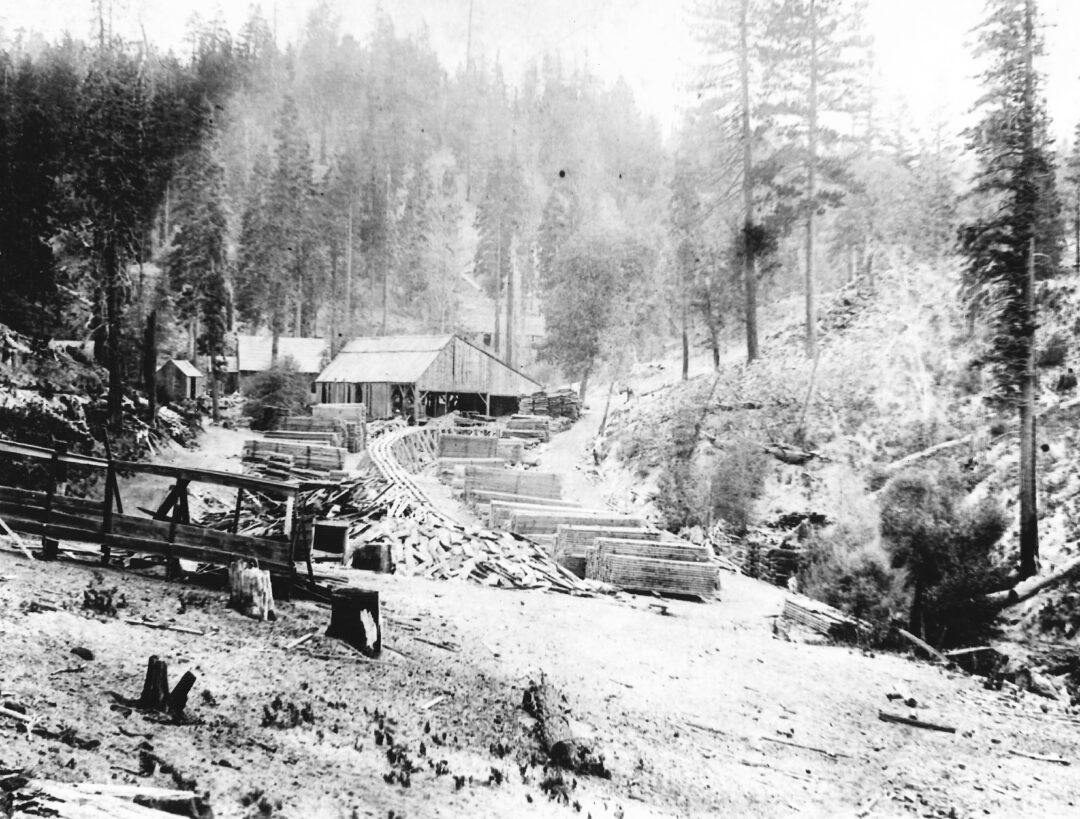
The Hook and Suverkrup Sawmill on Hook Creek
Hook partnered with younger John Suverkrup in 1888. Suverkrup converted Hook’s circular fencepost and shingle sawmill into a full lumber mill that year and they begin cutting 10,000 feet of lumber a day. By 1890 the Suverkrup and Hook Lumber Mill had hired 20 men and the mill was processing 25,000 feet of lumber a day, opening a lumberyard in San Bernardino at the corner of “F” Street and First Street to sell their lumber at wholesale and retail prices.
Suverkrup’s honorable, square dealing methods were the keynote of his life and, with his charming personality, this led to prosperity and respect. He joined the Pioneer Society and the San Bernardino Chamber of Commerce. In 1894 Suverkrup married Emma Williamson; they had three sons – Herbert, John and Fred.
The Arrowhead Reservoir Company was operating Camp Comfort near Hook Creek, housing the workers of the Little Bear Dam Project who were drilling shafts into the ground to collect water. One shaft was 13 feet in diameter and was cut 70 feet down into the bedrock. Then lateral tunnels were dug 461 feet to the east and 421 feet to the west. A second shaft was dug at Shake Creek, 150 feet deep with a lateral tunnel dug by hand toward Hook Creek, where a flume was planned, to divert the water into the irrigation reservoir for San Bernardino instead of to the Mojave River.
In 1909, the Deep Creek tunnel to redirect the water into the Little Bear Reservoir was using an electrically powered air compressor to speed up the digging. After the Riparian Water Rights Law was passed, this diversion of all Deep Creek water which supplied the Mojave River motivated the desert landowners to file lawsuits for stealing their water.

An ad for Suverkrup Lumber Company
Meanwhile, after a 20-year partnership, John Hook retires, selling his mill and lands to Suverkrup, who closed the sawmill in 1910 but continued running Suverkrup Lumber Company. Part of the 640 acres Suverkrup bought from Hook included the bluff overlooking the future reservoir.
Little Bear Lake owner James Mooney loses the Riparian Rights lawsuit in 1913, so he changes his project’s focus, investing $20 million additional dollars into creating a private fishing resort.
As the lake fills, in 1916 Suverkrup advertises 55 Cedar Glen lots “facing beautiful Little Bear Lake for sale for $150 each.” These are the first private property lots sold at the lake.
James Mooney died in Ohio during the 1919 flu pandemic; his descendants sell the lake for $650,000 to the J.B. Van Nuys investor group, aka the Arrowhead Lake Company. Suverkrup dies March 9, 1922, at age 71.
The Cedar Glen Resort becomes a popular 1920s tourist destination with mail delivery by rural Star Route #3 until 1939 when the Cedar Glen post office is established. After WWII, in 1946 Cedar Glen’s Happy Face Malt shop opens and more homes are built.
The Santa Anita Turf Club, which purchased Lake Arrowhead in 1946, begins donating land to nonprofits including the Forest Lawn Scout Camp and Mountains Hospital as they prepare to sell Lake Arrowhead in 1958.
After the 1971 Sylmar earthquake, the California Department of Safety of Dams checked every dam in California, declaring the Lake Arrowhead Dam was potentially unsafe, threatening to lower the lake 70 feet unless a solution was found. The solution to the dam problem was the 1975-1977 construction of the downstream Papoose Lake dam which noisily affected the serenity of the Cedar Glen area.
The 2003 Old Fire burned a swath of homes in Cedar Glen, including the Wildhaven Wildlife Rescue Center and destroyed the area’s water system. Unfortunately, many property owners were under-insured with multi-generational family-owned homes. They were prevented from rebuilding on their small 1920s size lots, as the county had increased the minimum size of a buildable lot. Cedar Glen continues to recover 22 years later.
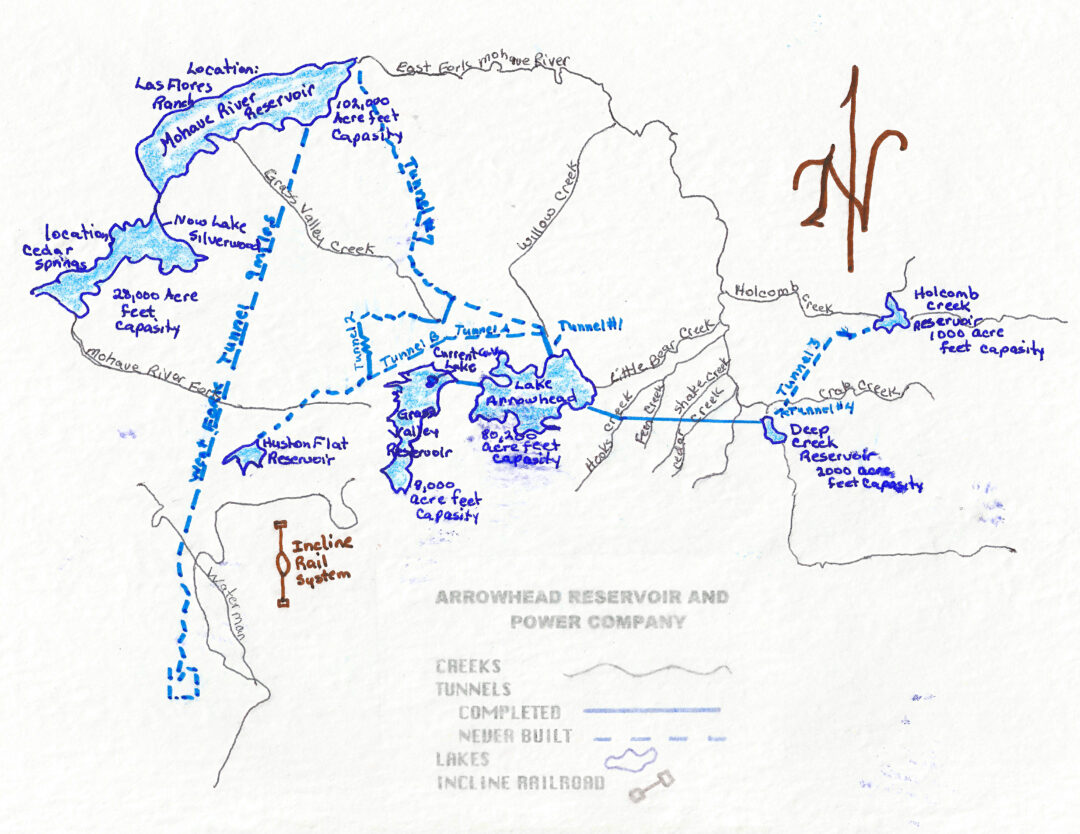
Map showing the proposed seven-lake project for the Arrowhead Reservoir Company and the Hook Creek tunnel designed to consolidate as much water as possible to send to San Bernardino for ARC’s irrigation project.



0 Comments