



By RHEA-FRANCES TETLEY
Staff Writer
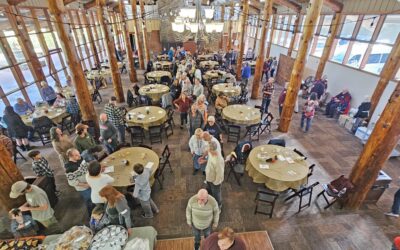
Lake Arrowhead’s Lake Valve Project held an interesting and detailed public informational meeting on Saturday, November 8 at the Burnt Mill Beach Club, discussing the various alternatives and opportunities that may be available to Lake Arrowhead property owners now that the state has demanded repairs to the lake’s valve/drainage system for lake and downstream safety. The orderly meeting was well-received by the public, the committee and the consultants who came well prepared.
About 35 interested residents attended the meeting in person, while another 32 attended by way of Zoom. Many questions were asked on how the project, depending on which of the various options are chosen, will affect lake use and residents, and how soon. Also attending were consultant representatives from JCB and Associates, Schnabel Engineering and Kimley-Horn, for financing options.
The ALA Valve Replacement Committee is attending a meeting in Sacramento, along with the Schnabel Engineering Company that they have hired, with the California Department of Water, Division of Safety of Dams (DSOD) on November 12, where they will discuss the current status of the dam, what is already known about its outlet valves, what is unknown, and some of the considerations of ways to get the repairs that are required accomplished. This meeting, with all the slides and power-point information and photos, is available for viewing at their website ALA-CA.org. on the Valve tab.
The state has a legal mandate to make all dams in the state safe and Lake Arrowhead Dam is unique in so many ways, with two dams and its long-complicated history which totally affects the current situation. In 2016, the DSOD was charged to make all dammed lakes in California have “outlet capacity.” Lake outlets must have the capacity to lower a lake’s level by 10 percent in seven days and 100 percent in 90 days, which would be about 1,222-acre feet per day for Lake Arrowhead. The 10 percent goal would lower the lake about 15 feet. Lake Arrowhead does not have any real water release capacity at this time at all.
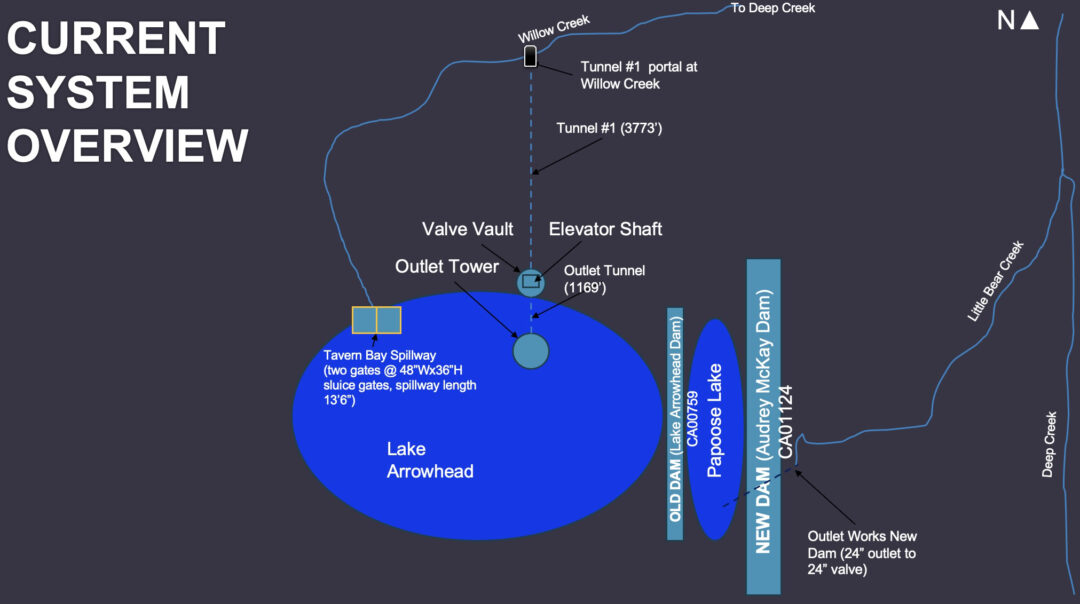
The lake was initially designed for sending all the water to San Bernardino, through the outlet tower and tunnel #1. The only water release from the lake now is through the Tavern Bay spillway, built after 1973, to keep the lake from flooding the properties surrounding the lakeshore. There was never a plan for lowering the lake level, since a full lake is best for recreational use.
The 130-year history of Lake Arrowhead’s reinforced cement core dirt dam began its construction project in the 1890s as an irrigation project to send water to San Bernardino. When that was ruled illegal in 1914, a transition to a private recreational lake was made, because the lake was already filling. ALA was formed in the 1970s when the dam was found not seismically sound. The construction of Papoose Lake and dam was chosen as the solution to that crisis, it was explained, creating the CSA-70 Dam commission and the Tavern Bay overflow spillway.
The fact that ALA owns the dam and the land around and under the lake, plus the outlet tower, tunnel #1, and spillway gates at Willow Creek will make this valve repair different than most, as this is privately owned land; this is not normal around most lakes. Also, privately owned land would need access permission. Rarely are two functioning dams located so close to each other, so that is another consideration. Although the past is well-documented, the current functioning status of these facilities requires additional investigation.
The private lake is vital to the area, providing drinking water for Arrowhead Woods and surrounding areas. It is a jewel for the area, providing recreational opportunities and driving tourism. Lake Arrowhead received from the DSOD in 2018 the first notice of its concern over the outlet deficiencies, just two years after the water outlet requirement became law. The lake hired Tetratech to issue an Outlet Valve Assessment report in 2020, but it didn’t satisfy the state. The valves are old and rusty and the old system, even if it worked well, may not drain the lake swiftly enough, nor completely, said James Bellis of JBC and Associates.
Juan Sorenson said Schnabel Engineering has previous experience with the DSOD. Sorenson outlined several of the challenges in meeting the DSOD requirements, discussing the options and choices that may satisfy the DSOD to meet the water release demands.
Some considerations that will not completely solve the DSOD’s requirements that have already been considered and found to be inadequate individually, include replacing the old valves, creating a siphon system or a pumping system or extending the spillway and increasing its capacity. Buying out the downstream property owners also won’t satisfy the DSOD, who want the water release flow requirement met.
They are currently in Phase One of the four phases needed for the completion of this repair The entire project may take a decade or longer.
Phase One is Alternatives Analysis; during this time they are examining various alternatives and the feasibility to complete them, and doing a risk analysis of possible solutions to choose the best one for Lake Arrowhead’s unique situation. This will take much more investigation of current facilities and development of proposals and options. At the end of Phase One, the solution method will be chosen. Lake Arrowhead has a high hazard dam, because of its proximity to the San Andreas fault, so some FEMA money may come this way as part of a mitigation plan, or a state grant for part of the expense.
The four primary alternatives being considered at this time during Phase One are subject to DSOD review and changes and other alternatives that may also need to be considered:
- Option 1: Use a new pipe to connect to the existing portal, but bypass the tower, remove everything in the valve vault, and with a new pipe send the water to tunnel 1.
- Option 2: A new pipe tunnel would tie into Tunnel 1, downstream of the valve vault and tower, bypassing both.
- Option 3: Connecting old Lake Arrowhead Dam and Papoose Lake. Papoose Lake would be drained, and a new tunnel would be added to create an outlet from Papoose Lake to the downstream side of Lake Arrowhead Dam. This would create a hydraulic connection between the two dams/lakes and allow Papoose Lake to refill. Required DSOD outlet draining would flow through Papoose Lake. (Concern was raised of failure of the old dam during construction and working so far below the water level, which would require any divers to spend three hours to return to the surface.)
- Option 4: Build a a new bored tunnel from the toe of new MacKay Dam to wet tap into Lake Arrowhead lake itself, upstream of old dam, thus bypassing both dams as a direct drain outlet.
During this first phase they will be researching the quality of the current tunnels, valve vault and other current equipment and their viability. The DSOD will make the final decision as to which option is advisable, and then ALA will weigh in with cost and impact to residents being significant factors.
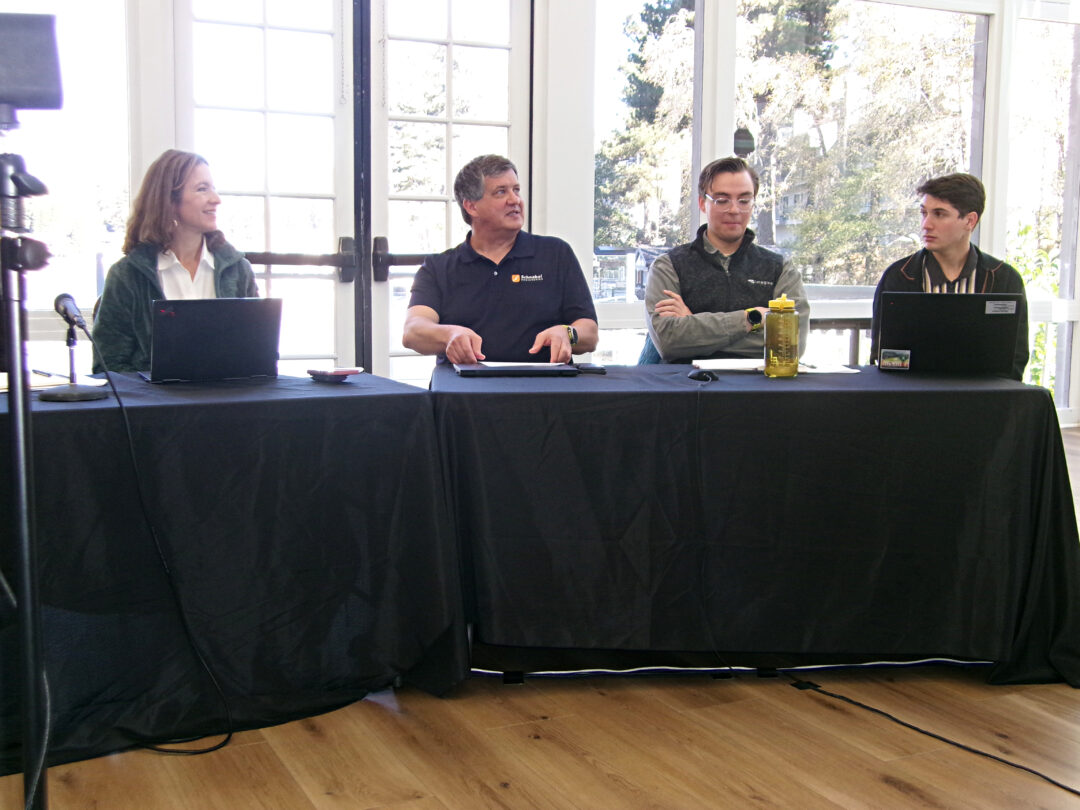
Several consultants who contributed to the meeting.
Phase Two will be the design stage, where after the method has been chosen all the engineering drawings will be completed and approved, this is before a true cost estimate can even be realized. The ALA will be trying for grants and other financing options as all four repair scenarios under consideration at this time are complicated and quite expensive.
It was explained by Tami Bailey of Kimley/Horn that a not-for-profit such as the private Lake Arrowhead Association may have difficulties getting federal FEMA funding. But since California Proposition 4 has passed, Lake Arrowhead may qualify for part of that $1.3 billion, since the ALA has already previously applied for $232 million, which is considered 49% of the program costs at this stage, as part of their resiliancy programs for safety. Since San Bernardino County and the mountains were declared a disaster area a couple years ago, there may also be some funding from that for planning and design to mitigate future disasters. Lake Arrowhead is not a public lake and there is every intention to keep it that way, so public funding is not an option.
Phase Three is the environmental and permitting stage, where all CEQA, and NAPA environmental concerns are addressed and permits are obtained from the California Water Quality (Lahontan) Board, California Fish and Wildlife, U.S. Army Corps of Engineers and other local, county, state and federal agencies. This could take a significant period of time as each agency does their own independent investigation.
Phase Four is the construction stage. ALA and Schnabel will offer guidance in selecting the contractors and sub-contractors and oversee construction, then verify the repairs are made to the specifications.
Audience member Walter Dishell wanted to know how his daily use of the lake will be affected by these proposed repairs and what about his property values? There will only be short parts of construction causing any disruption, since this is mostly being done underground and any lake work would hopefully be done during the winter when most boats are off the lake. This repair should improve property values because, if the dams were to fail, all the water would drain away, as would property values.
Scott Rindenow wanted to know what scenario would trigger the reduction in lake level and if nothing occurred who would be endangered. The answer given was that, if an earthquake occurred and the dams fail, there are 30 homes downstream that would be flooded and the lake would self-drain. The DSOD has a concern for all life and the environmental damage caused by all the silt behind the dam. It is safer with the double dams, but the lake can’t be drained deep enough, so this mitigation repair is required by law. The probable worst case is the lake would need inspection after a major earthquake and maybe drained 15 feet after that to eliminate possible dam failure. It would then be inspected by the state DSOD. If it passes the inspections, it would be allowed to refill. The lake receives its water from snowmelt and rain.
Richard Savage, president of Sunrise Rotary, lives below the MacKay Dam, which holds back Papoose Lake on Little Bear Creek. He says four families live there fulltime and 13 others live there part-time since they lost some residents and homes during the Old Fire.
To just drop the lake level by 10 percent or by 15 feet would not solve the problem, as the deep part of the lake would still not be drainable and the loss in value of the docks from the smaller lake surface would be greater than fixing the outlet valve situation. In fact, because of the depth of the lake (185 feet), even dropping the lake level 50 feet would not be adequate to satisfy the DSOD.
To update the old dam to new earthquake standards would also not solve the problem, as the 115-year-old dam would need to be totally replaced and the lake would be required to be drained during that type of construction, which would be very disruptive to the residents, and even more expensive that the other options.
ALA will be providing frequent updates on this Valve Replacement Project. This is an Arrowhead Woods problem, not exclusively an ALA problem, as all in the area will be affected by this situation.
After the meeting, conclusions were that this was a very informative meeting of the various aspects of the problem and proposing possible solutions that, although expensive, are doable. The meeting was positive, with information on what has occurred in the past and the DSOD’s requirements and possible solutions so far brainstormed. Those attending the meeting seemed satisfied by the responses so far and the proposed direction that ALA is pursing under the direction of the DSOD guidelines.
For additional information, see the ALA-CA.org website and see their many answers on many issues, including this Valve Project topic, where this whole Zoom meeting is available for viewing.


0 Comments