



By Mary-Justine Lanyon
The fourth- and fifth-graders at Charles Hoffman Elementary School were full of great questions.
The occasion? A visit to the school by two guest speakers, one of whom had attended CHE.
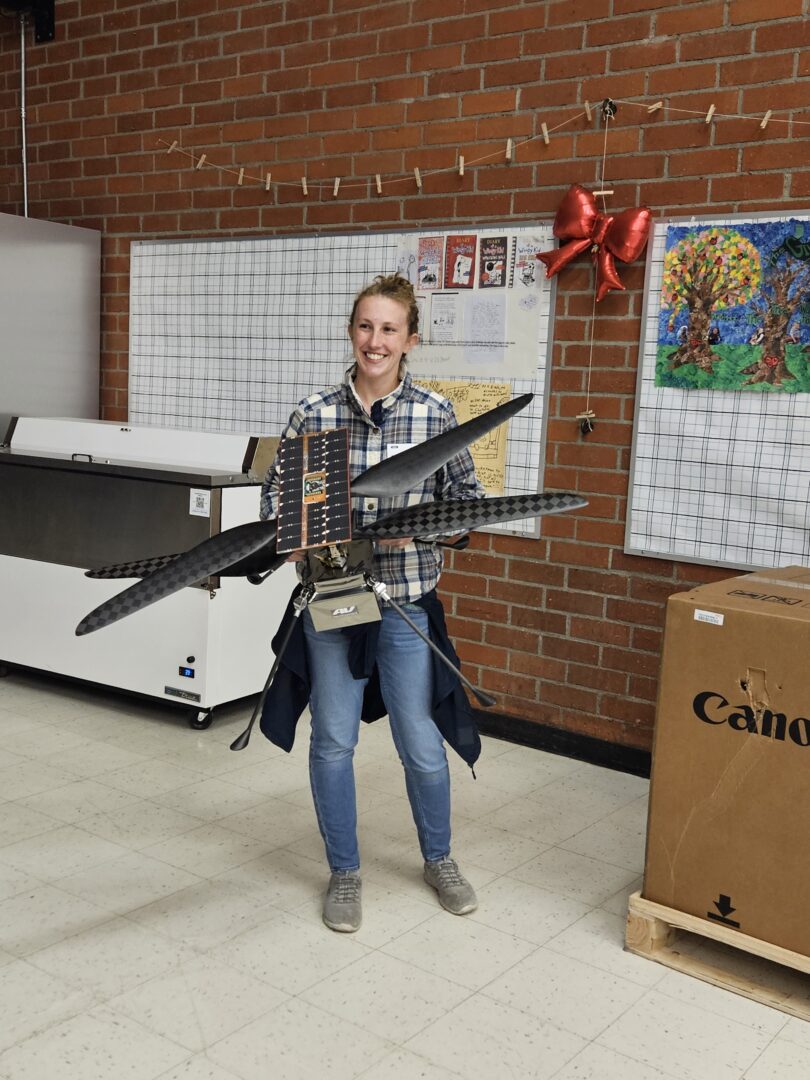
Paulina Ridland – the former CHE student and Rim High graduate – was joined by her fellow engineer Jeremy Tyler from AeroVironment to talk with the students about Terry.
Terry is a replica of Ingenuity, the helicopter developed by NASA’s Jet Propulsion Lab and AeroVironment. Ingenuity is currently on Mars, having been taken there by the Mars Rover Perseverance.
“What are the challenges of exploring on Mars?” Ridland asked the students? One student called out, “Oxygen.” Ridland told him he was right as the atmosphere on Mars is so thin it is difficult to create lift.
“There are a lot of issues with unpredictable weather,” Ridland added. But Ingenuity and Terry both have big blades to capture air. Since the helicopter has to be very lightweight, those blades are made of a Styrofoam-like material covered in carbon fiber. On Mars, Ingenuity performed the first flight ever in the atmosphere of another planet.
When one student asked why there is interest in studying Mars, Ridland said that Mars is the closest planet to Earth. “It doesn’t take as long to get there,” she said, noting it took Ingenuity eight months. In addition, Mars is similar in size to the Earth, just a bit smaller.
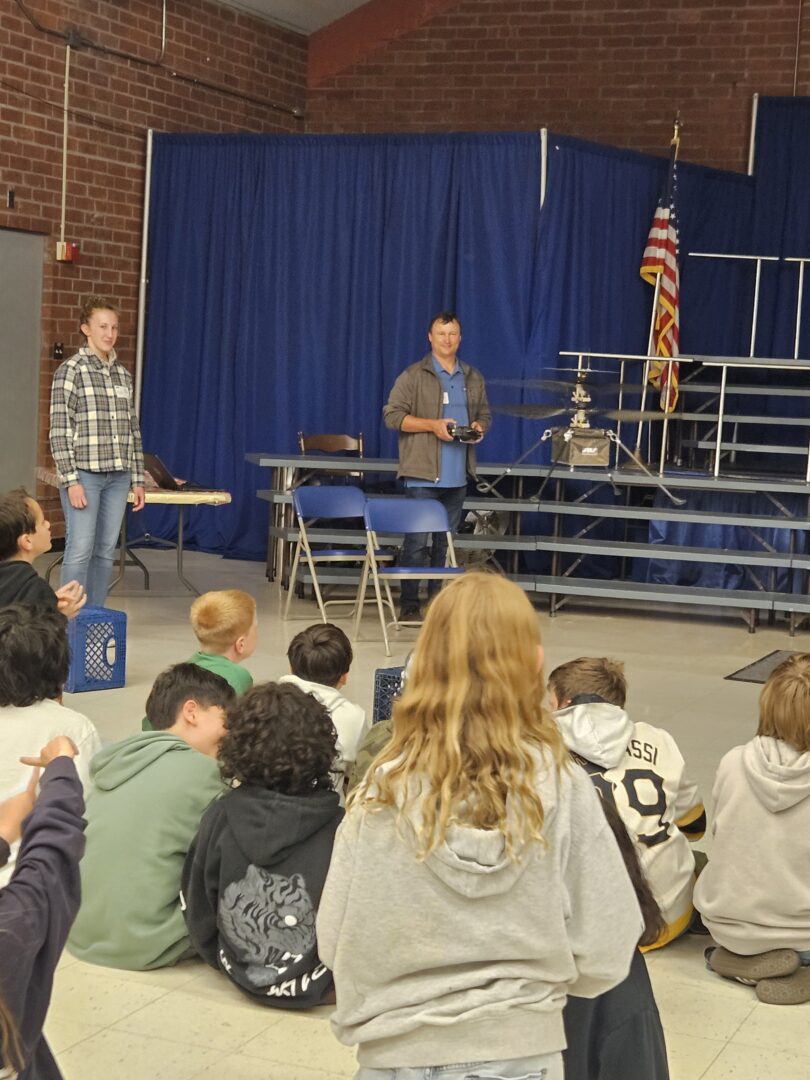
Jeremy Tyler flies Terry as Paulina Ridland and CHE students watch. He is one of two people permitted to fly the helicopter.
“That’s a great question,” Tyler told the student. “When the solar system was formed, Mars and Earth were very similar. Mars has oceans, rivers, rain, rainbows – just like Earth. But Mars is a little too far away from the sun so it cooled down. Its magnetic fields and volcanos stopped.” He added that molten material inside the earth generates magnetic fields, which protect the atmosphere.
“Mars lost its atmosphere and the water evaporated,” Tyler said. “Now there are dry lake beds. By studying Mars, we can get information about Earth when it was formed. Mars is a snapshot of what Earth was like when it was first formed. Studying Mars helps our understanding of Earth.”
Ridland told the students that scientists believe there could be life on other planets. Other planets have moons. One moon has a shell of ice; scientists are making a robot that looks like a giant worm. It will be able to work its way through the ice, looking for water.
“Was there life on Mars?” she asked the students. “There is evidence of water and dry river beds.” Those could be an indication that was there life in some form but not necessarily life as known on Earth.
Ridland – who earned her mechanical engineering degree at the California Institute of Technology – is currently working on Skyfall, a project that would allow scientists to retrieve samples from Mars.
According to the AeroVironment website, “Skyfall is designed to deploy six scout helicopters on Mars where they would explore many of the sites selected by NASA and industry as top candidate landing sites for America’s first Martian astronauts.
“The data Skyfall collects could also advance the nation’s quest to discover whether Mars was ever habitable.”
These helicopters, Ridland said, would have arms to pick up samples from Mars.
In looking ahead to the possibility of landing people on Mars, Ridland said they are working on sending robot up to build houses from Martian soil.
“Here’s something interesting,” she told the students. “There are big lava tubes on Mars. They look like big holes in the ground. Because Mars has such little atmosphere, there is more radiation from the sun. One idea is to live in those caves, tunnels.”
Tyler – who graduated from the University of Arizona with a degree in aerospace engineering – helped develop Ingenuity and Terry. “Jeremy has made things that have gone into space,” Ridland told the students. “I’m making something right now that will.”



0 Comments