


By Mary-Justine Lanyon
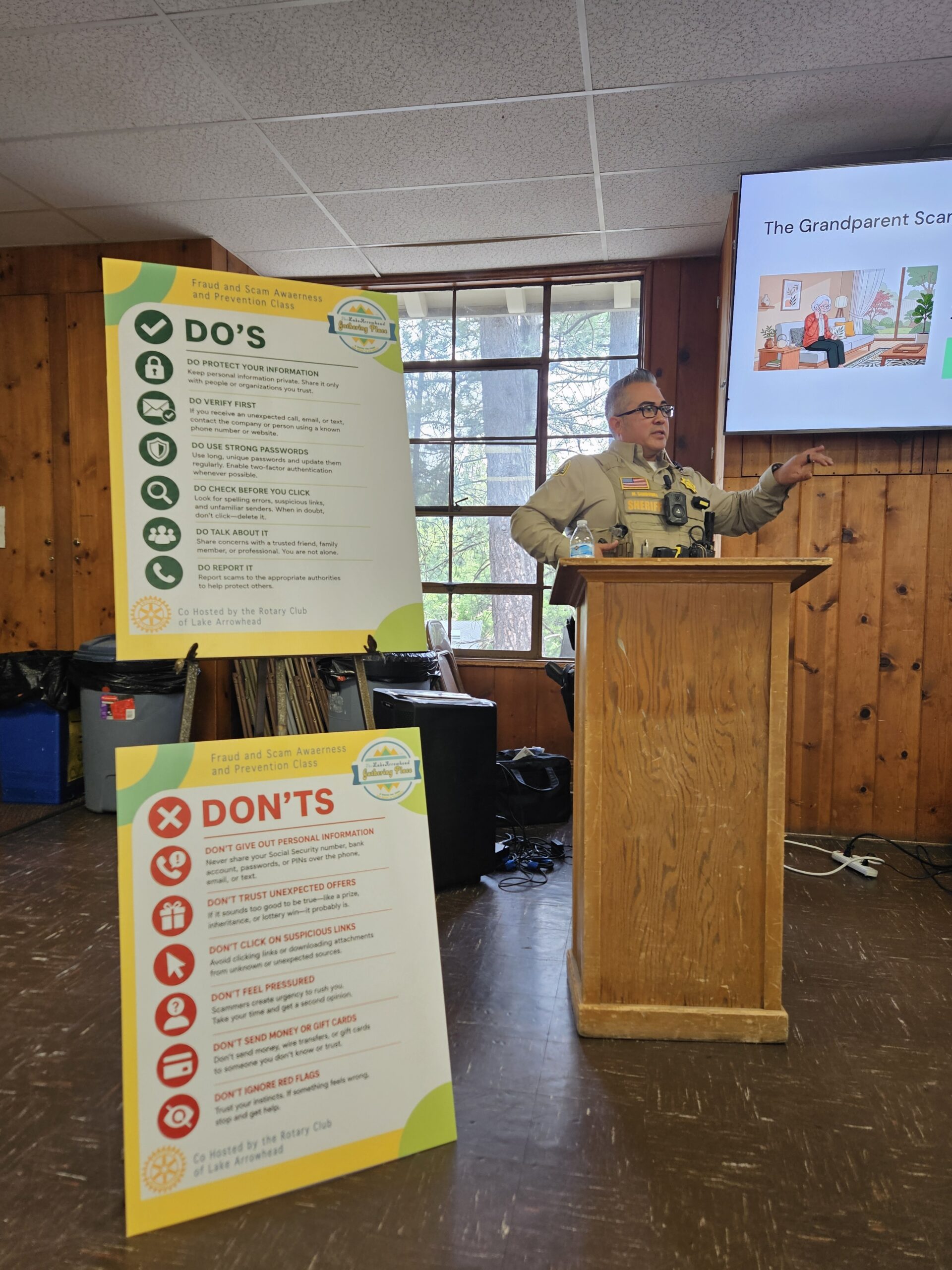
Four speakers at the fraud and scam seminar sponsored by the Lake Arrowhead Gathering Place and the Rotary Club of Lake Arrowhead agreed we need to be suspicious of anything that seems too good to be true.
Deputy Mark Sandoval of the Twin Peaks Sheriff’s Station noted that today scammers are using urgency, fear, fake voice, romance and untraceable payments to push people into fast decisions.
“The safest response is simple,” he told the participants. “Pause, verify and never pay under pressure.
“You are not obligated to answer any of their questions,” he said. “And you can hang up. Verify anything they say independently.”
Red flags include someone either on the phone or by email or text asking for payment by gift cards. “No law enforcement will ever tell you you have to pay a debt with a gift card.”
He also warned that scammers can take an audio clip and make it sound like your relative. “Have a family safe word,” he urged.
Patrick Miller, the information security officer at Mountains Community Health, also pointed to the urgency shown by these scammers. “They don’t want to lose you. They want you to act now. Just say, ‘No, thank you.’”
Miller suggested keeping business and personal passwords separate. He said there are password management systems that house all your passwords; you have one password to get in. Don’t he said, store your passwords in a document on your phone or computer.
He also said using multifactor authentication is a good idea. “You put your password in and then you get a code on your phone that you put in,” he said.
When wondering if something is legitimate or a scam, ask yourself these questions: Is it something expected? Is it normal? Have you verified it?
Gerontologist Jacqueline Lauder addressed Medicare fraud and why seniors are targeted. Older adults are seen as being wealthier and many come from a more trusting generation.
Many older adults live alone and are isolated, making them appear more susceptible to scams. And not all seniors are tech savvy, making it difficult for them to tell when something they see online is fraudulent.
In 2026, Lauder said, close to 20 percent of Americans – 69.6 million – have Medicare, which loses an estimated $60 billion each year due to fraud, errors or abuse.
“Medicare fraud hurts everyone,” Lauder said. “It costs people their time, money and well-being.
Examples of Medicare fraud include phone calls asking you for your Medicare number so they can send you a new card. “Medicare will never call you and offer you anything or ask for your number,” Lauder said.
She urged anyone on Medicare to check their billings and statements carefully, looking for any services or equipment billed for that were not received.
A scammer pretending to be from Medicare may call, she said, offering you some equipment that they bill for but you never get. Not only is this taking money away from Medicare but it can create problems for you down the road.
“Let’s say they order you a walker and they get paid for it. You don’t get a walker at that time. But if you need one in the future, Medicare will deny the request, saying you already received one,” Lauder said.
With your Medicare number in hand, a scammer can enroll you in hospice, getting paid for it. Once a person is enrolled in hospice, Lauder explained, that stops all their other Medicare coverage, like cancer treatments.
In addition to the fraudulent phone calls you may receive, you may be approached in person. “Walk on by that person outside the grocery store,” Lauder said. “Never sign anything. Do not give them your Medicare number.”
If you are the victim of Medicare fraud – even if it seems like a small amount on a bill – Lauder said it is important to report it to the Senior Medicare Patrol at (855) 613-7080. It is a federally funded and mandated organization that investigates Medicare fraud.
If you are looking for free, unbiased counseling and assistance, call the Health Insurance Counseling and Advocacy Program (HICAP) at (800) 434-0222.
And then you can call what Lauder calls the “magic number,” (800) 510-2020, the Area Agency on Aging. “They will connect you with the person you need to speak with,” Lauder said.
The final speaker was Rodney Shepherd, a Medicare broker with HRBC Insurance in Crestline. Building on Lauder’s presentation, he noted that “Medicare will never call you nor will a company you’re not insured with,” he said.
In fact, Lauder added, it is illegal for an insurance company to call you trying to get you to switch to their plan.
Shepherd urged everyone to save their EOB – explantion of benefits. “It helps monitor what you are being billed for,” he said. If there is an incorrect entry on a bill, it could be as simple as a clerical error or it could be a fraudulent entry.
Shepherd also noted that the cost of Medicare Part B was $195 in 2025 but has risen to more than $200 because of fraud.
“I have clients asking if they should buy food or medications,” Shepherd said. “This is what fraud is doing.”
Joy Patrick Eckert, president of the board of the Lake Arrowhead Gathering Place and host for the seminar, reminded everyone: “If it’s urgent, slow down, don’t respond immediately. And there’s nothing to be embarrassed about – report any fraud.
“Stop – verify an email address, text or phone number. Do not click on a hot link. We all still have manners – it’s hard to just hang up on someone. We are all horribly polite – stop it.”
A recording of the seminar as well as the resources shared will be posted at lakearrowheadgatheringplace.org.



0 Comments