




By RHEA-FRANCES TETLEY
HISTORIAN
Since Jamboree Days is celebrating the 120th anniversary of the naming of Crestline, it seemed like a good time to introduce Dr. Wesley Thompson, whose name is not familiar to most mountain residents today, but it was familiar to residents of San Bernardino County over 120 years ago, when he left a lasting imprint on the Crestline area.
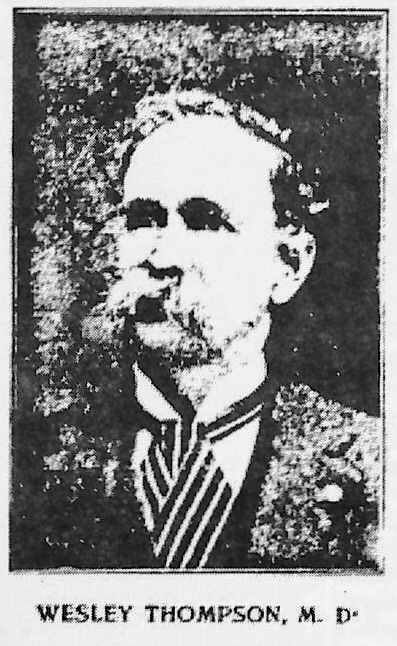
Dr. Wesley Thompson
Wesley Thompson was born on June 30, 1845, in Fort Wayne, Indiana. His early education was in a log schoolhouse, afterwards attending M.E. Seminary in Tippecanoe, finishing his education at Des Plaines University.
Thompson joined the 87th regiment of the U.S. Army in 1863 during the Civil War. He served under General Sherman during the historic “March to the Sea.” Unknown to him at the time, that campaign destroyed the farm belonging to the parents of Byron Waters, another significant man in San Bernardino Mountain history. Thompson was discharged from the army, at the age of 20.
Returning to Indiana in 1865, he entered the pharmaceutical drug business, then attended medical school, at Miami Medical College in Cleveland, Ohio, graduating in 1869, practicing medicine in Effingham, Illinois, for 18 years.
He married Mary M. Little. After childbirth, Mary developed poor health. Doctors prescribed a move to the dry, warm California climate to benefit Mary.
In 1887, the family moved to Del Rosa, north and east of San Bernardino, where Dr. Thompson practiced medicine. Wesley and Mary were the parents of six children: Victor, Mary, Rubie, Jennie, Ada and Emma. He was elected to the school board in the Del Rosa School District.
In 1889 his medical expertise was noted and he was elected San Bernardino County coroner. He served at least three, four-year terms as coroner, while continuing his medical practice.
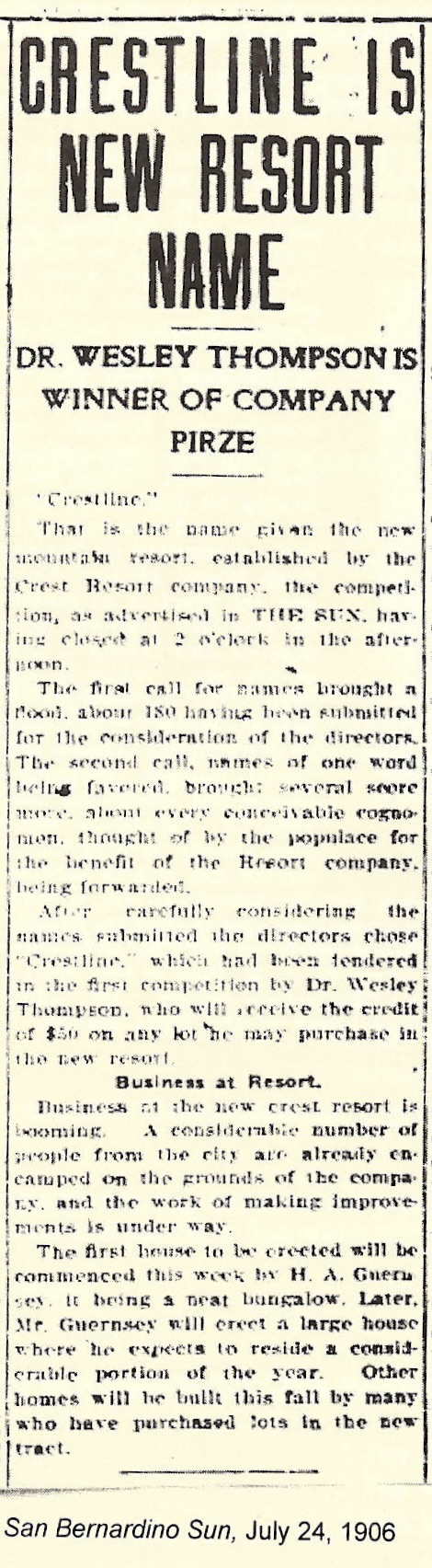
The article in the July 24, 1906, Sun newspaper announcing the new name for the Crestline area.
The Thompsons enjoyed camping in the San Bernardino Mountains to escape the summer heat. The family used Daley Canyon Road (which went directly from Del Rosa to the Little Bear area) but preferred the more expensive and newer Arrowhead Reservoir Toll Road as it was less steep and wider, and there were fewer out-of-control lumber wagons going down it, than Daley Canyon Road. He frequented the campground at Skyland. He could see his Del Rosa home from there. Near the crest was also an area referred to as “Fly Camp,” so nicknamed because of the Arrowhead Reservoir Company’s horse and oxen corrals nearby.
In 1906, the county opened the former Arrowhead Reservoir Toll Road to free public wagon usage. So, lumberman Henry Guernsey decided to develop 630 acres of his harvested timber tract land, located north of Skyland, into a summertime recreational destination. He knew valley residents wanted to escape the valley heat and enjoy fishing and camping under the tall pines. Guernsey cleared the underbrush and dug wells so visitors would have access to water. Guernsey held a contest for naming his new Crest Resort. There were 180 name submissions in the contest.
The winning name was announced at 2:00 p.m. on July 23, 1906, at the water trough at the fork in the road, where Andy Fletcher Triangle Park is today. Henry Guernsey proclaimed the area “Crestline,” with the technically correct (since it is on the “line of the crest”), catchy name, submitted by Thompson.
Thompson won a lot suitable for building a cabin in Crestline, one of the first “vacation developments” on the mountain. Guernsey began building Thompson’s cabin and one for himself in his new tract immediately. By 1908, there were 14 cabins in the tract, as well as the Crest Corner Market.
Dr. Wesley Thompson’s naming of Crestline in 1906 may be best remembered for removing the onus of the previous moniker, “Fly Camp.” Despite the success of Guernsey’s subdivision being short-lived, the name was not forgotten.
Dr. Thompson was also there to witness the beginnings of Crestline as a real community as the 1915 Rim of the World (automotive) Drive went straight through Crestline, the route of current-day Crest Forest Drive.
It was in 1919 that Postmaster Samuel W. Dillin (De-Lynn) relocated the Skyland Heights post office down to his new grocery and photography store and stage stop, at the current corner of Crest Forest Drive and Highway 138. Dillin chose the now common-usage name of Crestline to officially name the post office, thus officially adopting Thompson’s name for the town.
On July 23, 2006, to celebrate the 100th anniversary of the naming of Crestline, a community party was held across from Lake Gregory at Goodwin and Son’s Market. They hosted a community ribbon-cutting ceremony revealing a huge multi-media mural, A Tribute to the California Grizzly Bear, painted by Molly Collins. It combined large wooden sculptures of forest animals from wood salvaged from the 2003 Old Fire with a painted forest/lake setting. Speeches were given by various members of the community honoring the mural and the anniversary of naming Crestline. Then the community rocked out to a live band.
When Goodwin’s Market needed to repaint the market, it unfortunately had to paint over the mural in 2022, a couple years before its roof collapsed in 2023. The wooden sculptures had already been safely relocated to the Mountain History Museum where they are now on display.
The 1906 and 2006 celebrations and now this year’s Jamboree Days are all honoring the choice of the name “Crestline,” submitted by former San Bernardino County coroner Dr. Wesley Thompson in 1906.
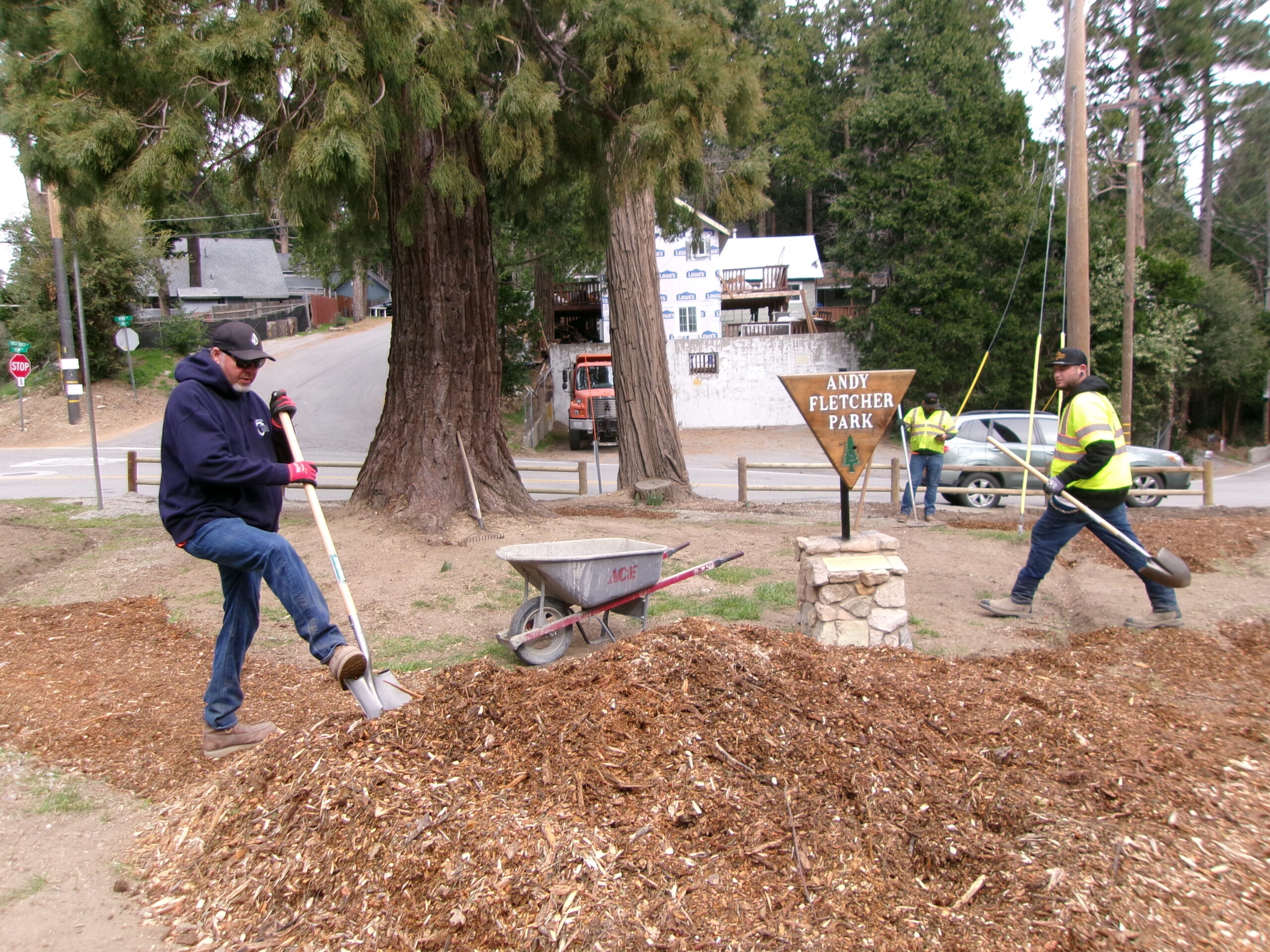
County workers sprucing up Andy Fletcher Triangle Park where Crestline was named for the 120th anniversary of the towns naming,



0 Comments