




By RHEA-FRANCES TETLEY
Historian
Green Valley Lake is a deeply significant historical area beginning back in 1894 when the original horse-drawn Bear Valley Wagon Toll Road to Big Bear was built following an old burro trail. It took two days by stage to reach Big Bear Lake beginning in the valley up the City Creek Road built by the Highland Lumber sawmill at Fredalba.

The Lilleberg Museum focuses on the history of Green Valley Lake. (Photos from the Rhea-Frances Tetley collection)
Green Valley was chosen for the overnight stay because it was the point travelers reached at the end of the first day of travel toward Big Bear from Highland
The Bear Valley Wagon Toll Road Company built an 11-room, overnight lodging run by Ben Pitt at their toll house in the Green Valley meadow. The road then continued over the Snowslide section of road on the northside of the mountain peaks to Big Bear, arriving at Fawnskin on the Big Bear Lake’s north shore. The wagon roadway was closed several months each winter due to heavy snow drifts covering the road.
The Tillitt family took over the tollhouse and maintaining the dirt road in 1903. The toll road was purchased by San Bernardino County in 1911 for $4,000 and made into a free public roadway for wagons (and later as part of the 101-mile-long Rim of the World Drive for autos in 1915). The Brookings Lumber Company approached Lighteningdale near the Tillett’s Green Valley property in 1911, clear cutting the trees.
The Snowslide Road section, because of the limited winter transit, was the first section of the Rim of the World Drive to be replaced with a south-face road for auto traffic in 1923. That re-routing and construction of the new road, called the Deep Creek Cutoff, completely bypassed Green Valley and Fawnskin. That Deep Creek Cutoff is now known as Highway 18’s Arctic Circle; due to those old deep cuts into the mountainside it has frequent winter rockslides.
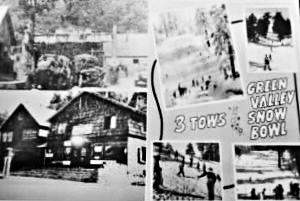
GVL Snow Bowl poster
With the 1924 diverting of 95 percent of the traffic away from Green Valley, economic disaster was predicted to hit the community. This encouraged Harry McMullen, who called himself Green Valley Mac. A fishing guide who led parties up to Deep Creek and Big Bear, he suggested new attractions for a resort development of Green Valley. So G.V. Mac bought the meadow believing that flooding it would bring new vacationers to the area.
Green Valley Mac then sold the idea, and his land, to the DeWitt-Blair Co. who were financed for $85,000 by Union Bank. They hired contractors Clinton, Code & Hill who designed the dam, a resort subdivision and a water system. Dam construction began in 1925 along with roads being cut in and lots developed as the dam was being built.
The dam was finished in 1926, creating an 8.5-acre lake. The lots on the property the Tillits had homesteaded in 1912 were the first to be sold since they not been logged and were forested. The lake was stocked with trout for members of “Top of the World Club” in 1928. (Their clubhouse burned down in 1959 and the Green Valley Lake Water Company is now on that site.)
The Depression affected the new mountain subdivisions greatly. In 1929 the GVL developers went bankrupt and Union Bank sold out to Bank of America in 1932. Capital Land Co. took over and aggressively began a promotional campaign. Electricity arrived in the Green Valley Lake area in 1934 and the next year the mutual water company was established with all property owners participating.
The March 1938 storms dropped tropical rain that melted the snow on the ground and flooded the GVL lake. When debris jammed the spillway, local resident Jim Reid cleared it by hand, saving the dam from destruction.
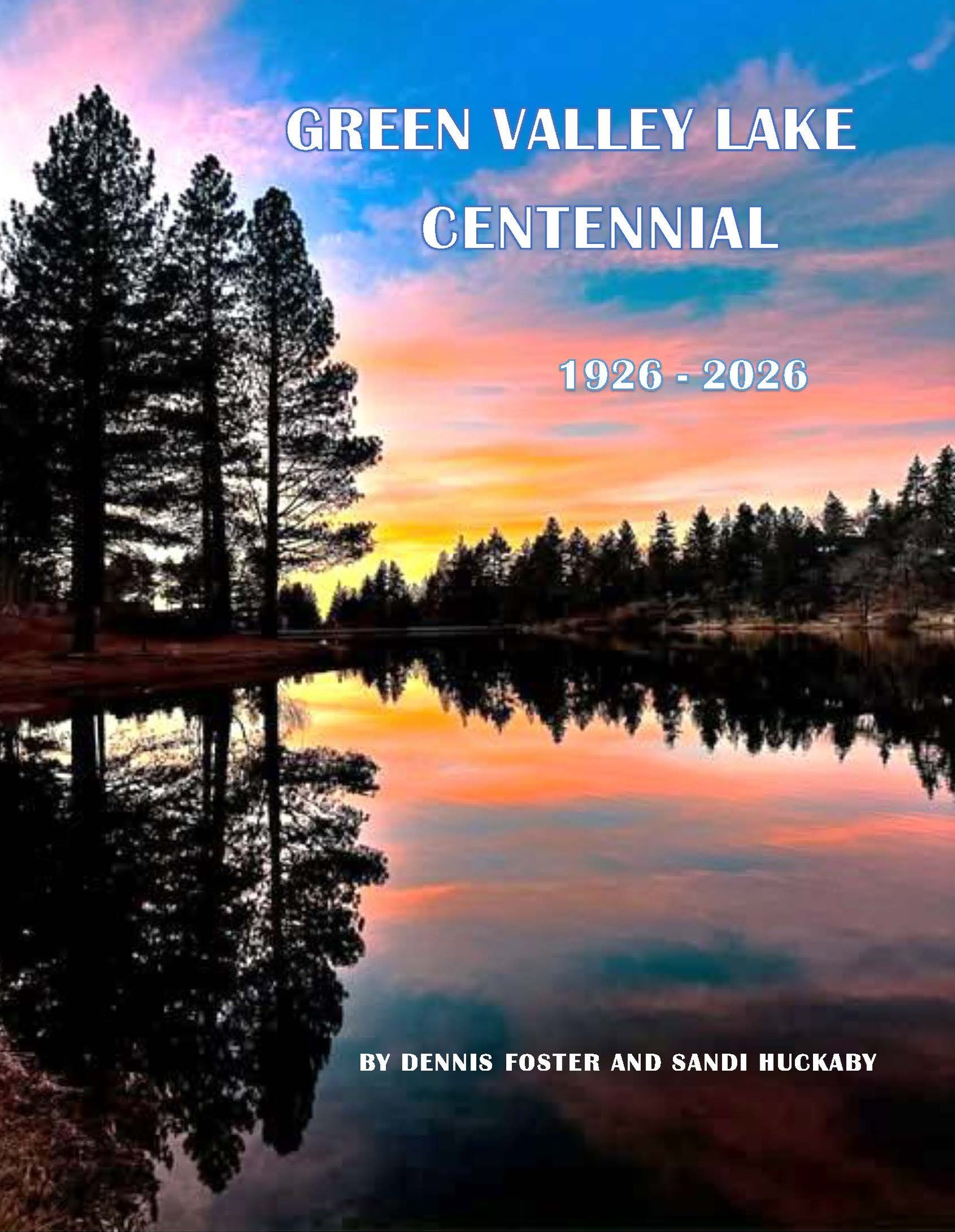
GVL centennial book
After the Depression, the ski slopes became a big part of the development of Green Valley Lake. Les Salm began operating a ski run with a 300-foot rope-tow powered by a 7-hp engine on “Suicide Hill” in 1939-40, on the south side of the campground. Then, using an automobile engine, he added another 150-foot-long rope-tow 150 east in 1941.
The mountains were closed to all but mountain residents from 1942-45 due to WWII stopping all tourism. In 1945-46 Joe Fox and Laurence Ferguson opened up the ski lifts and in 1950 sold them to Bob and Doris Wubben who operated the original rope tow and set up two 500-foot-long toboggan runs on Suicide Hill, which now deserved its name. The toboggan runs closed in 1953 due to insurance costs.
The Crestline-Lake Arrowhead water aqueduct system was built in 1962-1972 to bring water from Lake Silverwood up the mountain. The county installed the sewer system in 1975-77, building the water treatment plant in Running Springs. In 1985 the Green Valley Lake Fire Department (mostly paid call or volunteer) was annexed into SB County Fire.
Don and Ann Howe and Lyle Ferguson bought the Snow Bowl ski area and operated it for the next 25 years. Around 1998, the Peake family took over the ski hill, renaming it “Big Air Green Valley,” for snowboarders, including future Olympian Shawn White. In 2006 Green Valley Lake local Roger Lee learned to ski and competed in the 2006 Paralympics in Turin, Italy.
Disaster struck the community on Oct. 22, 2007, when the 2007 Slide Fire – a continuation of the Sept. 14-21 Butler II Fire, which began from embers of the Butler I Fire, caused by a September 1st lightning strike – was pushed by severe Santa Ana winds, burning 12,759 acres surrounding Green Valley Lake. The fire destroyed over 100 homes and three businesses, including Fox Lumber, the ski hill outbuildings and the ski lift, destroying the winter economy.
A community garden was created where Fox Lumber used to stand. It has become a community gathering place and the staging area for the summer concert series. The “Eddie the Eagle” statue is a signal of hope that the town has recovered from the fire that nearly destroyed it.
This year, 2026, the community celebrated the 100th anniversary of the building of the lake, with numerous events and concerts. The Lilleberg Museum issued a centennial book written by Sandi Huckaby and Dennis Foster on the town’s history.

Members of the Top of the World Club



0 Comments