




By Mary-Justine Lanyon
Most people in the United States have been exposed to some level of PFAS (per- and polyfluoroalkyl substances).
“We are learning it’s everywhere. We are trying our best to understand how our lake might be getting contaminated.” With those statements, Matt Brooks, the operations manager at the Lake Arrowhead Community Services District, opened his update on PFAS at the Jan. 23 meeting of the LACSD board of directors.
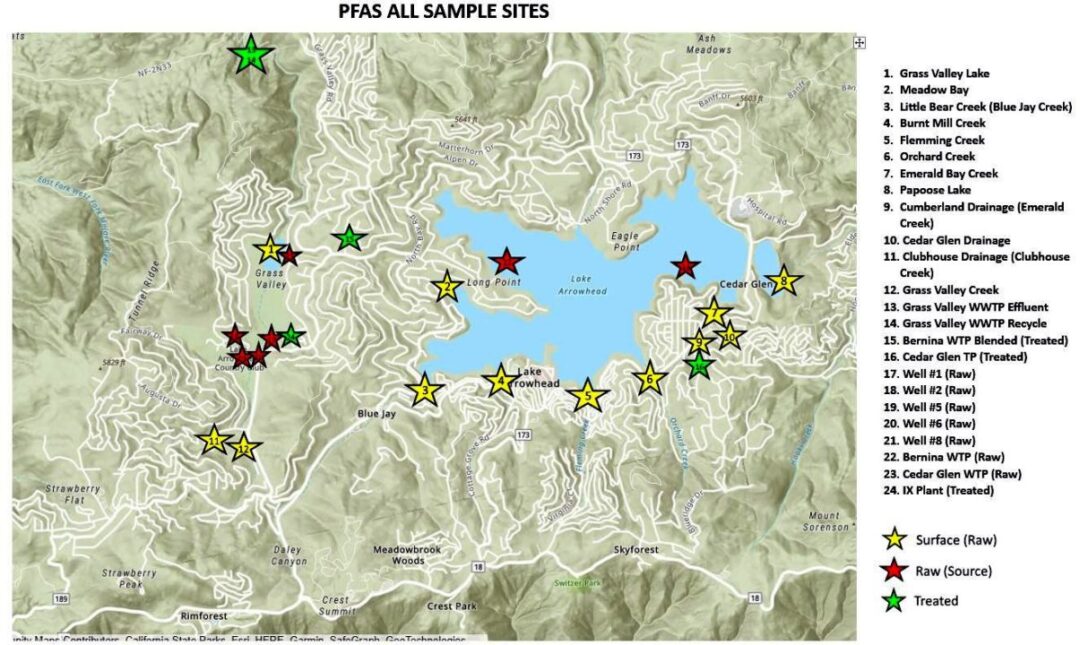
Operations Manager Matt Brooks shared this map of where LACSD has sampled for PFAS. (Courtesy LACSD)
The district has done the required sampling, Brooks said. Some trace amounts were found in Lake Arrowhead – levels so low they can barely be detected, he noted. LACSD is in the process of sampling in four consecutive quarters; they are waiting for the EPA (Environmental Protection Agency) to provide sampling windows.
“We have to follow detailed instructions,” Brooks said, “and send the sample to a certain lab.” It can take four months to get the results, he said.
“The district has done a lot of voluntary sampling to try to determine the source of PFAS,” Brooks said. “We’re trying to chase this upstream to see what may be there adding contaminants.” In addition, he noted, the district has put a concerted effort into wastewater, sliplining 90 percent of the pipe around the lake. The remaining 10 percent will be completed in the near future.
LACSD has spoken with two firms – Battelle and Dudek – about both locating the source of the PFAS and treating the drinking water to remove them.
Dudek, an engineering firm LACSD has worked with before, conducted a site visit recently. They are addressing water treatment for PFAS, Brooks said.
He added he had read that early estimates of removing PFAS from water across the nation could run as high as $400 billion. “It will cost a lot of money for everyone,” Brooks said. And it will affect drinking water rates. For that reason, the board approved seeking treatment money at its December meeting.
“We take public health and drinking water quality very seriously,” Brooks said. “We have since Day 1. They are Priority 1 and 1A.”
Greg Guillen, a representative from Dudek, joined the meeting on Zoom, noting he had toured the facility the previous week. “We got a good handle on the problem up here with PFAS and drinking water,” he said. “We will study the problem and come up with some solutions to remediate it.”
During the tour, he said, they looked at the sources of drinking water and the treatment facilities, getting an understanding of how the facilities work together.
“We will develop a preliminary design report, looking at what is the most appropriate technique to remove PFAS from the drinking water.” By appropriate, he said they mean the most cost-effective removal technique for this community.
The most common techniques currently to remove PFAS are activated carbon, ion exchange and reverse osmosis. “We’re looking at things that not only remove but destroy PFAS,” Guillen said. “It would be very expensive. We’re looking at technology that can be implemented now.”
Their cost, he indicated, will include disposal of the medium into which the PFAS are pulled out of the water.
“It seems like there are many different sources of PFAS,” said President John Wurm. “I don’t think we’ll be able to eliminate the sources but we can treat the water.”
“I wish it were as easy as blaming one source and turning it off,” replied General Manager Catherine Cerri. She added that recycled water is very unlikely to be a source of PFAS.
At that point, audience member Michael Schultz said, “You have answered all our questions. We were under the impression last month the PFAS was only in Lake Arrowhead. We’ve been running scared.”
He added that he expects LACSD to keep their ratepayers informed. “There’s great information on the website,” he said. On the home page of the district website, lakearrowheadcsd.com, there is a link to PFAS facts and information.
When another audience member asked if there’s a trend toward increasing PFAS or if they are remaining stable, Brooks said the numbers they are seeing now are “fairly stable.
“We are learning PFAS are everywhere. Everything with human contact will bring contamination with it: sunscreen, dock and boat coatings, anything water repellant. We think it’s been in there a long time. We are focused on removing it from the drinking water and trying to identify the source or sources.”
After additional comments by ratepayers online, Director Robert Morris concluded the discussion: “We’re going to get it out of the drinking water. We’re concerned but focused on getting the problem resolved. We will make sure the public gets all the information we have as we get it.”





0 Comments