



By TIM WILCOX
Special to the Alpine Mountaineer
“What a Diff’rence a Day Makes.” This popular ballad from the mid-1930s could serve nicely as the theme song for leap year. Adding a day to the calendar every four years makes an enormous difference. It’s especially relevant because we’re living in a leap year, we’ve just passed through a leap month and Feb. 29 is a leap day.
You’re probably aware that this happens every year that can be evenly divided by four, such as 2012, 2016 and 2020. The exceptions are “centenary” years—those ending in double zeroes such as 1700,1800 and 1900. For complicated reasons, the rule is that if a year is divisible by 100 but not 400, the calendar adjustment is skipped. Consequently, 2000 was a leap year.
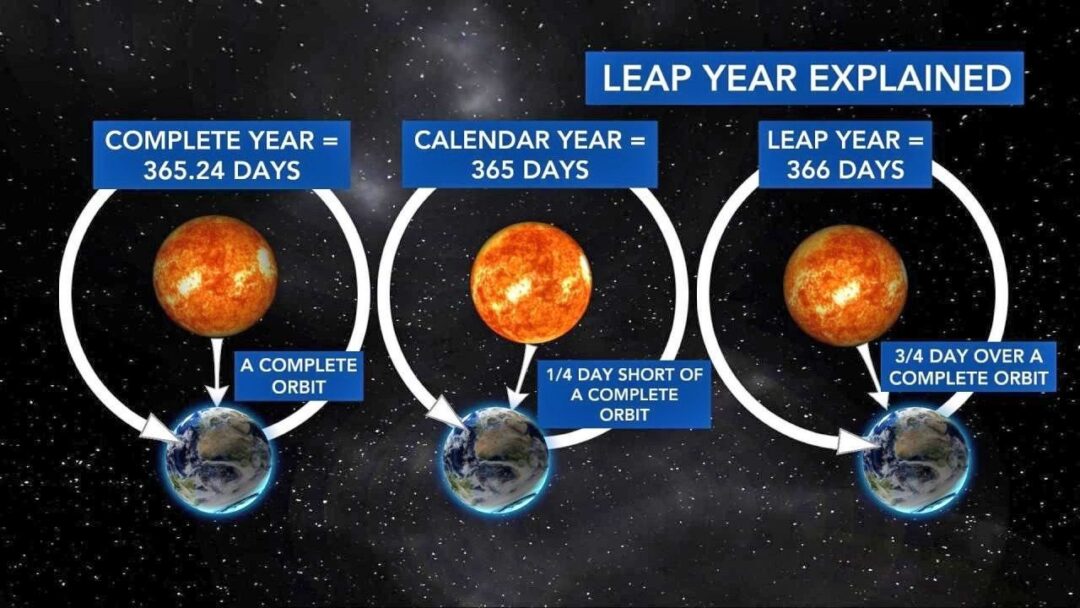
According to Live Science: “Leap years exist because a single year in the Gregorian calendar is slightly shorter than a solar, or tropical, year – the amount of time it takes for Earth to completely orbit the sun once. A calendar year is exactly 365 days long, but a solar year is roughly 365.24 days long, or 365 days, 5 hours, 48 minutes and 56 seconds.”
Think about that for a moment. Without the quadrennial adjustment, with each passing year the gap would widen between the start of the calendar year and the solar year. How much of a gap? Precisely 5 hours, 48 minutes and 56 seconds per annum. Over the course of many years, the difference would significantly disrupt our calendars. For instance, after 10 years it would be more than two days. And after a century, it would’ve grown to about 24 days.
As an extreme example, noted by the National Air and Space Museum, “If we stopped using leap years, then in around 700 years the Northern Hemisphere’s summer would begin in December instead of June.” Thank goodness for leap years, then!
By the way, the name itself derives from the fact that after Feb. 29, every remaining date of the year leaps forward by two days relative to the past year rather than just one. Also, Julius Caesar introduced the first leap year in 45 BC, though in a different form from our calendar adjustment. But that’s a story for another time.
This is an unusual leap month for the Alpine Mountaineer. Why? Because with an official issue date of Thursday each week (though the paper is usually available on Wednesday), we’ll have five editions in February. How often does that happen? Every 28 years. The last year with five Thursdays was 1996. The next one will be 2052.
Of course, this cycle holds for every day of the week. For example, some leap years have five Sundays in February, others five Mondays and so on. There are seven days in a week, and we make the leap every four years. The arithmetic is simple: 4 x 7 = 28.
Here’s to experiencing a comforting sense of timely adjustment on Thursday, Feb. 29, and throughout the rest of this leap year!





0 Comments