



By Mary-Justine Lanyon
The Lake Arrowhead Community Services District was surprised, General Manager Catherine Cerri said, to find the presence of PFAS in Lake Arrowhead. “Our drinking water is so pristine,” she said.
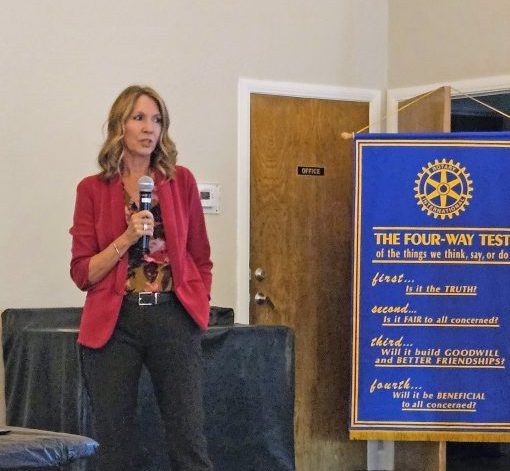
Cerri was addressing the Mountain Sunrise Rotary Club, updating them on the testing that has been taking place and the water district’s plan for dealing with what are called “forever chemicals.”
There are numerous sources for PFAS (per- and polyfluoroalkyl substances), which have been used in consumer products and industrial processes since the 1940s. Some possible sources include paint, building materials, sunscreen, Trex decking, boat coatings and covers, boat carpet and upholstery, fire retardant, waterproof clothing, air pollution and rainwater.
In 2018, the State Water Resources Control Board was authorized by AB 756 to begin monitoring for PFAS. Because the testing technology was still being developed, the SWRCB slowly phased in the number of water agencies that were required to sample for PFAS, starting with the larger agencies.
On Oct. 31, 2022, the SWRCB issued an order for certain water agencies to sample for PFAS from specific water sources. LACSD was not named in the order but volunteered to start sampling at the earliest possible date in 2023 under a separate effort conducted by the EPA.
This group of chemicals, Cerri said, is resistant to water, oil, fire and heat. There are hundreds of these chemicals in the category. “They are very useful,” Cerri noted, “so Congress doesn’t want to ban them. But their formula has been changed to make them less toxic.”
They are called “forever chemicals” because they don’t break down in the environment.
A person is exposed to the chemicals by consuming water or food – about 20 percent of exposure – and by inhaling the fumes created by cookware, carpet, clothing, even waterproof makeup (about 80 percent).
The state and EPA, Cerri said, “want to remove PFAS from drinking water so they can control that one level of exposure.”
The possible dangers of PFAS exposure include a suppressed immune system, a lower birth rate and there is some evidence of certain cancers. Studies are ongoing, Cerri noted.
At each meeting of the LACSD board of directors, Operations Manager Matt Brooks gives an update on the testing, which is ongoing. There is some confusion over the numbers, Cerri said, as there are two sets: for raw water and finished drinking water.
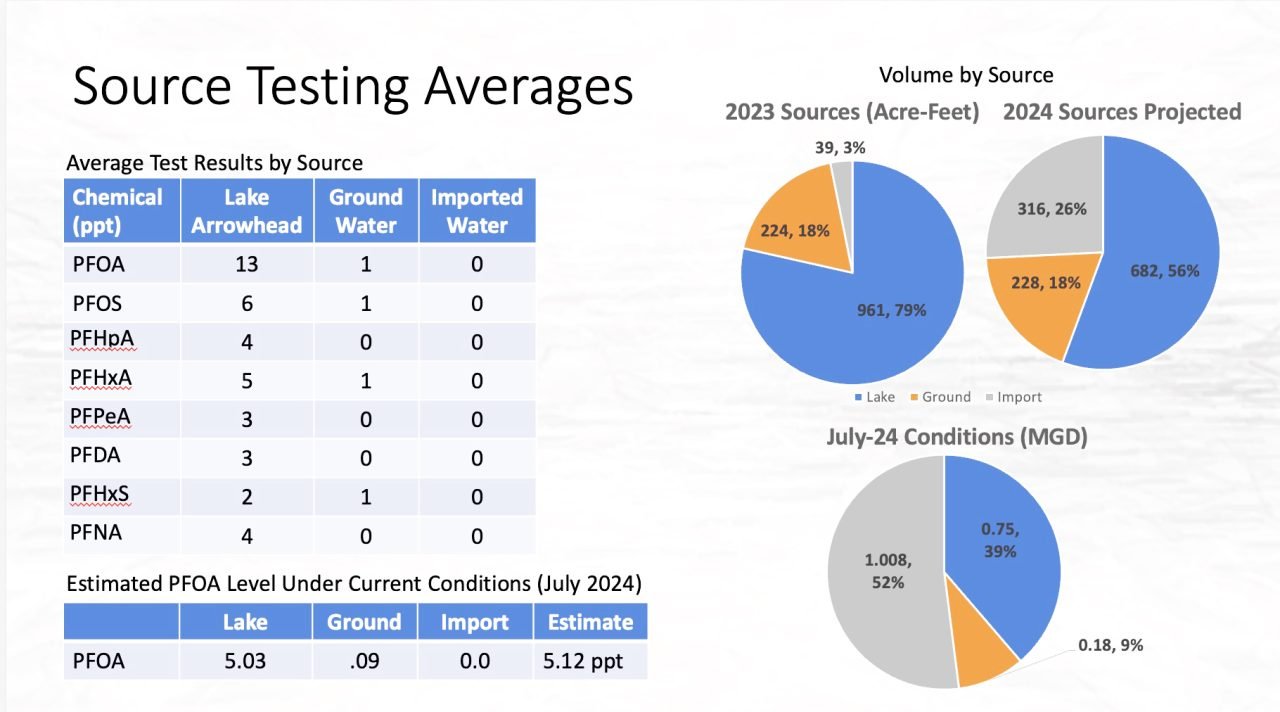
The measurement of PFAS detected is in parts per trillion. (Source: LACSD)
The levels are higher in the raw water. The finished drinking water is a blend of water from Lake Arrowhead, groundwater from wells and purchased water from CLAWA (Crestline-Lake Arrowhead Water Agency).
In 2023, Cerri said, LACSD’s blended drinking water included 79 percent from the lake, 18 percent from wells and just 3 percent imported. The decision was made to start buying more imported water, she noted, adding that, when the State Water Project water was tested, it was “non-detect” for PFAS.
The current blend, Brooks reported at the July 23 LACSD meeting, is 56 percent lake water, 26 percent purchased water and 18 percent groundwater.
“For some agencies,” Cerri said, “purchasing State Water Project water is their permanent solution. It’s an option for us but it’s very expensive.”
Instead, LACSD opted to install treatment systems to remove the PFAS from the water. “Lake Arrowhead as a water source is a great asset for this community. Despite the PFAS, it’s very high quality water. Its clarity is equivalent to distilled water. We barely have to treat it. And it’s our lowest cost, highest quality water. It is in the best interest of the community, when the lake is full, to utilize it.”
LACSD has applied for funding from the state to help offset the installation of ion exchange systems at both the Bernina and Cedar Glen treatment plants. Recently, Brooks said, the system designer had visited both sites. And, he said, the state Division of Drinking Water will work with LACSD as they move forward with the design “to assure a smooth permitting process.”
“You can feel confident our water is safe to drink,” Cerri told the Rotarians. “Our #1 goal is public health.”
Brooks had said something similar at the LACSD meeting: “Our #1 priority when we get out of bed in the morning is the public health of every one of us in the district. We are excited to be moving forward with the engineering team to provide treatment.”
For additional information on PFAS, visit the LACSD website, www.lakearrowheadcsd.com.





0 Comments