



By DOUGLAS W. MOTLEY
Senior Writer
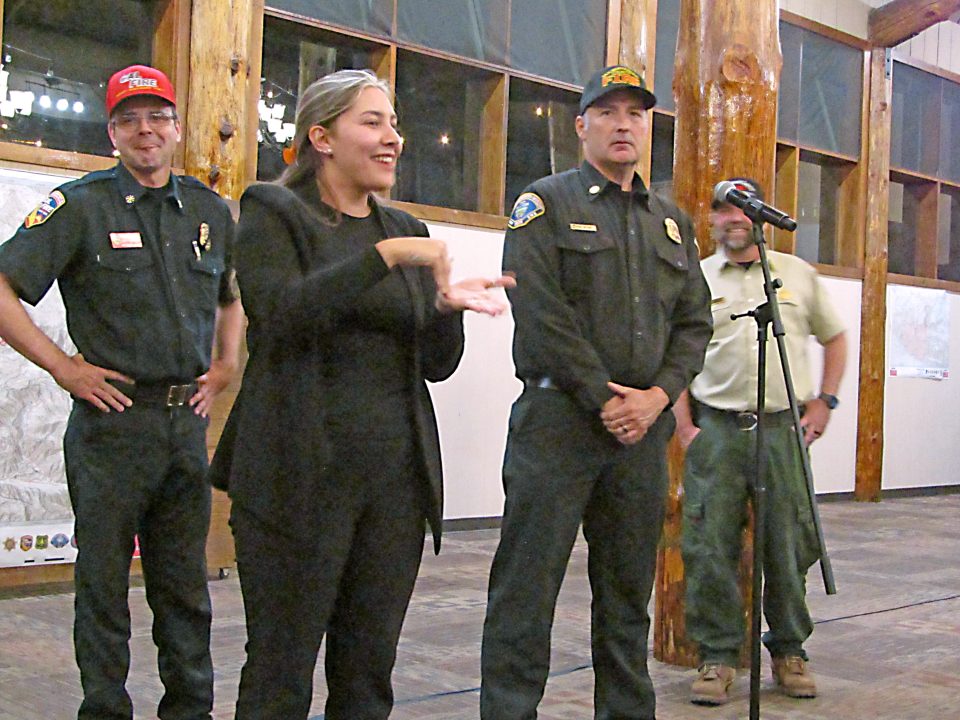
A community meeting to inform mountain residents of progress being made on quelling the acrid smoke and flames of the Line Fire in the hills above Highland was held on Wednesday, Sept. 12 at Crestline’s San Moritz Lodge. The meeting, which got underway at 7 p.m., attracted dozens of public officials and firefighters from throughout the region, as well over 200 local residents, eager to learn when the nightmarish scenario would end.
Noting that the San Bernardino National Forest is the most fire-prone national forest in the country, Cal Fire Public Information Officer Blanca Mercado said the blaze had grown from a half-acre to just over 36,000 acres but, due to the diligence of firefighters from San Bernardino County Fire, Cal Fire, the U.S. Forest Service and Highland Fire Department, only one home in Running Springs had burned so far.
Cal Fire Operations Section Chief Jeremy Pierce told those attending that crews have been focusing their efforts on building fire lines from Highway 18 to Running Springs and Arrowbear Lake, as well as dozer lines on the eastern side of the blaze to prevent it from reaching Big Bear. “Our main goal right now is moving over and holding it to 330. At the City Creek Fire Station, we’re making a dozer fire line, digging through dirt to remove all inflammables. We’re making tremendous progress, but we’ve got a lot left to do. It’s steep terrain, with an up and down path over drainages, into canyons and across creeks,” Pierce said as he pointed at the forementioned territory on a huge map behind the speaker’s podium.
Pierce added that dozers had cut a line from City Creek to Running Springs through extremely steep terrain. “We had some pretty good fire runs up there but no additional fire loss, as of today.”
San Bernardino County Sheriff Shannon Dicus took to the podium and announced that the suspect wanted for igniting the Line Fire is in jail. “When all is said and done and we take a forensic look at this case, we’re going to find out that this person was possibly responsible for more fires. Folks, your homes are our homes. Running Springs was our first evacuation area and while we were there a couple decided to loot a house. If you are going to disrupt or be an opportunist in San Bernardino County and we catch you, you are going to jail – this I promise.” Dicus’ statement resulted in thunderous applause from the audience.
“We’re not out of the woods yet,” said U.S. Forest Service Unified Incident Commander Josh Boehm. “We’ve lived it before and we’re going to live it again; this isn’t going to be the last time.”
“The first day in Highland,” said San Bernardino County Fire Department Chief Dan Munsey, “I looked up and had no doubt the fire was going to come up the hill. It came on strong. The fire behavior we saw was extreme, and our fire season is just beginning. What we’re seeing here is going to happen again. What it required for us to go into Running Springs is nothing short of a miracle. Anyone would tell you it’s impossible to put 21 strike teams in Running Springs in less than two hours, but we did it. Our firefighters are the best in the world, especially our firefighters in Crestline, Lake Arrowhead, Fawnskin and Fredalba, who came here from their homes.”
“When we make a recommendation to evacuate, we take it seriously,” said Chief Kevin Bohall, the unified incident commander for Cal Fire. “Let us get in and do our job.” Their three priorities, he said, are lives, property and natural resources. “We think about repopulation and how we’re going to get you back into your homes.”
“We’ve gotten where we are today because of all the folks who have already spoken,” Bohall added. “Because of our collaboration. But our biggest collaborator is you,” he told the audience. He and the other first responders spoke to the importance of creating defensible space around homes, to make the firefighters’ jobs somewhat easier.
“Good things are on the horizon,” Bohall said. “The weather that’s changing in our favor.”
Sheriff Dicus announced that his department has what he called a 100-person modified field squad with officers trained in all aspects of crimefighting, “They can tell on their cellphone whether someone in a mandatory evacuation zone residence has actually left the area,” he said, adding, “We have a high-low siren on our patrol vehicles, like the ones you hear in England and Mexico. When you hear this, it’s time to go.” When someone asked why the National Guard had been brought in, Dicus said, “The National Guard moves through a neighborhood to make sure no one is breaking into homes.”
Pointing out that the blaze had burned radio antenna towers on Keller Peak that were being used to communicate during the Line Fire, Boehm said they have backup repeaters and that communications were not affected. “I’ve been on this mountain for 40 years and it’s great to see the communities come together.”
“We saw extreme fire behavior this week,” said Chief Munsey. “What you saw will happen again. We went into Running Springs with 21 strike teams (a strike team consists of five engines of the same type) and our mechanics repaired 20 of the engines.” Emphasizing the importance of keeping your property fire safe by removing all weeds and brush closer than 100 feet from your home and any other structures, Munsey said, “If you don’t protect your property, it’s harder for us to do our job.”
During a question-and-answer session, one attendee asked, “Why wasn’t this fire nailed when it was a quarter of an acre?” In response, Munsey said, “We jumped on it with a strike team. What I saw was shocking. Flashy fuels will continue spreading. It also takes up to 48 hours for the mutual aid teams to arrive. There was another fire in Lytle Creek today and we stopped it. We stop 97 percent of all fire starts immediately.”
One woman said she heard a rumor that firefighters took their time to stop the fire’s spread because they could make more money if it burns longer. Munsey’s reply was, “If you hear lies, call them out and check your sources and make sure your opinions are backed up by facts.”
As for when the evacuees can return home, Pierce said the incident command team meets every morning at 10:30; each partner makes recommendations. “I know what it’s like to be evacuated,” Pierce said. “I know how important it is to get you home and to a sense of normalcy. But it has to be safe for you and the firefighters.” Sheriff Dicus added that “we have to get word from Fire that it’s safe. As soon as I get that recommendation, I’ll spin it out.”
The audience question most appreciated by the presenters came from a man who asked, “How are the guys doing on the front? Are they being taken care of? Are they getting rest?”
“As a team,” said County Fire’s Mountain Division Assistant Chief Jason Serrano, “we appreciate your asking that. It means a lot. All of our firefighters – those who have responded from throughout the state – have been working tirelessly. We ensure they have their rest periods. Every shift they are assigned they are working as hard or harder than they need to to button this up as quickly as possible.
“They are being taken care of,” Chief Serrano added, noting the base camp in Beaumont has all the supplies they need. And, he said, “We take care of them emotionally, providing motivational talks and therapy dogs at the camp.”
At the end of the day on Wednesday, the Line Fire had reached 18 percent containment, with 65,000 residences under evacuation orders or warnings.





0 Comments