



By Mary-Justine Lanyon
Editor
As a young girl, Hilda Valenzuela Wendtland grew up in Cuba, where she was born, under communism and Fidel Castro.
“Our voices were silenced, people were sent to prison and shot by a firing squad. The world knew nothing about it,” Hilda told members of the Crestline-Lake Gregory Rotary Club.
In school, Hilda was punished for being a Christian. As such, she refused to wear the bandanna that identified the other children as members of the communist party’s youth movement. “I wasn’t going to deny my faith,” she said.
Her mother had passed away from cancer, leaving Hilda and her three brothers with their father.
The only way off the island was by sea on a little boat. Hilda’s older sister was married; her husband was taken at 16 for trying to leave by boat. He spent 16 years in prison.
On April 1, 1980, Hilda and her family were part of a group on a small bus that crashed into the Peruvian embassy, seeking political asylum. Castro got so angry, Hilda told the Rotarians, he told the ambassador, who was a young man, that he had to give the people back. “Castro told the ambassador, ‘You don’t know how to kill but I do.’” The ambassador refused Castro’s request.
In the end, 10,800 Cubans flocked to the Peruvian embassy where they sought refuge.
“We were outside,” Hilda said. “We had to stand on our toes because people were packed in so tightly.”
It rained for days, creating mud – or what they hoped was mud – the people sank down into. They stood there for days with no food; on the fifth day, each person was given a small raw potato with dirt on it.
Hilda’s father became very ill. A Cuban colonel watching the outside of the embassy asked Hilda to take her father to the fence. The colonel asked Hilda’s father what his plan was – to leave his children as orphans? His response: “My plan is to die in this embassy but my children will be free.”
But that is not what happened. On the 53rd day, Hilda, her father, her brothers and a family friend were taken from the embassy and eventually put on a small boat. Once they got out into international waters, Hilda’s father was transferred to a Coast Guard boat on a gurney. Hilda jumped on top of her father and went with him.
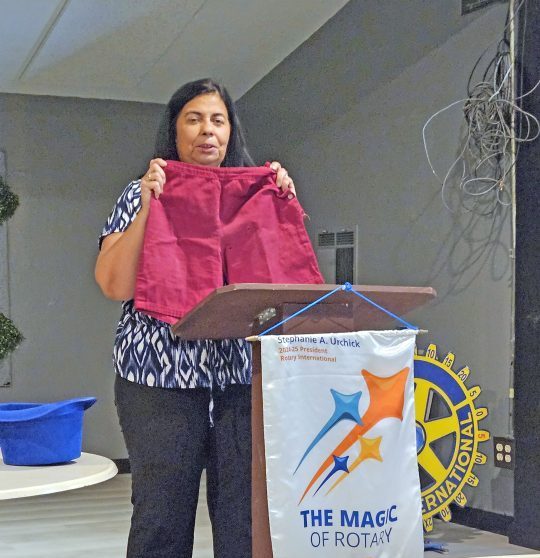
“I spent 53 days wearing the same clothes,” Hilda said, holding up the shorts she had worn. “What I saw when we landed will always be my image of the U.S. You have the privilege of having been born here. I only see the good – there is no bad.
“I saw young men, American men, trying to breathe life into my father. They worked as though their father was on the ground. That’s my vision of the U.S. – people who save lives without asking who you are, what your political agenda is. By all accounts, my father was the worst unhoused person you have ever seen. Imagine the worst. And there was the Coast Guard, saving him.”
The men kept smiling at her, Hilda said, and offered her an apple, which she had never seen.
They arrived in Key West. “The person who extended a hand to me was a Marine,” Hilda said. “The military welcomed me. I thought, ‘This is the promised land.’”
Her father had promised that, when they arrived in the U.S., they would call his brother, who was already in the U.S. She called him, saying, “Uncle, we’re here, in the U.S.”
While she waited for her uncle to arrive, Hilda said, “I saw nothing but kindness.” Her brothers arrived shortly thereafter since they were on the other boat. “My uncle took responsibility for us.”
They stopped at a gas station and went into the convenience store. “I had never seen a store like that. In Cuba we stood at a counter and gave them our ration card. I had never seen a place where you could just touch things, grab things. There was ice cream – in Cuba you had to eat it at the parlor. You couldn’t take it home.”
While in the store, Hilda realized her uncle and the attendant were talking about her. “We had to leave as I had no shoes. I had not worn shoes for 50 days.”
Reflecting on her journey, Hilda told the Rotarians: “We had just arrived in the promised land and there was nothing that could go wrong. For me, the last 43 years in this country have been positive. There is nothing wrong. When I arrived, I realized I had left prison.”
Hilda reminds us all that “we have a duty for the next generation. Spread the word of freedom. Teach children who don’t know what Cuba or Russia is about, that they have to vote. When children vote at 18, they are already involved in what is going on. Don’t tell them how to vote but to vote.
“Don’t be surprised by a law that has passed while you are not involved.
“I may have been an immigrant, had a terrible childhood, went through hell for 53 days but I am here – I have arrived.”
Hilda added that she hadn’t planned to tell her story, one her husband, Dennis, was unaware of. Her children didn’t know. “I was too embarrassed,” she said. But now she feels better, having talked about it. “It took everything in me to relive this story,” she said.
Hilda Valenzuela Wendtland now lives in Redlands, where she is a real estate agent. Her book, Barefoot to Freedom, is available on Amazon.


0 Comments