



By Mary-Justine Lanyon
Editor
Mike Pate, general manager of the Arrowhead Lake Association, left the Lake Arrowhead Dam and MacKay Park advisory committee stunned as he concluded his report to them on the status of the dam.
“This is the largest challenge since the new dam was built in 1974,” Pate told them.
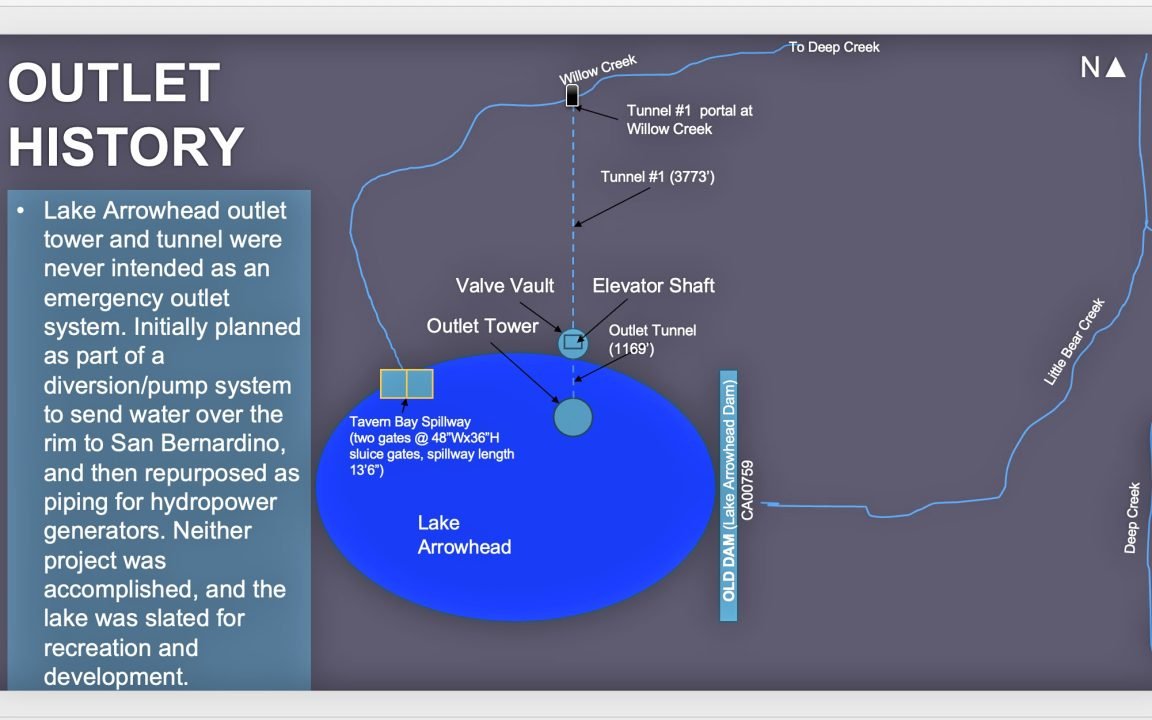
Lake Arrowhead outlet history
The challenge? ALA must, according to the directive from the Division of Safety of Dams, develop a way to lower the level of Lake Arrowhead in case of an emergency.
When Lake Arrowhead was first crested, Pate said, the tower was put in but it was never meant to be an egress for emergency use. The thought was it would provide water to the bottom of the hill.
“There are no emergency means to empty Lake Arrowhead – this was overlooked for decades,” Pate reported. “The problem we’re facing as a community could have been avoided at a couple of points.”
Pate had a meeting with the DSOD and eight engineers on Aug. 29. They said, Pate said, “had we maintained and exercised the valve system 30 years ago, they probably would have grandfathered us in.”
One of the engineers, Pate noted, “was stunned when he learned there was no egress from Lake Arrowhead. We are grateful they are not threatening us in any way.”
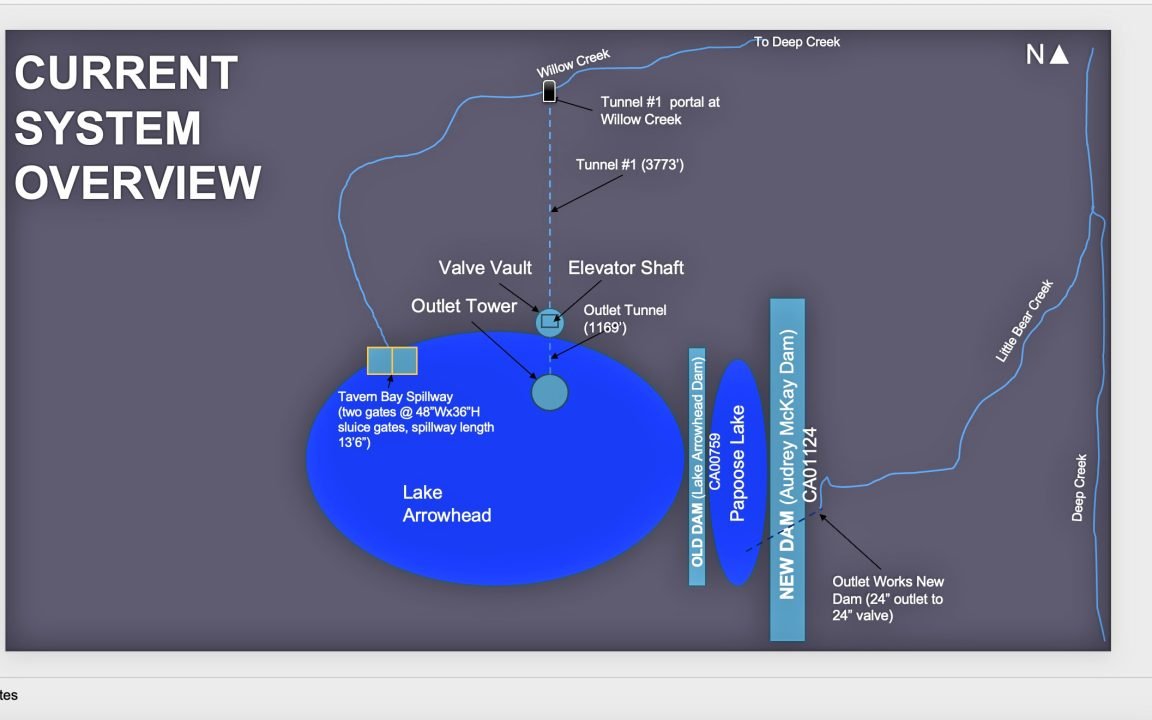
The current system overview
When the new dam was built, there were plans, Pate added, to add a spillway and egress through the new dam (Papoose). But the budget ran out. “It would have taken $1 million more to build it the way they would have liked but they approved it.”
There were two key moments, Pate told the committee: They should have maintained the valves. And they should have built an egress system through Papoose.
“That didn’t happen.”
This became a major issue with Oroville nearly failed and DSOD began sending ALA strong emails. “Covid put that dog to sleep for a while on both sides,” Pate said. He received an email from DSOD and called them. Their question? “Where is your report?”
“We got the ball rolling immediately,” he said. “We followed their request and instructions.”
ALA contacted Tetra Tech, who had done an initial valve study in 2000. They shared three options, which were very preliminary. “There was no way to do a full testing of the old system to know if what they were proposing was truly possible or adequate,” Pate said.
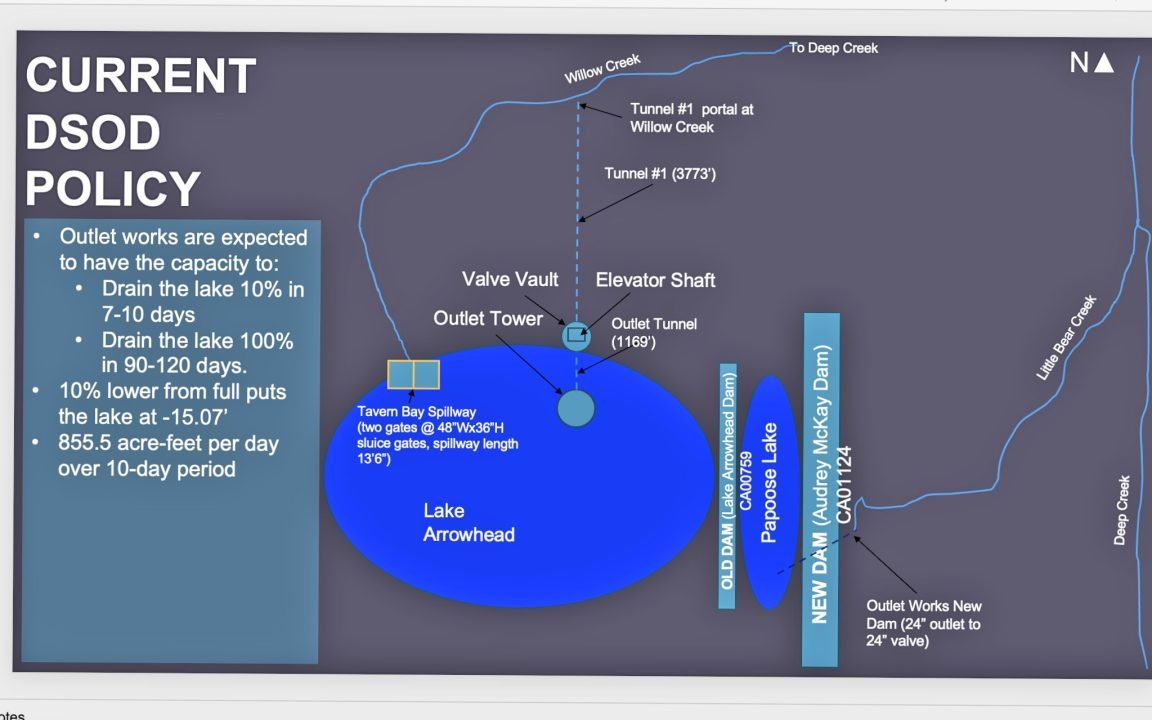
The DSOD requirements
Of the three options, there is one DSOD said might suffice – a $13 to $14 million solution.
Fast forward two years, Pate said, DSOD has made it very clear there’s no known way to test the seismic reliability of the tower, the valves, the systems under the water. The tower goes down 180 feet to a tunnel that is not accessible; it has water in it. Maybe, Pate suggested, someone could get a drone in it.
“DSOD is of the opinion there’s no way the tower would be adequate to build a new egress system for Lake Arrowhead,” he said.
What is required? ALA has to be able to lower Lake Arrowhead 10 percent in seven to 10 days and to empty it in 90 to 120 days. “Even Tetra Tech’s best solution didn’t come up to the 120 days,” Pate said. “But they were close to 10 percent in 10 days.”
And, Pate noted, “DSOD has made it clear they are not responsible for coming up with a solution. But they have the authority and regulatory might to insist we solve it. We don’t want to be caught sleeping at the wheel.”
So what is ALA doing? “We are beginning to come up with a draft timeline. We sent a similar one to DSOD with a proposal of how we will proceed. We haven’t heard back from them yet.”
But what they have heard from DSOD is that have to meet the regulations. “They are very nice but inflexible,” Pate said.
As the ALA general manager, Pate has spoken with Lewis Murray and Supervisor Dawn Rowe, he has met with Senator Rosilicie Ochoa Bogh and has a meeting set with Congressman Jay Obernolte.
ALA has formed a valve committee, chaired by Past President David Dahl.
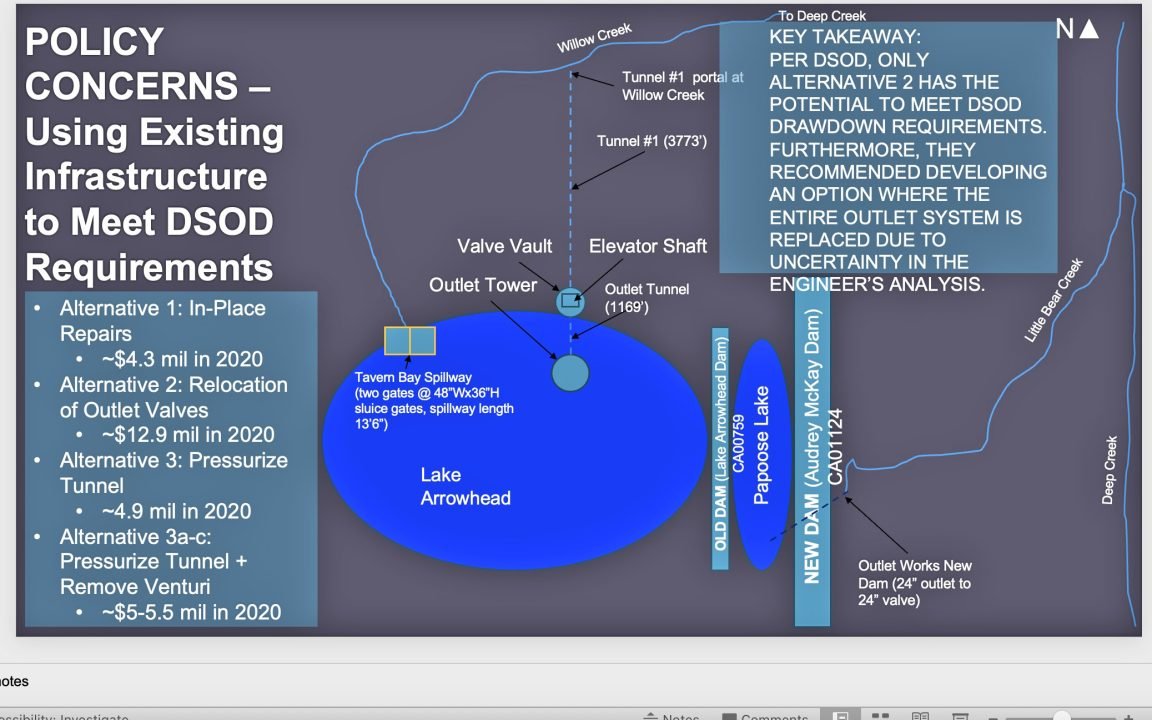
The key takeaway
Pate did ask DSOD about possible solutions. They pointed to the Newell Dam in Santa Cruz, which had a similar tunnel and tower system. They just completed their project at a cost of $100 million. However, Pate noted, “this isn’t apples to apples. Their expenses were not similar to ours.” The Newell Dam project took five to six years. How did they pay for it? Pate said they were able to get federal grants. “We might be able to find some grant money but we are in a trickier position as this is a private lake.”
Pate did receive an email from the head of DSOD about a grant opportunity for several hundred thousand dollars. He just completed the application, which was approved by the ALA board; it is for a $400,000 initial grant to do the first steps – look at engineering firms and possible solutions. “Maybe they know of some options that are less expensive,” Pate said.
He anticipates the largest and longest part of the process will be the CEQA and environmental impact statement. “That could take years,” he said. “We are looking at it being into the 20s or 30s to complete the project. It’s only been a few weeks since we learned of this exciting project we’re facing. This will require the entire community to be involved.”
When committee member Brenda Murray asked if ALA has the reserve funds to cover this project, Pate said, “Nothing on this level.
“There’s not a chance on this earth ALA could pay for this kind of project.”





0 Comments