



By RHEA-FRANCES TETLEY
Historian
Logging in the San Bernardino Mountains started during the 1840s Mexican era using primitive sawpit methods, followed by David Seely who built a water-powered sawmill on Seely Flats in the 1850s. Lumbering moved into Little Bear Valley using steam power and continued eastward.
Elderly David Seely sold 1,600 acres of timberland to James and C.D. Danaher in 1890 near the future Running Springs. The Danahers organized the Highland Lumber Company in 1891, opening a modern sawmill using a 260-horsepower steam engine bandsaw at Long Point in Fredalba. It could cut 60,000 board feet a day.
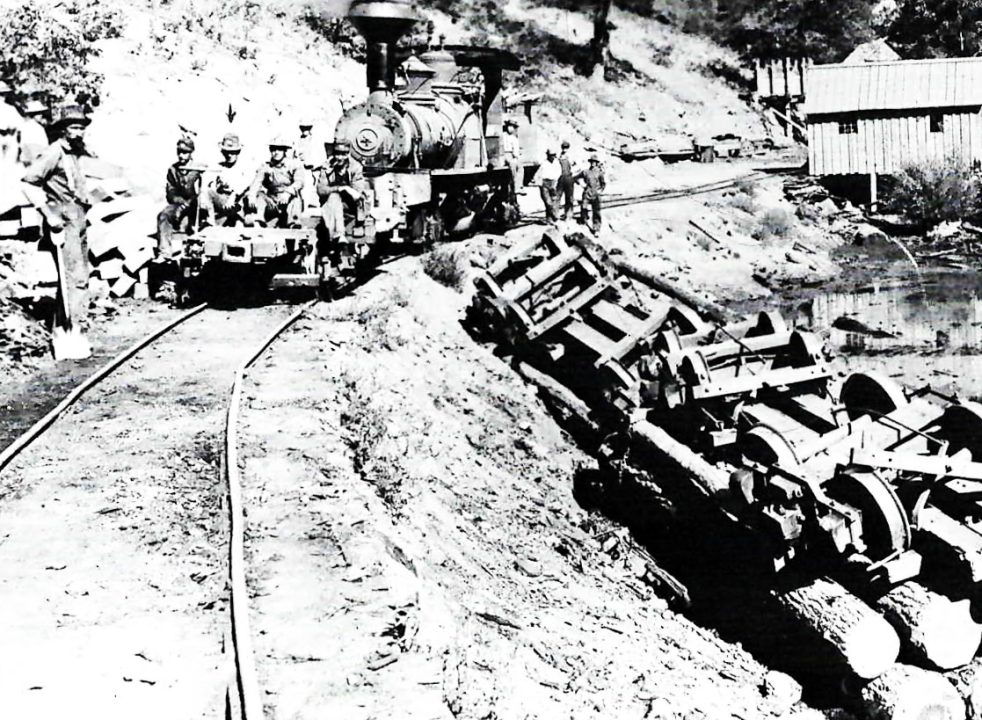
Derailed Brookings logs.
The Danahers wanted to get their lumber to market quickly and built a wagon road up City Creek Canyon from Highland, using their cut lumber to build bridges. They roofed the mill for year-round milling and built 35 cabins for employees. Unfortunately, the national depression of 1892-93 shuttered the mill.
In 1899, the Danahers’ Highland Mill and timber rights were sold to the well-financed Michigan-based Brookings Lumber Company, who enlarged the operation significantly by adding 6,000 acres. Brookings added modern efficiency by hauling a narrow-gauge railroad engine, tracks and cars to transport logs from the forest to the mill. This enabled them to move the cut logs efficiently, enabling quick clear-cut lumbering of an area. Then they’d move the tracks to another timber tract to cut. By 1903 there were 200 employees working at the mill.
Between 1901 and 1911, the Brookings Company was delivering about 10,000,000 board feet of lumber per year to lumberyards and to the company’s Molina citrus box plant in Highland. Lumber transportation between the mill and Highland continued via the steep wagon road and accidents were common.
The Brookings sawmill suffered many problems and fires. In November 1900, a fire destroyed the sawn lumber at the mill, but the sawmill was saved. In September 1902, the men were quarantined at the mill for smallpox. In December 1903, a donkey steam engine sparked a forest fire, destroying standing timber but was kept away from the mill.
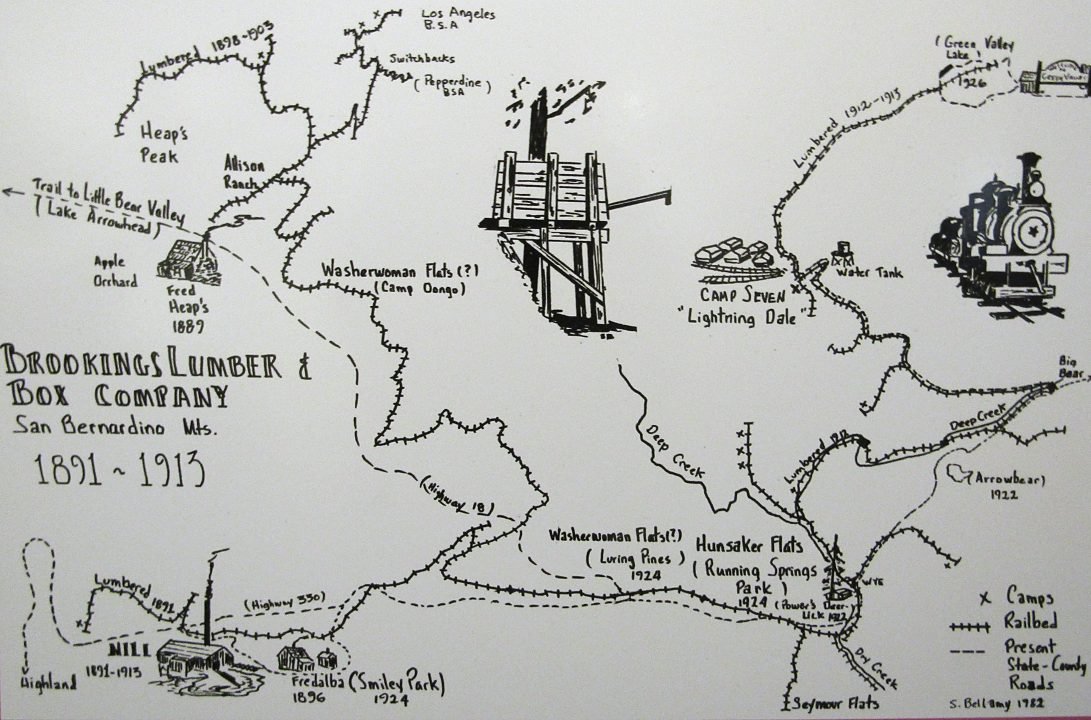
A map of the Brookings Lumber Co. and the surrounding area.
In October 1906, the sawdust in the Fredalba sawmill’s engine room ignited. Workers used the millpond water to fight the fire, but the sawmill and 3,750,000 board feet of stacked lumber were reduced to ashes. By July 1907, a new mill was constructed, but 50 loggers staged a labor strike. Fire again threatened the mill in 1911.
But they enjoyed good times too. The Brookings baseball team, the “Lumber Pilers,” played the Santa Fe Railroad’s San Bernardino Shop team, as well as the “Colton Fruit Express Boys” and the “Pacific Fruit Express” baseball teams, winning enough games to get them newspaper recognition.
However, Brookings’ “clear-cut” methods of logging damaged the watershed of the mountain, resulting in newspaper headlines of “Wilderness Destroyed” in 1904. San Bernardino Valley residents began lobbying to save what was left of the forest, demanding replanting the areas that had been cut. In 1907, another group sued Brookings to not cut the so-called “largest tree in San Bernardino County that was 230 fet tall with a circumference of 20 feet 8 inches.
In October 1910 there was a tour of the newly reforested lands associated with Brookings’ operation, but criticism continued. By September 1912, Brookings had succeeded in cutting most of the usable pine trees but was planting apple trees to replace the pine forests.
In December 1913, Brookings was advertising lumber at a discount to “clear the lot.” The mill finally shut down on June 10, 1914, with a 15-minute-long whistle blast. The population of Fredalba dropped with the departure of the Brookings sawmill workers, when they relocated to the new Brookings sawmill in Brookings, Oreg.
In less than 24 years, the Running Springs area forest had been decimated.



0 Comments