




By Rhea-Frances Tetley
Mountain Historian
The Mormon Road Historical Monument is California State Historical Site #96. It’s located just west of the Crestline Bridge on a portion of the original main road, which is now a large turnout. This is a restored monument, as the original was destroyed during the 1960s while the road was being widened.
The monument’s purpose was to recognize the first road built into the San Bernardino Mountains in 1852 by 100 volunteer men in 10 days to reach the “vast timber resources of the mountains,” described by San Bernardino author Leo Lyman as “a classic feat of community activity.”
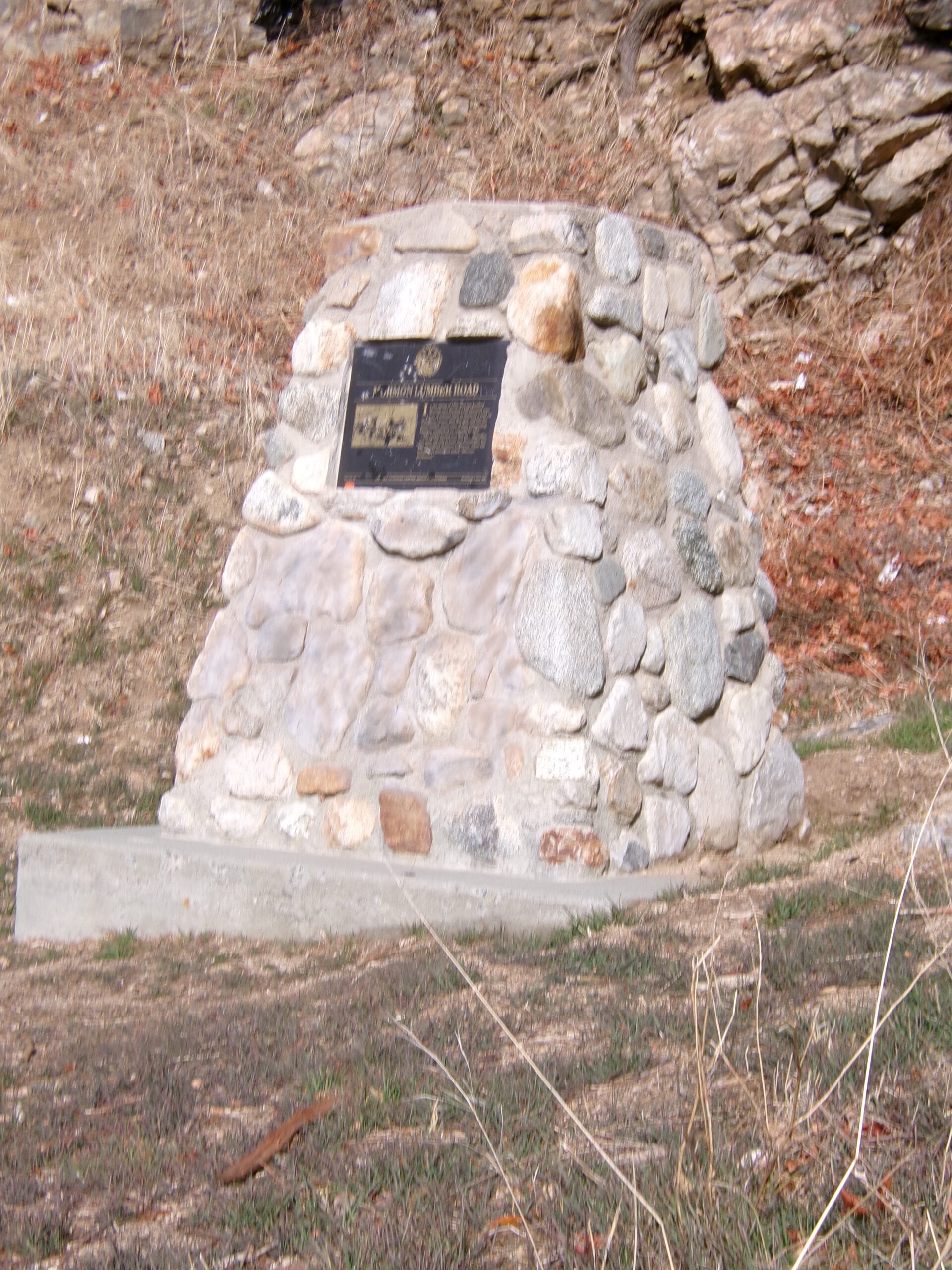
State Historical Landmark #96 recognizes the creation of the first road built into the San Bernardino Mountains by the Mormon Pioneers in 1852 (circa 2000).
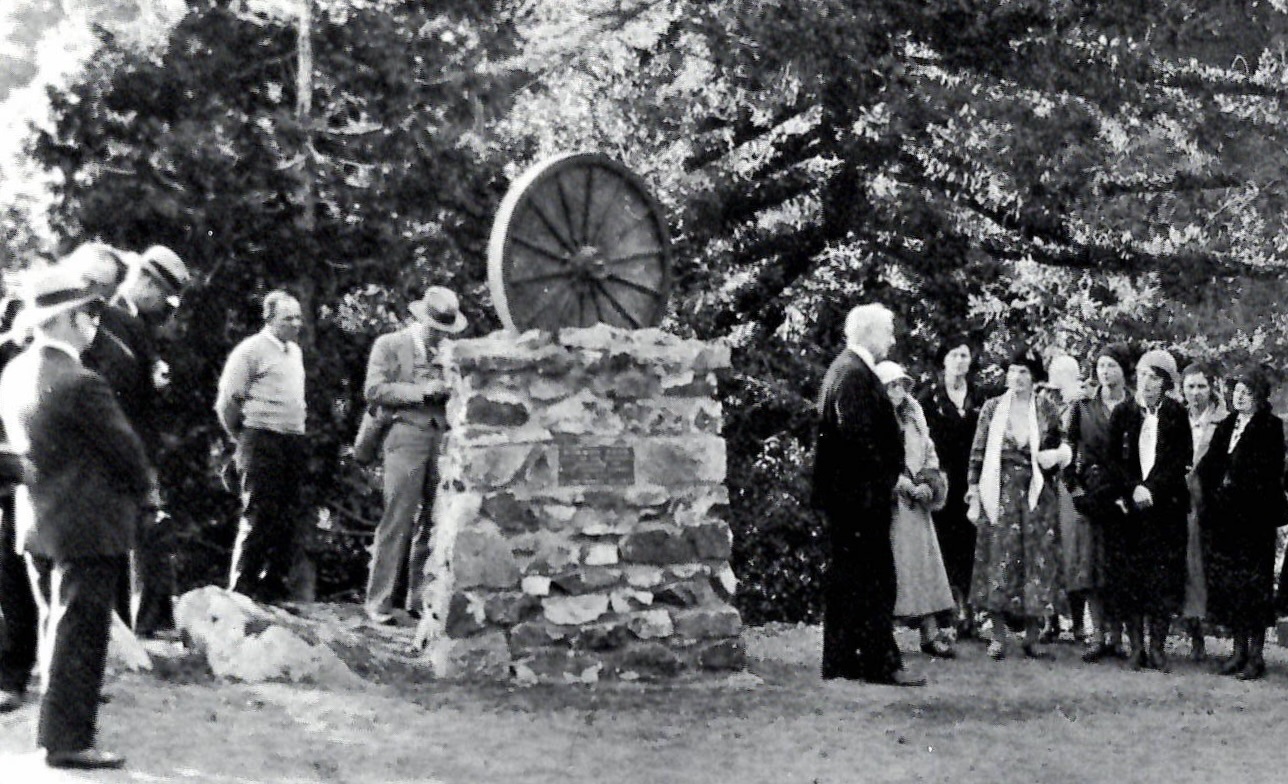
The original Mormon Road Monument aka Pioneer Monument was dedicated on Nov. 10, 1932, by the Thursday Club, which was composed of prominent women who lived in the Crest Forest area. George W. Beattie, a respected educator and author of the book Heritage of the Valley, was the guest speaker.
The stone monument stated, “Mormon Lumber Road, built by the pioneers. Dedicated to the Pioneer Women of 1852 by the Women of 1932, Thursday Club of Crest Forest.” Attending the dedication representing the governor was California Highway Commissioner Frank A. Tetley, who was the developer of Rim of the World Park now known as Valley of Enchantment in Crestline.
The Pioneer Monument remained in that spot until the High Gear Road was being widened as part of a plan to make a four-lane highway to Big Bear, starting at both ends, from the Big Bear Dam and San Bernardino, working to meet at the center of Highway 18 this side of Running Springs. This plan led to the construction of the multiple cantilevered bridges on the mountainside on Highway 18 coming up from San Bernardino to the Crestline Bridge in the mid-1960s. (This full four-lane highway was never completed for numerous reasons, including the discovery of several earthquake faults, skyrocketing costs and the election of a new governor.).
The one-lane Crestline Bridge to Mt. Andresen (which was a repurposed train trestle) had to be replaced because the new highway was to be wider. Mt. Andresen was where the former incline railway had crossed the High Gear Road route at the Crestline Bridge in the 1920s. The dirt from the removal of Mt. Andresen was relocated to a site a quarter-mile to the west, to the current four-lane-wide roadbed fill, adjacent to the original road bed which is now the separated turnout. This fill removed a sharp curve in the roadway.
Vandals started a Caltrans vehicle at that highway construction site and pushed the monument over the cliff one night. The cement wagon wheel top of that original monument was collected, pulled up the cliff and preserved by Pauliena LaFuze and is now displayed at the Rim of the World Historical Society’s Mountain History Museum in Lake Arrowhead.

The Mormon Road Monument dedication ceremony in 1932.
Author and educator Stanley Bellamy attempted to rebuild the Mormon Road Monument in 1983. He rebuilt the base in the nearest turnout but was denied permission by Caltrans, who eventually pushed that stone base over the cliff in 1997, when interest in restoring the monument was again being expressed.
Drive out onto the old roadbed (the separated turnout) and see the Mormon Lumber Road Monument. The current monument was installed by the Sons of the Mormon Pioneers on June 1, 1991, and has assumed the State Historical Monument #96 designation celebrating the original road. The 1991 ceremony attracted 100 people and included speeches by author Leo Lyman and by Pauliena LaFuze, a former educator, noted historian and author of the book, Saga of the San Bernardinos.
Just three-quarters of a mile east, along the oldest section of “The Narrows” of Highway 18, is an ignored turnout with a tree. California Highway Commissioner Frank A. Tetley was promoting the concept of beautifying the state’s highways at the time of the opening of that road section. The Narrows was considered an engineering marvel at its opening, cutting a road up into the side of a steep rock face. Tetley again represented Governor Rolf and cut the ribbon opening the High Gear Road on Oct. 22, 1933.
This cute little turnout could be tied to Tetley’s desire to be sure every highway in California was beautiful. It has a rock bench seat around the shade tree and the view overlooks the valley below with a view all the way out to Catalina Island on a clear day. In an era when the state speed limit was 25 mph, these small turnouts were large enough.
State Highway Commissioner Frank A Tetley cuts the ribbon opening the Rim of the World High Gear Road in 1933.
In his article. “Not an Ugly Highway in California,” Tetley wrote: “California is a beautiful state. There is a glory in its mountains and valleys, an attraction of coasts and beaches; a draw to its rivers, its lakes, its forests and its deserts that has made California a name to compare with among the people and the nations of the world. The enhancement of the highway systems’ beauty is a responsibility equally shared by us all… When placed at a roadside rest, trees could provide shade and comfort during a long journey and allow our citizens to enjoy the scenic views of our beautiful state as they travel. Scenic turnouts along highways will allow an opportunity for motorists to experience the beauty that surrounds them in our state, firsthand.”



0 Comments