

By RHEA-FRANCES TETLEY
Staff Writer
During a heavy rainstorm, over 50 mountain residents gathered to learn about the effects that aging has on the body and mind and what aging actually means.
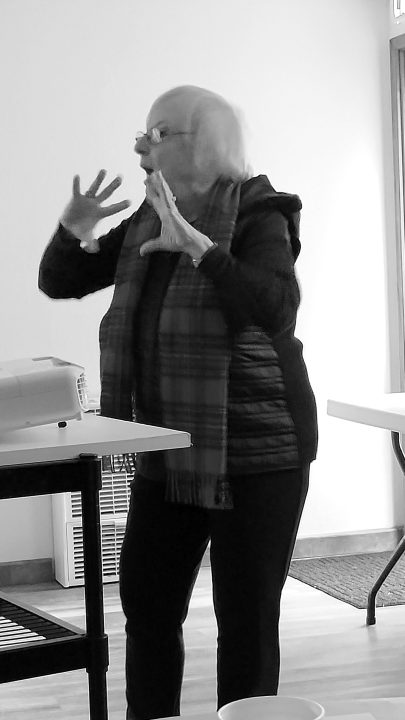
“Understanding Aging” by Jacque Lauder, MSG was presented by Soroptimist International of Rim of the World on Saturday, March 2 at St. Richard’s Episcopal Church in Skyforest. It was the first seminar of a four-part series called “A Walk in the Mountains” on understanding health and wellness, which is being financially sponsored by a grant from the San Manuel Band of Mission Indians.
This seminar on aging used simulations that engaged the attendees to help them understand the physical and social aspects of aging and how that impacts each person, emotionally, as they age. This impact that affects them also impacts all that surrounds them, including their families. The needs of these aging individuals change as they age, and society needs to see that need change to meet those needs. Attending were caregivers, family members and even senior citizens themselves.
One of the goals of this seminar was to create some insight into what “baby boomers” are and their future. Baby boomer is a phrase used to describe the large group of adults who were born after WWII, from 1946 to 1964. The first baby boomers hit the age of 65 in 2011 and, at the rate of 10,000 a day, the last will hit age 65 in 1929. Boomers have always had and are still having a great impact on American society.
This impact is continuing to extend and now the age group of those 85 and older is the fastest growing part of the population at this time. There will be 83.7 million adults over the age of 65 in 2050 and, as health care and social services improve, it may enable the death rate to decline. As this occurs, the perception of what older adults can do will also need to change.
Aging is associated with biological, physiological, environmental, behavioral and social changes and various aspects of how to individually deal with the consequences of those changes and how Americans need to respond to those life changes. Life is a series of changes and losses and sometimes they come closer together and the loss is multiplied, while other times they come slower and are spaced out, enabling some individuals to cope easier. It occurs at different rates in each life and can be impacted by health changes, and some health changes are influenced by external losses. It is the reaction to those changes that is also a part of the aging process.
After age 65, some Americans experience sensory impacts to their bodies. One in six have had their vision impacted and may wear glasses and as they age may have a problem in discriminating between shades of colors, functioning in low light situations and adapting to glare, possibly leading to tripping hazards not being seen. One in four have some hearing loss, often in the higher pitch levels, and sometimes clarity in hearing well such as over the telephone.
More disturbing is that one in four have a loss of feeling in their feet, and this sensory loss can lead to falls. More importantly, three out of four of older adults develop a change in their posture, which can affect their balance when walking, which compounded with the loss of feeling in their feet also can also contribute to falls, which may lead to broken bones and life-changing head injuries.
These sensory impairments may increase with age, and more so over the age of 80, compared to those in the 70-79 age group. Vision and hearing impairment doubles in the 80s but can be corrected or improved by technology, such as hearing aids, glasses, eye surgery and enlargement of print. Loss of feeling in the feet increases by 40 percent, so when walking those older adults need to be more aware of their surroundings and potential trip hazards.
The cognitive levels of older Americans can be affected by depression and isolation and by less challenging mental input, often from a lack of friends and interpersonal social interaction. This dementia, or memory loss, is normal with aging. The difference between memory loss and dementia is that memory loss is not disabling.
Dementia is disabling and is marked by a decline in two or more intellectual abilities such as memory, language, thought, abstract thinking, communication and judgement. This decline in judgment may lead to the thought they have no boundaries, reflecting that impairment in thought and possibly not acknowledging their physical limitations.
Those around older adults need to promote independence but be aware if they have a decrease in their communication skill sets or increase in individual needs and help them with shared decision-making when necessary and useful for their well-being.
Alzheimer’s is just one form of many types of dementia but is the best known. It is where the patients progressively lose the ability to communicate effectively and can get confused and agitated when confronted, so respect and positive techniques are needed to work productively with them as they can go in and out of dementia. Social services are being updated and changed to respond to those changes.
This awareness of creating and having an understanding and empathy toward the challenges associated with aging is essential, says Lauder. “The growth of the older adult population is impacting communities, families and individuals and transforming the way organizations conduct business and deliver services in the community. It presents a unique challenge.”
The next seminar in “A Walk in the Mountains” series will be held on April 13, also in the social hall of St. Richard’s Episcopal Church at 28708 Highway 18 in Skyforest. This second seminar will feature a panel of speakers on breast cancer survival, discussing their challenges, experiences, thoughts and concerns after diagnosis and treatment for cancer.
Soroptimist International of Rim of the World has been active for the past 20 years, supporting cancer diagnosis and awareness through their October cancer walk, and by offering free diagnostic mammograms each October at Mountains Community Hospital through their mammogrant program. They fund their programs, including their Every Girl Counts, for Mary Putnam Henck Intermediate school-aged girls, through their annual daffodil sales and sales of their community discount cards. The upcoming seminar on cancer survival will be the second in this four-part Soroptimist series of health and wellness.





0 Comments