



By Mary-Justine Lanyon
Editor
Tustin resident Susan Svoboda had always been a very healthy person. Like so many adults of her age, she had had her tonsils removed as a child. And she gave birth to two children in the 80s – without so much as an aspirin.
So it came as quite a shock to her when, in November 2021, she was diagnosed with breast cancer.
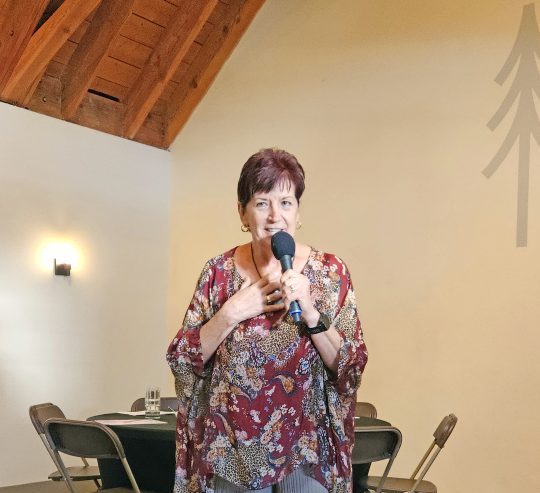
“I had never missed a mammogram,” she told members of the Women’s Club of Lake Arrowhead at their Sept. 18 meeting at Refresh in Crestline. She was scheduled for her annual test that November but felt she was just too busy. When she tried to reschedule it the day before, she was told it was too late. And so she want.
Two days later, she got a call to return for another mammogram. “Alarms went off,” she said. In addition to the second mammogram, she also had an ultrasound and then a biopsy.
“I was a wreck,” she admitted.
She met her surgeon who told her the breast cancer – invasive ductal carcinoma – was close to the front of her left breast so she would have to remove the nipple. Svoboda was also told she would have a six-inch scar.
“It was devastating to hear this,” she said.
Svoboda had her surgery in January 2022, under Covid conditions. Her husband had to drop her off, leaving her out in front of the hospital.
In the “old” days, she told the Women’s Club, surgeons would take 12 to 14 lymph nodes on the side of the breast cancer. But today they can take just two or three and get the same results.
The surgery went well, she was told. Her cancer was early stage.
And then the journey began. Svoboda met with her oncologist. She went armed with a notebook in which she wrote down all her questions. “Because you’re scared,” she said, “you forget what you wanted to ask.”
The results of her Oncotype DX test showed she had a low enough score that she did not have to have chemotherapy. However, the oncologist did recommend she take an estrogen inhibitor for five years. Svoboda went home and researched the side effects of the pill. “I couldn’t sleep for a week, thinking about it,” she said.
She asked the oncologist about her chances of getting breast cancer again. With the pill, she was told, the chances were 4 to 5 percent; without it, 8 to 10 percent. She chose not to take the pill and risk the side effects, which can include joint pain, dizziness and bone thinning.
Svoboda was quick to say that this was her personal decision; she is not advocating for others to follow suit but to make their own decisions.
“You need to be your own best advocate in anything medical,” she said. “Ask questions – ask more questions. If a doctor acts as though you’re asking too many questions, get a new doctor.”
The next stop on Svoboda’s journey was a visit with a radiation oncologist. She was scheduled for and had 15 treatments. “I’m a very high energy person,” she said. “This knocked me on my rear end. I still did everything I needed to do but I would sit down to rest and fall asleep.”
Today people ask Svoboda if she is cured. “There’s no such thing,” she said. “I am in remission.”
The news that she had breast cancer hit Svoboda very hard. “I told very few people,” she said, adding it was most difficult to tell her grandchildren. But those grandchildren bolstered her spirits by sending her loving texts, telling her how much they loved her, that she is the strongest person they know.
“I printed out those texts and put them in my notebook,” Svoboda said. “I realized I had the outline for a book.”
That book, I Hate the Color Pink: One Woman’s Emotional Journey with Breast Cancer is available on Amazon.
As for the title, Svoboda said she hates all those pink ribbons. “They always remind me of my breast cancer,” she said.
A few people close to Svoboda told her they had no idea she had had breast cancer until she announced the publication of her book. “They were angry. I said it is my story to tell.”
Svoboda has talked with a number of book clubs and other organizations. At the end of one talk, she said, a woman came up to her and said she was 49 and had not yet had a mammogram. “Because of your talk,” the woman said, “I have an appointment next week.” Svoboda said she has countless stories like that.
Her advice to other women? In addition to getting your mammograms, Svoboda said women have to “find their tribe – other women who lift you up, praise you, encourage you.”
Men, she noted, are linear. They want to find a solution. “Women like to meander, talk about stuff, rehash. That’s why we have girlfriends.”
Throughout her journey, Svoboda writes in the book, she experienced the kindness of strangers.
She had started running at the age of 55, running first 5Ks and then half-marathons. She had set a goal of running 65 half-marathons by the age of 65 and she accomplished that.
“I believe exercise is vital during the whole journey of breast cancer,” she said. “Exercise is a powerful tool in your breast cancer toolbox.”
A year after her surgery, Svoboda was happy to receive the news of a benign mammogram.
bre



0 Comments