



The cost of operation to citizens going forward is my issue.
By Mary-Justine Lanyon
Editor
A year ago, local contractor Kory Griggs of Indoor Weather Heating, Air & Refrigeration became aware of some amendments to rules for gas furnaces and water heaters being proposed by the South Coast Air Quality Management District (SCAQMD).
“I lost sight of them,” Griggs told the Government Affairs Committee (a committee of the Lake Arrowhead Communities Chamber of Commerce), “and then saw a final presentation this October. They struck me as a little much, to be honest, insofar as what they are proposing will cost citizens of the SCAQMD, including the mountain communities, a very large amount of money.
“Citizens have no idea about what is coming.”
Griggs’ reason for speaking out about the proposed rules is to “spread good information and try to get the citizenry involved to the best of my ability. The only way to effect change is to get the people who it affects involved.”
These rules, he added, won’t affect the manufacturers and won’t affect him. In fact, he said, “I will make more money.”
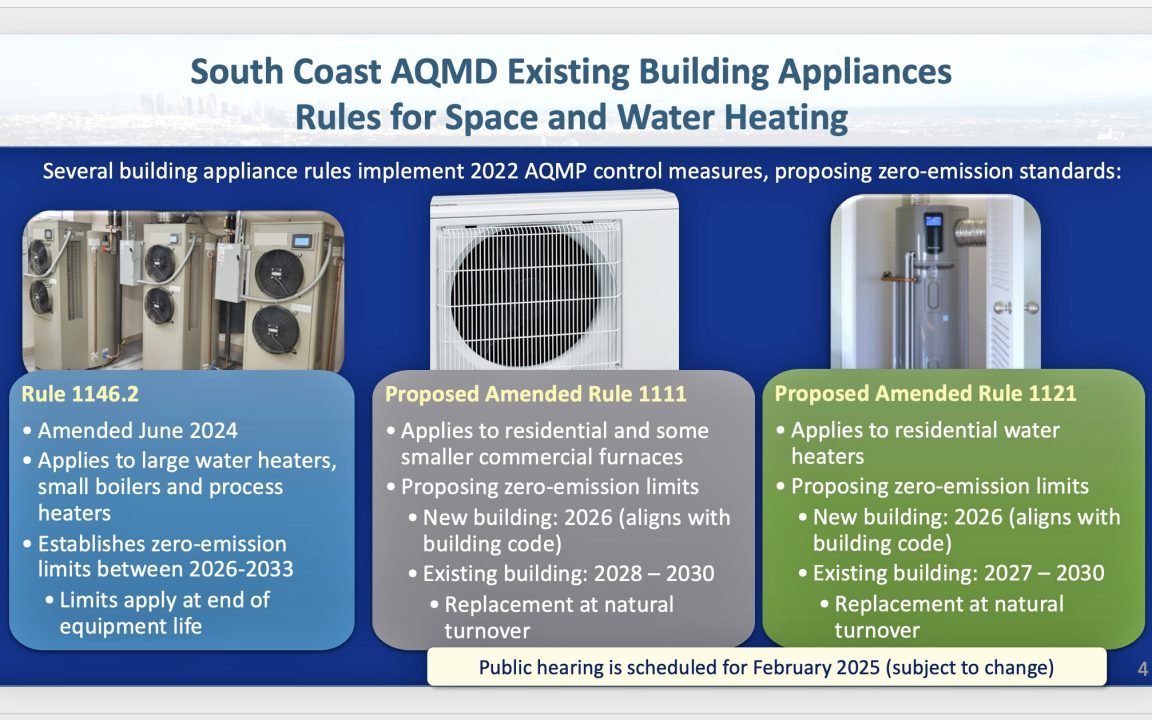
The two rules that would affect residents, if passed, are Rule 1111 and Rule 1121. The first applies to residential and some smaller commercial furnaces; the second to residential water heaters.
They are part of SCAQMD’s proposed zero emission limits. New builds would be required to have electric furnaces and water heaters installed by 2026, which aligns with the building code. Existing gas furnaces would be replaced in 2028 to 2030 at their “natural turnover.” Existing gas water heaters would be replaced in 2027 to 2030, also at their “natural turnover.”
Michael Krause and Heather Farr of the SCAQMD shared their perspective on the proposed rules.
Michael Krause, the SCAQMD assistant deputy executive officer, and Heather Farr, the SCAQMD planning and rules manager, participated in the Government Affairs Committee meeting.
Krause clarified that, for homes with existing gas appliances, those residents would not be required to remove them and replace them. Instead, they would replace them with electric when the existing ones fail. “We recognize these appliances last about 20 years,” Krause said. “Their natural replacement might be in 2044.”
SCAQMD was going to vote on these proposals on Dec. 6, Griggs noted, but they delayed the vote for 90 days. “We stirred up enough hoopla on the mountain, got public comments in and swayed the governing board to delay. They said they wanted to delay to get more public comments. They recognize the public is directly affected by this in ways the AQMD doesn’t usually affect the public.”
Griggs told the committee he has several issues with these proposed rules. One is the cost of installing a heat pump, which would be the preferred zero-emission technology.
When he adds air conditioning to a home, he said, the average ticket is $18,500. The average ticket in the winter to replace a furnace is $6,700. With the switch, the average ticket in winter would be $18,500. “There is no difference between a heat pump and air conditioning – it’s the same system.”
And in addition to the cost of the system itself, there is the cost of upgrading an older home’s infrastructure. “Most people on the mountain don’t have the infrastructure to deal with this 300-percent cost increase for installation.” Some homes will be relatively easy to make the change, but many will not be.
But “what really gets me,” Griggs said, “is the cost of operation. I have gone through the math to try to figure out how this makes sense.” He acknowledged that heat pumps are more efficient than gas furnaces. The problem lies in the cost of electricity in Southern California.
“The average electric bill in Southern California is almost 400 times more expensive than the average in the U.S.,” he said. “AQMD wants us to switch to a fuel that costs us on average 40 cents per kilowatt-hour (kwh) when the rest of the nation spends 16 cents per kwh.”
Residents will have to spend money on infrastructure upgrades, turn on the system and their average utility bill will go up 300 to 500 percent.
Griggs noted that he installed a heat pump in his home; his electricity bill went up almost 500 percent to heat the house in the same way a gas furnace could.
“The cost of operation to citizens going forward is my issue. No one has planned for a $1,000 electric bill every month.”
Griggs has been talking with the SCAQMD and was pleased to say they have been working with him. Representatives came up to the mountain, visited Griggs’ shop and walked some job sites.
Input from SCAQMD
Krause told the committee that “this is not a new arena for us as an agency. We were the first agency in the U.S. to address an air quality issue.”
He added that heat pumps are not a new technology. They are, Krause noted, in wide use in Scandinavian countries “where it’s cold in winter.
“We are trying to clean the air, create a good public health environment for the 17 million folks who live in the metropolitan area.”
Krause said this is new terrain in the sense they are looking at fuel switching. “In the past we have regulated furnaces and water heaters. Rules have been on the books for decades. We work with the manufacturers to create better, cleaner technology. This is a different way to generate comfort heating and water heating.”
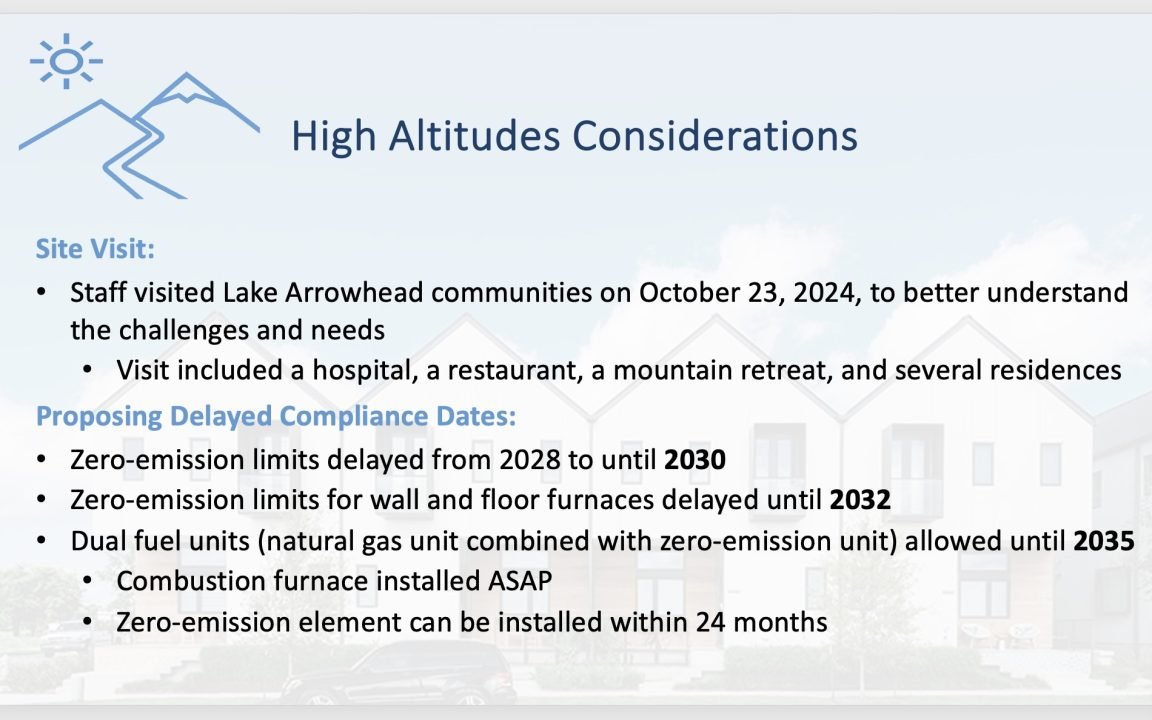
Farr noted they have adjusted proposed compliance dates, extending the dates where the agency thinks it will be more challenging.
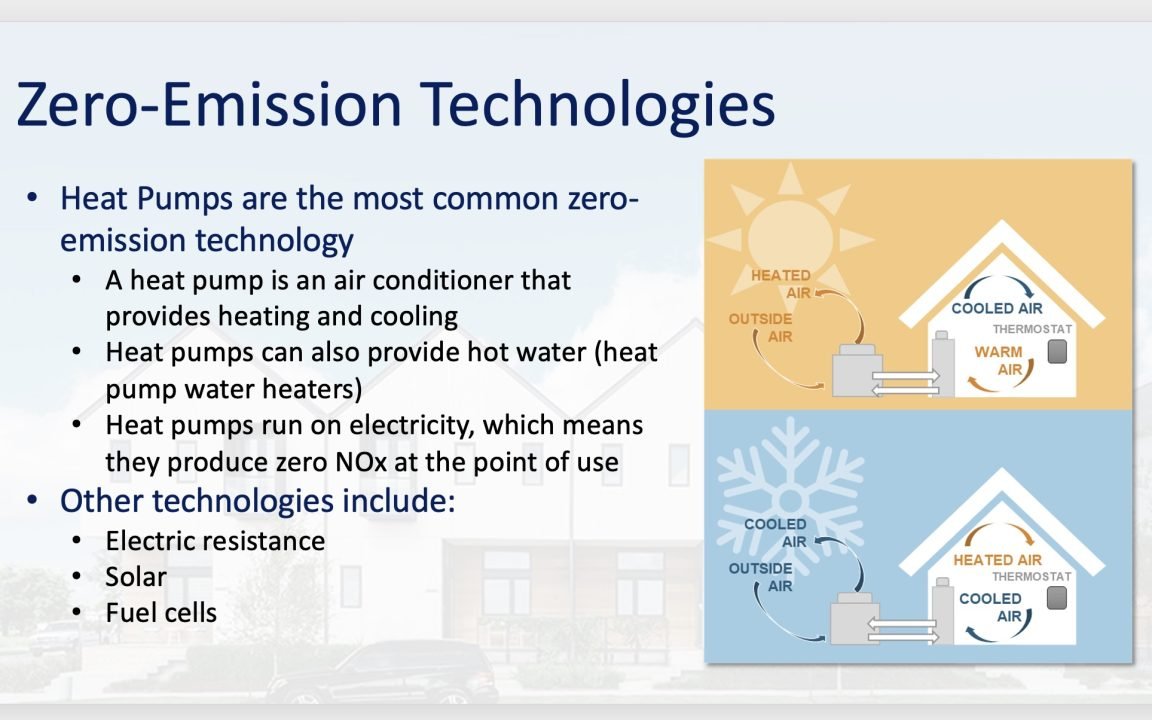
“We are technology neutral,” Farr said. “There are different types of technology but heat pumps are the most common. One unit serves as heating and cooling and operates on electricity. There are no NOx emissions. They run very efficiently.”
Farr went on to say that they looked at the costs and made some projections. “We forecast the cost of electricity versus gas. It showed gas would go up more, electricity would stay stable. We project a cost savings over the life of the unit. We are seeing a lot of technology development so the prices of the units will come down.”
She acknowledged the input from Griggs, saying the conversations they have had have been very helpful.” As a result, they have proposed some delays in implementation at higher altitudes. “We will give the mountain area a longer time to comply with zero emissions,” she said.
Should a mountain resident experience an emergency during the winter – their gas furnace fail – SCAQMD recognizes they need heat immediately. They would be permitted to install a gas furnace, which would have to be replaced with zero-emission technology in 24 months.
Air Quality Specialist Emily Yen joined the conversation, noting there are a number of rebates available which SCAQMD hopes will be “stackable.” The capital cost, she speculated, will be essentially covered.
SCAQMD released a request for proposal for Go Zero, an upcoming pilot program to encourage the transition to zero-emission appliances. There would be rebates for heat pumps for single-family and multi-family homes and for small businesses. There would be funds available for installer training.
SCAQMD hopes to launch the Go Zero incentive program by early 2025.
Griggs concluded the presentation by making something very clear: “There is nothing wrong with heat pumps. Almost every air conditioning unit we install is a heat pump. They are very efficient at heating and cooling a home. I want to be the heat pump expert in the mountains.
“The issue,” he reiterated, “is the operating costs and the amount the heat pump has to operate are excessive.”
Griggs said he had been heating his home with a 100,000 btu gas furnace. The biggest heat pump he could install only produces 52,000 btu. “The system has to run longer. It will heat the house but it will run 50 percent more often than a gas furnace. I’ll be warm. The system will be quiet and efficient.”
Laura Dyberg, the committee chair, told the SCAQMD representatives it would be good to schedule a couple of public meetings on the mountain. “That would address Kory’s concerns about educating people. We can get people informed and give them a chance to share their thoughts.
“We have to make the information digestible to the average citizen.”





0 Comments