



By Mary-Justine Lanyon
Editor
The goldspotted oak borer, which is native to Arizona, was first detected in Southern California – in San Diego – in 2004. For several years, mountain residents have heard the warning to “buy it where they burn it,” referring to firewood, which was believed to be the way the pest was being brought into new areas.
This past September, the GSOB was detected in oak trees in Crestline.
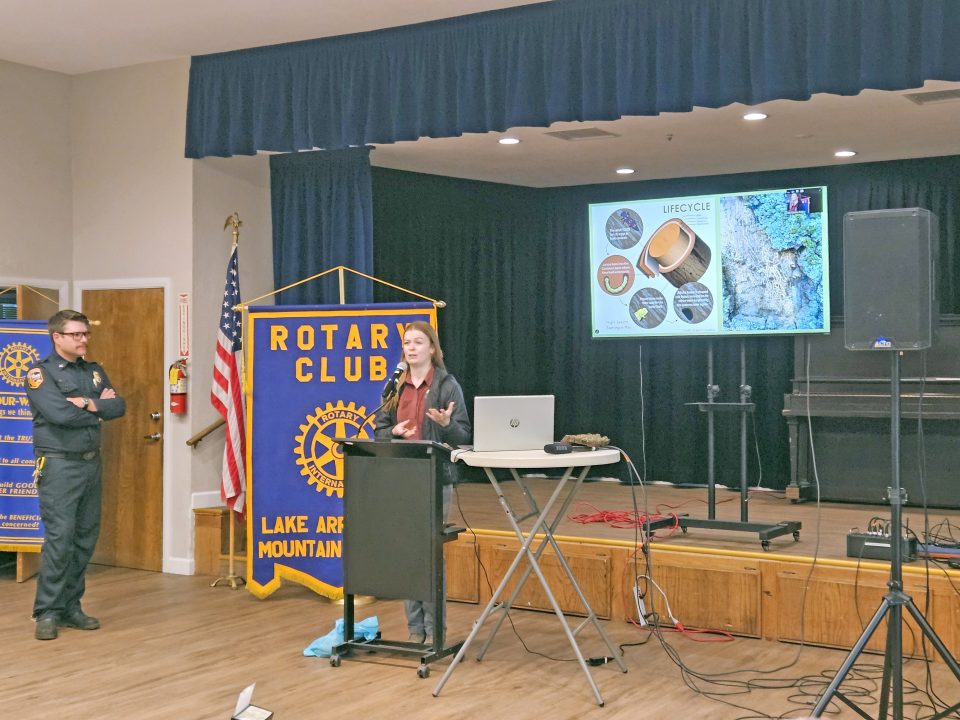
Kayla Thompson, a forestry programs specialist with the Inland Empire Resource Conservation District, and Ian McBride, a forester with Cal Fire, educated members of the Mountain Sunrise Rotary Club on the GSOB at the club’s Dec. 18 meeting.
“Hotspots are near campgrounds,” Thompson said. She said there are three types of oak that act as host trees: the California black oak, the coast live oak and the canyon live oak. The black oak is the preferred host, she noted.

These three types of oaks are the host trees for the GSOB.
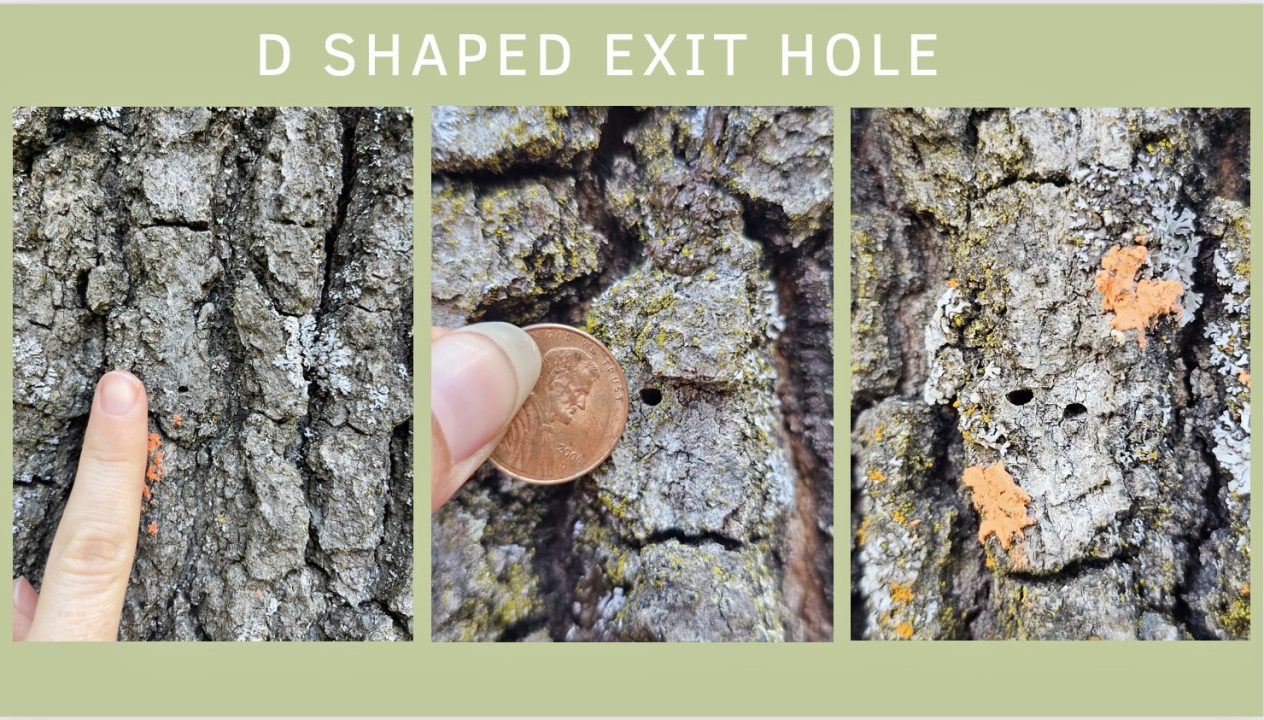
The GSOB makes a D-shaped exit hole in the oak tree’s bark.
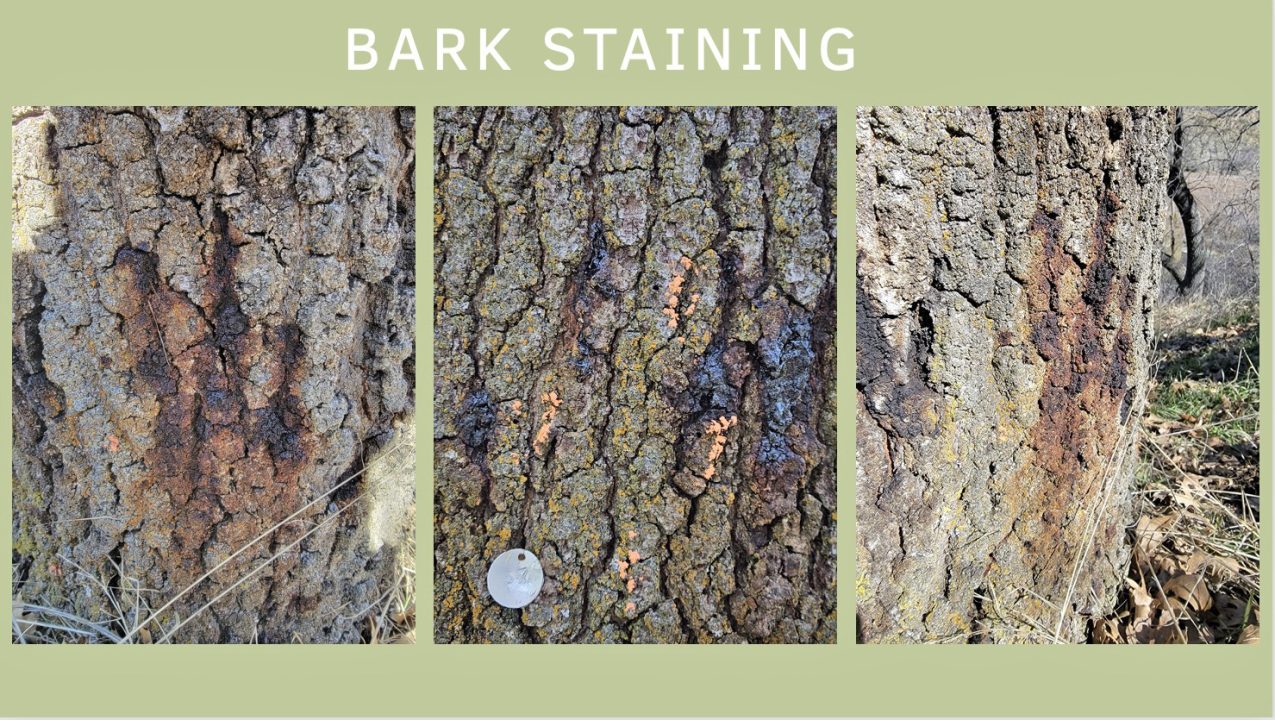
Another sign of GSOB infestation is staining on the bark.
The GSOB was first found in Crestline on Moon Drive, close to Lake Gregory. “We surveyed 50 trees and found 10 infected trees near power lines.” Because of their proximity to those lines, Southern California Edison removed them.
The GSOB larvae create D-shaped exit holes in the bark. Thompson passed out GSOB “business cards,” with such a hole punched in it. The GSOB also leave a telltale blue staining on the bark.
When a survey is done of trees, the crew rates the level of infestation according to the number of exit holes. Low is zero to nine, medium 10 to 24 and high 25 or more.
There are management practices that can be implemented. Injections during the larval stage from November to February can be done every two years. And contact sprays can be done annually at the beginning of the GSOB flight season in May.
Once a tree is infected, the tree can be treated and, if necessary, felled and tarped with UV-resistant plastic for two years.
The Inland Empire Resource Conservation District is working with private landowners to detect GSOB on their properties. They will inspect the trees, tagging or marking any that are infected. They will make management recommendations and provide a map of the survey to the landowners.
“We have surveyed over 6,057 oak trees on 199 properties,” Thompson said, adding that 60 trees have been removed.
As for how residents can help stop the GSOB spread, Thompson had these suggestions:
• Buy local firewood that is sourced within 50 miles of where it is burned. Ten miles is ideal to further minimize the risk.
• Buy debarked, heat-treated certified firewood when possible.
• Help spread the word about the risks these invasive insects pose to the forest.
• Have your neighborhood surveyed.
McBride told the Rotarians that “pests kill 10 times the number of trees as a normal fire.”
As a forester, he oversees timber operations. He noted there is an insect control program being established at Pilot Rock.
“The black oak is resilient,” McBride said. “We can’t stop the spread of the GSOB but we can slow it down.”

Laura Dyberg brought this inflatable GSOB to the Rotary meeting. (Photo by Mary-Justine Lanyon)
He also told the Rotarians about the Sawmill demonstration project Cal Fire is creating off Grandview Road in Twin Peaks. This southernmost demonstration state forest will showcase what a healthy forest looks like. It will include hiking and biking trails.
Laura Dyberg, president of the Mountain Rim Fire Safe Council, said the GSOB is a “different situation from the bark beetle, which is indigenous to the mountain.” When the bark beetle infestation and damage to pine trees took place, it was due to having too many trees and too few nutrients. The GSOB is invasive.
“Millions of dollars are being put into finding the best treatment,” Dyberg said. “They are having tremendous success in San Diego.”
“To have a healthy forest,” McBride noted, “you need a diverse forest. There will always be outbreaks. To maintain the forest, we need an ecologically diverse forest. Oaks are in a constant state of growing and dying.”
To find out more about having your property surveyed, send a message to forestry@iercd.org. And for more information on the GSOB, visit www.gsob.org.




0 Comments