



By Mary-Justine Lanyon
Editor
During the public comment section of the Jan. 28 meeting of the Lake Arrowhead Community Services District board, ratepayer John St. John raised the question of how and how often LACSD’s hydrants are inspected.
The question came up due to the lack of water Los Angeles firefighters were able to get from hydrants while fighting the Pacific Palisades fire.
In response, Field Operations Manager Nathan Porter read a statement describing LACSD’s protocol:
LACSD’s valve and hydrant maintenance program is a proactive strategy designed to ensure the reliability and efficiency of the water distribution system. Each valve is thoroughly inspected, debris is removed and the valve is operated through its full range of motion. This process helps prevent issues such as rust, corrosion and mineral deposits, which can hinder valve function and proper shutoff.
In conjunction with valve exercising, the District conducts hydrant flushing. During this process, each hydrant is thoroughly inspected to identify and address any maintenance or repair needs, ensuring their reliability in emergency situations. If a hydrant requires repair, it is classified as a high priority, and repairs are completed without delay.
By integrating the valve exercising program with hydrant flushing, the District maximizes its maintenance efforts to enhance overall system performance and ensure reliability to our customers.
Porter noted LACSD has about 1,000 hydrants in Arrowhead Woods. He added they currently have no known out-of-service hydrants.
In addition, Porter said, it usually isn’t a hydrant itself that fails but rather the steel lateral.
When the question was raised if the hydrants are fed from the storage tanks, Operations Manager Matt Brooks said they are; they are fed from the treatment plants which have a capacity of 300,000 gallons if completely full.
As for whether there is a contingency plan to get water out of Lake Arrowhead if there is no water from the hydrants, Brooks said that would be a better question for the fire department.
“Domestic water systems are not engineered to fight wildfires,” Brooks said, adding they can fight multiple structures but not entire neighborhoods on fire.
Because Director Robert Morris had resigned from the LACSD board, the remaining directors heard from two candidates for that position.
Madeline Blua, who worked at a water district for several years, told the board she had moved to the mountain last summer and wants to “dig deep roots into this community. I want to promote resiliency for LACSD.” Blua also noted she teaches hydrology part-time at Cal State San Bernardino.
“I love bringing people the science,” Blua said. “What it takes to manage these resources.”
Michelle Ambrozic, a 23-year mountain resident, told the board she is very familiar with the community. She most recently served on the Lake Arrowhead Municipal Advisory Council and just “termed out. I am familiar with the unique challenges that come our way,” Ambrozic said. “I love serving the community.”
The four directors unanimously voted for Ambrozic to join them on the board. She was sworn in by Marisa Meads.
In his report, Engineering Manager Scott Schroder said they have been working on the Hospital Road sewer replacement, a project slowed down by the snow. As for the new corporate yard, they are making good progress and Schroder expects it to be done by summer.
Porter also reported on leaks that occurred during the fourth quarter. Those leaks ranged from 150 gallons to 2,242,800. In a couple of cases, it was a coupling that had failed.
The two-million-gallon leak was on the golf course. “We don’t like to see leaks that big,” Porter said, adding the country club did not call LACSD right away. “There is a natural spring next to the main so it always looks like there’s water there. The pipe was nine feet deep so it took a lot of work to repair.”
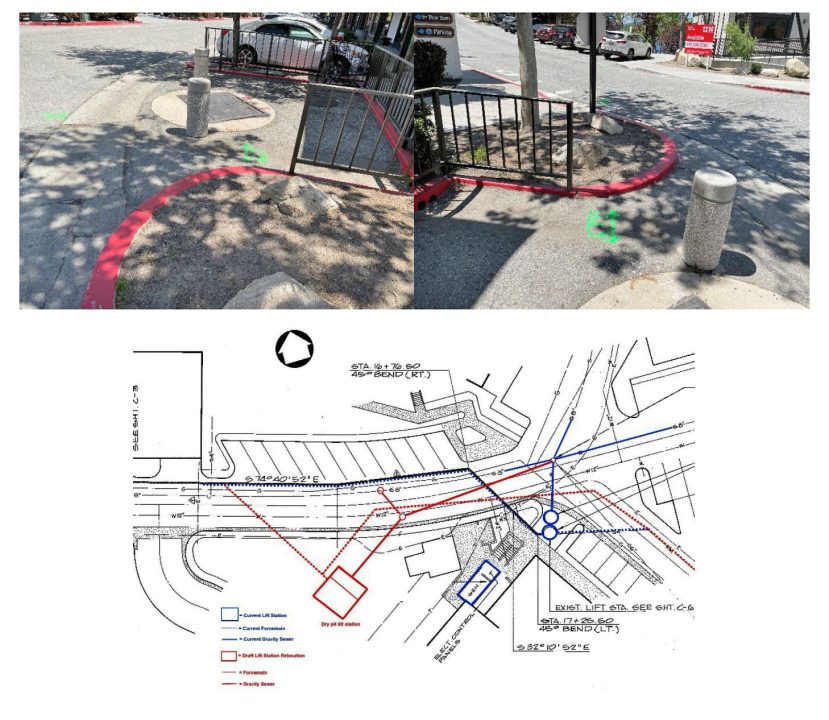
The current lift station (top and in blue on the diagram) will be relocated in Lake Arrowhead Village (red on the diagram).
As for whose responsibility the leak is, this was the answer from LACSD: “The 10-inch force main line break is the responsibility of, and will be paid for by, LACSD. While the line does run through the golf course property, the line services areas outside of the golf course, particularly in the filling of the Spyglass reservoir.”
In his monthly report on water delivered, Brooks said that consumption was up 3.9 percent in December 2024 (73.39 acre-feet) compared to December 2023 (70.62 a-f). For 2024 as a whole, consumption was up 5.3 percent (1,261 a-f) compared to 2023 (1,197.44 a-f). These numbers reflect water delivered to the distribution system and not necessarily metered, Brooks said.
As for lake draw, Brooks said that “we left quite a bit of water in the lake last year due to taking CLAWA water to blend and offset PFAS.” The December 2024 draw was 50.79 a-f compared to 56.81 a-f in December 2023. In 2024, lake withdrawals were down 17.2 percent (796.12 a-f) compared to 960.52 a-f in 2023.
Well production was down in 2024. Brooks. Hopes to have Well #5 back online soon.
And the purchase of water from CLAWA was up from zero in December 2023 to 13.61 a-f in December 2024. For 2024 as a whole, LACSD purchased 329.10 a-f from CLAWA as compared to 39.06 a-f in 2023.
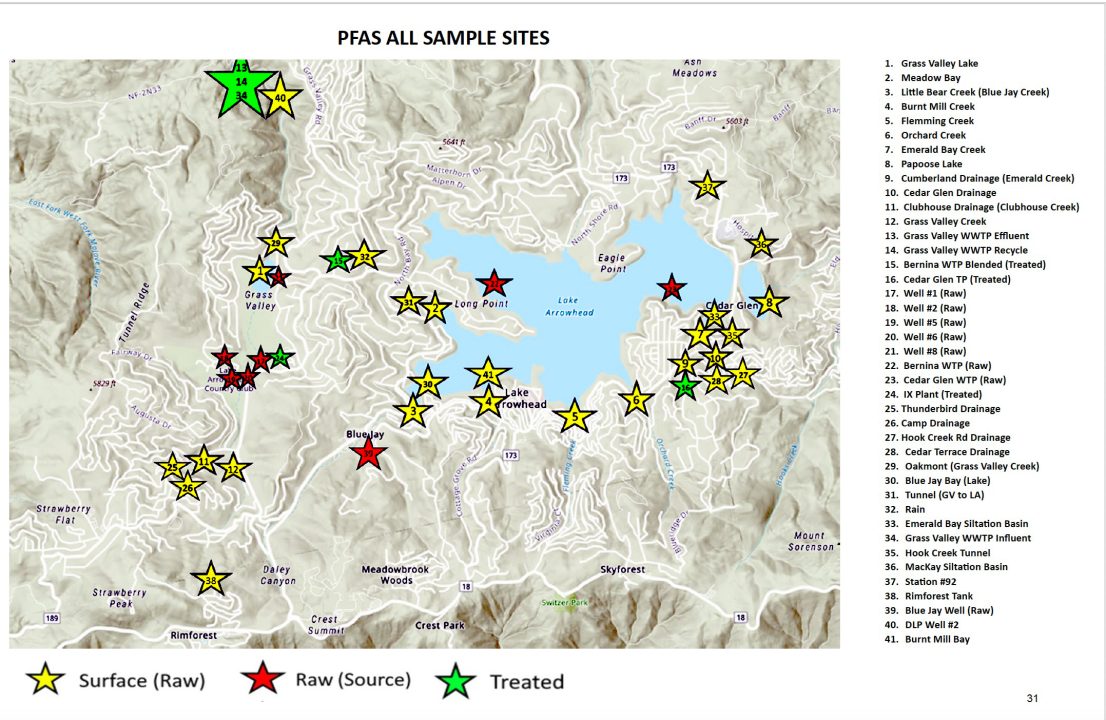
As for PFAS, Brooks said the district received a 60-perceent design for both the Cedar Glen and Bernina water treatment plants. The district met with the N2W design team to review that design.
The district continues to take samples which are tested for PFAS. The latest sample had been taken and sent out on Jan. 14. Brooks said they expected the results in a couple of days. “We will use that number to gauge our compliance,” he said.
Brooks had been asked about the water blending ratio in the drinking water LACSD is delivering to customers. That water, he reported, is 67 percent surface water from Lake Arrowhead, 13 percent from groundwater from wells and 20 percent imported water from CLAWA.
“We hope to back off some CLAWA water when we get Well #5 back online,” Brooks said. Director Steve Boydston asked Brooks what he thinks that CLAWA percentage might be then. “We hope we can take it to zero,” Brooks said. “Right now we are purchasing 100 gallons a minute from CLAWA.” That could save LACSD $34,000 a month.
Brooks added they have been running into weather delays getting Well #5 back online. “We hope to get it back online this month,” he said.
When Garin Vartanian asked why LACSD isn’t blending the water 50/50 with CLAWA water to bring the PFAS level down more, Brooks replied, “We are trying to be good stewards of the ratepayers’ money. We have achieved results by blending less CLAWA water.”
Brooks added that the last sample they took of blended water came in at 6.3 and 8 for PFOA. “We rely on samples to show us if we are in compliance. We take samples and monitor water quality for the community.”
“Our goal,” said President John Wurm, “is to bring the amounts (of PFAS) to at or below the standards set by the federal government.”
“We feel like we’re ahead of the game, getting these treatment systems in place,” Brooks said. “They are not required to be in place until 2029. We got on this immediately. The Division of Drinking Water has commended us for taking proactive steps, going above and beyond. We care about the PFAS in the water and where it is coming from.”
The board conducted its yearly review of Ordinance 65, which limits the number of meters that can be sold in a year to five a month up to 60 a year. That ordinance has been in place since 2007. Schroder reported that in 2024 LACSD sold just 16 meters. The first year the ordinance was in place, LACSD sold 43 meters; that number fell to 19 and then to single digits for most years.
The staff recommendation was for no changes to take place in the ordinance.
The board approved a contract with TKE Engineering to design the relocation of Lift Station No. 2, currently located near Alexandra’s Emporium in Lake Arrowhead Village. Schroder noted it has spilled in the past but not recently. This lift station “takes on the Resort and all of Lake Arrowhead Village,” he said. “When there’s an issue, there’s nowhere for us to put our equipment.”





0 Comments