



By RHEA-FRANCES TETLEY
Historian
 The Arrowhead Reservoir and Power Company (A.R.&P.C.) had the task of hauling hundreds of tons of cement and other construction materials to build the reinforced cement core wall for the Little Bear Valley dam to send irrigation water to San Bernardino.
Beginning in 1902, A.R.&P.C. Engineer Kellogg needed to speed up the slow oxen/horse-drawn wagon delivery process. In Ohio, the A.R.&P.C. investors said incline rail/cable systems were quite successfully used, so Kellogg designed a three–rail incline railway system to run from the top of Waterman Canyon up to the Skyland summit.
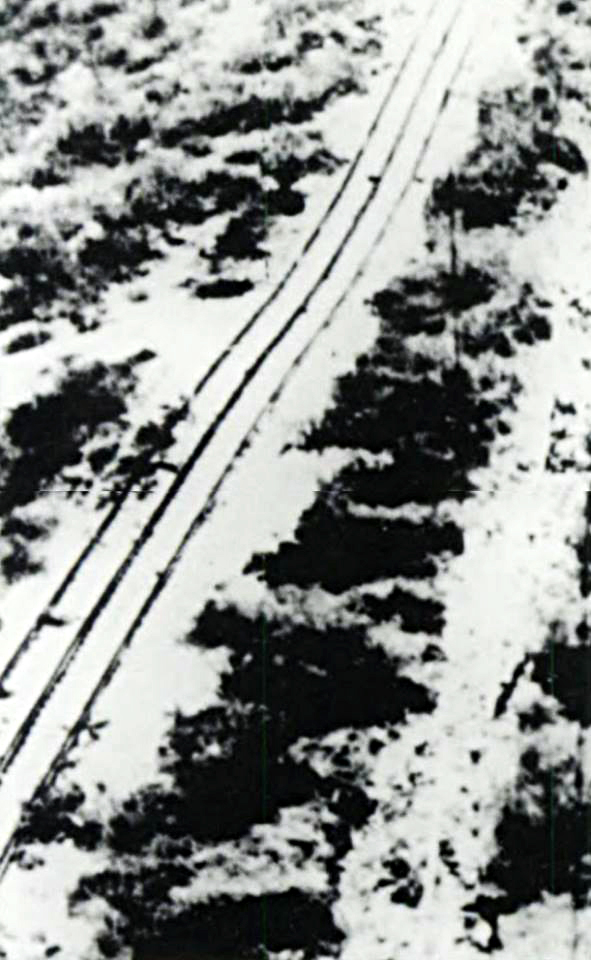
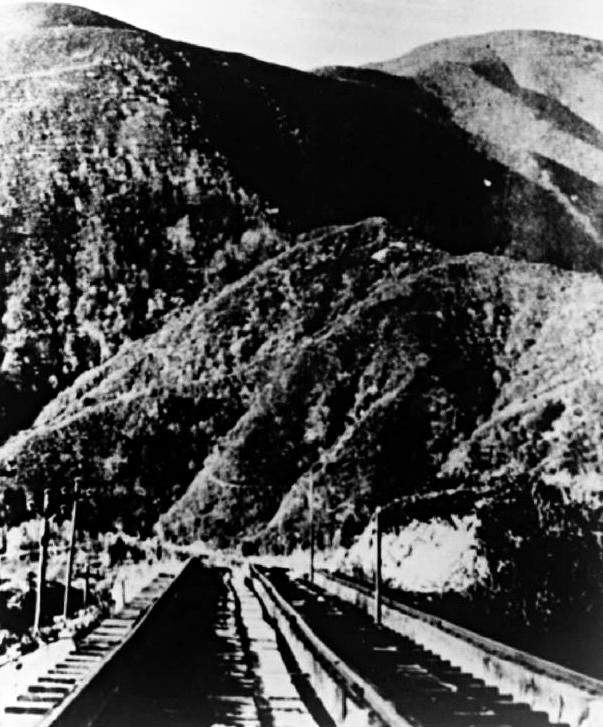
The dip in the incline rails can be seen on the hillside.
The incline railway was built in early 1906, primarily to bring construction materials up the mountain, but was looked upon favorably as the possible first leg in a rail line that would connect San Bernardino and the mountains for tourists. It was the first serious effort at creating a faster/easier route into the mountains; otherwise, the only way to the crest was in a horse-drawn stage.
The vision was that travelers would ride on the San Bernardino Valley Traction Company’s line to Arrowhead Springs with a short buggy ride up lower Waterman Canyon to the base of the incline railway. Once passengers had ridden the incline to the top, they would board the cars running along “an electric road (that) will be built along the mountain crest, thus forming one of the finest scenic routes on the globe,” as Adolph Wood had suggested. The Skyland Inn’s post office opened in 1906 as “Incline” in anticipation of incline tourists.
Kellogg designed the incline with a unique double-track system with three rails for nearly the entire 4,170-foot-length. The rail ties were 10 feet long for the triple rails. The two cars were operated simultaneously, balancing each other, one going up, while the other went down. Cars were hoisted up and down the 45-degree hillside by a donkey steam engine attached to the cars by cable powered from the top. They shared the middle rail except when the cars passed each other on the four-rail section in the middle.
The Arrowhead Reservoir Company was in a hurry to complete the incline rail/cable car system. The hillside rail route was completely pre-graded with the trestles pre-engineered and assembled off site for quick installation that spring. Rail pre-installation grading of the hillside was completed on Feb. 21, 1906.
A heavy 11-inch springtime rainstorm suddenly hit the area, washing out 150 feet of the pre-graded route. Those storms delayed rail installation until May 12; then Kellogg ordered the rails quickly laid up the mountainside without any engineering changes, nor any re-grading of the washed-out area. This haste resulted in a visible dip in the rails laid through that washed-out 150-foot section.
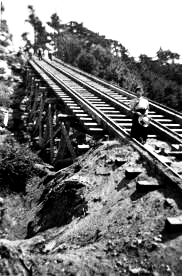
The bottom of the incline tracks.
The first Incline trip carrying three tons of cement bags was on July 31, 1906. When the incline car hit the dip in the rails, it jumped dangerously into the air, losing the load and dumping out the people. Many cable corrections and different loading configurations and load weights were tried by Kellogg to balance the loads, with limited success.
In 1907, a new 100-horsepower electric engine was tried, along with a heavier cable, attempting to hold the cars onto the tracks. Kellogg tried moving 10,000 pounds of cement up the incline, but it still wasn’t viable and stability was never achieved.
Kellogg designed many repairs to the cable system, but none worked. The incline was a failure and abandoned by the A.R.&P.C. The cement bags continued their 16-hour wagon trip up the Waterman Canyon public roadway.
The incline never worked well, although one family was able to successfully get safely down the mountain quickly for a medical emergency, plus several loads of apples were successfully transported down from the mountain orchards.
The incline was basically abandoned. The Incline Post Office’s name was changed to Skyland Heights in 1910, quickly erasing its memory.
During the 1911 fire the incline tracks and trestles were destroyed, completely ending the dream of an electric-powered, fast transportation system up and down the mountain.
The cement base which held the engine that powered the incline cables at the top of the incline in Skyland.


0 Comments